Table of Content
- Load Boards: Tools and Costs
- Dispatch Services: Time-Savers with Strategic Impact
- Freight Brokers: Margins, and Use Cases
- Real-World Breakdown: What Freight-Finding Model Fits You?
- Red Flags and Industry Risks
- What’s the Best Freight Strategy for 2026?
- Final Thoughts: Don’t Just Chase Loads. Build a Strategy.
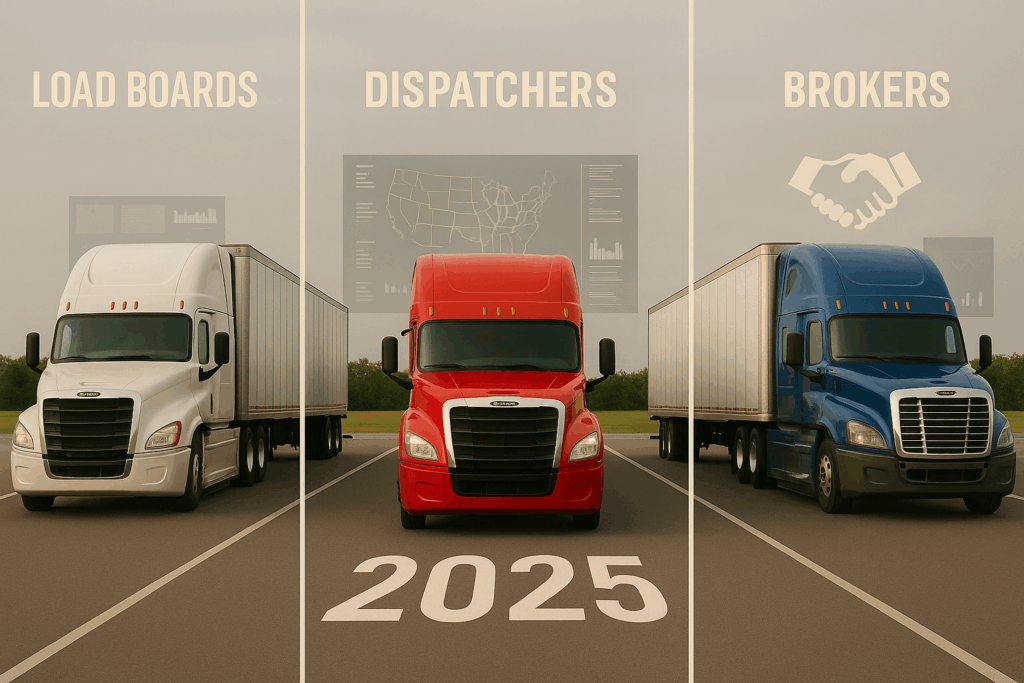
Spending $150/month on DAT but still running empty 20% of the time? There might be a better way.
In today’s freight market, U.S. owner-operators face more choices and confusion than ever before. Should you stick with load boards? Hire a dispatcher? Build direct broker relationships? Or mix all three? Each option promises opportunity, but each also carries trade-offs that can impact your bottom line, your time, and your sanity.
Spending too much time chasing freight – or too much money on tools that don’t deliver? It’s time to recalibrate.
Based on the latest industry research, real-world outcomes, and current pricing models, let’s break down the strengths, weaknesses, and best use cases of load boards, dispatch services, and freight brokers.
Load Boards: Tools and Costs
Load boards remain a go-to for many owner-operators. Platforms like DAT One,Truckstop, and 123Loadboard host thousands of available loads daily. They provide rate analytics, credit score tools, and increasingly popular features like “Book Now” and mobile apps.
But here’s the rub: while boards offer flexibility and visibility, they’re also incredibly competitive. Everyone’s seeing the same loads, often at the same time. If you’re a new authority, getting noticed can be tough. And the time spent refreshing listings, calling brokers, and filling out paperwork? It adds up fast.
In 2026, board subscriptions range from $50 to $180 per month, depending on the features you need. Many carriers run multiple boards simultaneously, pushing monthly board spend to $150–$300. That doesn’t include the unpaid time you spend booking – easily 10+ hours a week for solo operators.
Dispatch Services: Time-Savers with Strategic Impact
Hiring a dispatcher can feel like a cheat code – someone else does the digging while you stay behind the wheel. Dispatchers typically search loads, negotiate rates, handle paperwork, and plan backhauls. They might even follow up on detention pay and check in with brokers so you don’t have to.
Most dispatchers charge 5–10% of your gross, or a flat $75–$150 per load. If you’re grossing $8,000/week, that’s $400–$800 – an investment that often pays off. Many carriers report that dispatchers not only free up 10+ hours a week but also consistently book better-paying freight and reduce empty miles.
Great dispatch services act as your personal freight strategist – tracking rate trends, spotting backhaul opportunities, and staying one step ahead of shifting markets. When you partner with the right team, you’re not just outsourcing admin – you’re unlocking higher efficiency and better planning.
Not all dispatch services are equal.
Logity Dispatch operates differently from both load boards and transactional brokers. The focus isn’t volume or speed – it’s alignment. Loads are evaluated against your real cost per mile, lane balance, and exit risk before they ever reach the driver.
Freight Brokers: Margins, and Use Cases
Freight brokers are the licensed middlemen. They connect shippers with carriers and often control access to contract freight – the kind that rarely hits public boards. In a tight or inverted market (like we’ve seen in 2025), contract freight often pays better than spot.
Brokers don’t charge carriers directly. Instead, they build their margin – typically 15–18% – into the rate you’re paid. If the shipper’s paying $2.20/mi, you might get $1.85/mi. In exchange, you may gain access to consistent freight, steadier lanes, and a lower deadhead percentage.
The key is reputation. Brokers want carriers who show up on time, maintain safety scores, and communicate well. New carriers might get lower-quality loads until they prove themselves. But once you’re in a broker’s “core” rotation, you can see better rates and more consistency than chasing spot loads daily.
Real-World Breakdown: What Freight-Finding Model Fits You?
| Strategy | True Strengths | Key Drawbacks | Best For |
| Load Boards | – Total control- Easy to start- Tons of load access | – Time-consuming- Cutthroat rates- High deadhead risk | New authorities, solo owner-operators who prefer DIY |
| Dispatch Services | – Saves hours/week- Can get better rates- Handles admin | – 5–10% cut of gross- Must trust their quality & transparency | owner-operators grossing $6K+/week who want to scale or simplify |
| Freight Brokers | – Contract freight stability- Lower planning effort- Volume potential | – You get what’s left after their cut (avg 15–18%)- May not favor new carriers | Experienced owner-operators or fleets with good reputation |
| Hybrid | – Best mix of coverage and efficiency | – Requires effort to manage all 3- Risk of tool overload | Established owner-operators looking to optimize every load |
No strategy is flawless – but every option has a place. The real key is matching the right freight-finding model (or mix) to your stage of business, income goals, and how much time you’re willing to spend behind the keyboard versus behind the wheel.
Red Flags and Industry Risks
The trucking world isn’t short on scams – and 2024–2025 has seen its share:
- Fake dispatchers asking for upfront fees or offering “exclusive shipper access.”
- Double-brokered loads on boards, increasing legal and payment risks.
- Opaque broker fees and hidden charges like fake lumper fees.
- FMCSA Broker Transparency Rule (NPRM 2024) aiming to require brokers to provide transaction records within 48 hours.
What’s the Best Freight Strategy for 2026?
There’s no one-size-fits-all answer – but patterns do emerge.
– New owner-operators: Start with load boards to learn lanes, build a track record, and control your schedule. Track your hours and pay.
– Once you’re grossing $6K/week or feeling overwhelmed by admin work, consider hiring a dispatcher to scale up and get strategic.
– At 6–12 months in, begin forming relationships with 2–3 reliable brokers. Deliver clean paperwork, be on time, and request dedicated lanes.
In the long run, the hybrid approach wins:
- Use load boards to fill gaps or chase hot lanes
- Use a dispatcher to plan efficiently and offload admin
- Use brokers for consistent freight and higher utilization
The smartest owner-operators track time, cost, and loaded miles – not just gross revenue. If you’re spending 10+ hours a week on booking and still running 20% empty, it’s time to rethink your setup.
They understand that good loads don’t always create good weeks if sequencing and reload planning aren’t controlled.
Final Thoughts: Don’t Just Chase Loads. Build a Strategy.
In 2026, the difference between scraping by and scaling up isn’t just hustle – it’s strategy. Choosing the right freight-finding mix can help you eliminate waste, stabilize your revenue, and reclaim your time.
Operational clarity beats more tools
The most profitable owner-operators don’t rely on a single source of freight. They build systems that balance flexibility, consistency, and time on the road.
If you’re looking for dispatch support that fits into a broader strategy – not one that replaces it – Logity Dispatch works with operators who care about structure, cost control, and long-term stability.