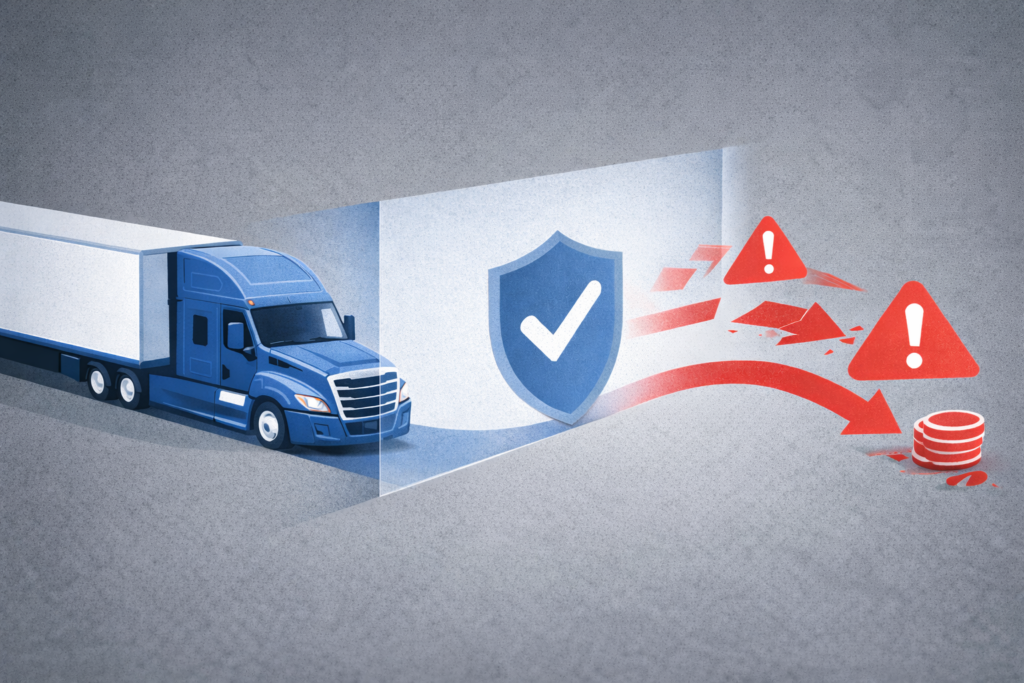
Freight fraud isn’t a rare edge case anymore. It’s part of the day-to-day reality of running a truck.
It doesn’t only hit careless operators or “rookies.” It hits drivers who are moving fast, trying to keep wheels turning, or trusting that a load looks legitimate because the details seem to check out – until they don’t.
Industry tracking from CargoNet shows that 2024 recorded the highest number of cargo theft incidents ever across the U.S. and Canada, with individual losses often reaching six figures. Alongside that, quieter forms of freight fraud – broker impersonation, double-brokering, and payment diversion – continue to grow. These don’t always make headlines, but they hit owner-operators hardest because the loss lands directly on the person running the truck.
For an owner-operator, the impact is immediate. One bad load can mean thousands of dollars in fuel, tolls, and operating costs that never come back – followed by weeks of chasing a payment that may never arrive. In a business built on tight margins and steady cash flow, that kind of hit doesn’t just hurt. It sets you back.
Many payment disputes and unpaid loads trace back to issues that start before pickup – with who controls the freight, how it’s posted, and how verification is handled.
That’s why vetting freight partners isn’t about being cautious or suspicious. It’s about running your business with discipline. This guide treats vetting as part of normal operations – the same way you treat maintenance, routing, or cost per mile – not something you only think about when something feels wrong.
Because in today’s market, prevention isn’t extra work. It’s how you stay in control.
Why fraud concentrates on owner-operators
Fraud doesn’t target inexperience. It targets exposure.
Owner-operators operate closest to the transaction itself. There’s no separate credit department verifying who’s on the other end of the deal, no legal team stepping in when something goes wrong, and no buffer between a bad decision and its consequences. When a load fails, the impact is immediate – and personal.
Complaint trends reviewed by the Federal Motor Carrier Safety Administration consistently show that owner-operators and small carriers are overrepresented in fraud-related payment disputes. Not because they’re careless, but because they have less leverage. Smaller operations are easier to rush, easier to pressure, and easier to disappear on once the load is delivered.
At the same time, the Transportation Intermediaries Association has repeatedly warned that broker impersonation and undisclosed re-brokering have accelerated since 2020. Publicly available MC data and widespread use of open load boards have made it easier for bad actors to look legitimate – at least long enough to move a truck.
This isn’t a failure of judgment. It’s a structural reality of how independent trucking operates today. And it’s exactly why disciplined vetting matters more for owner-operators than anyone else.
5 warning signs that deserve a hard stop
1. Authority looks valid, but contact details don’t align
One of today’s most common scams uses a real broker’s MC number paired with fake phone numbers or email addresses. The authority checks out. The contact doesn’t.
Enforcement reviews show a recurring pattern: recent changes to broker contact information appear frequently in fraud cases. A change alone isn’t proof of wrongdoing–but when the phone number or email domain you’re given doesn’t match federal records or the broker’s official website, the risk jumps immediately.
Why this works: drivers check authority, then trust the contact point. Fraud lives in that gap.
2. Payment terms that stay fuzzy–or shift later
Delayed or denied payment sits at the center of most broker-fraud complaints. It usually starts with soft language: “standard terms,” “net pay,” or “quick pay available.”
The problem isn’t the wording–it’s the absence of specifics. In many documented cases, timelines change after delivery or new deductions appear once the carrier has no leverage left.
Based on cost-of-operation research from American Transportation Research Institute, an unpaid long-haul load can erase weeks of net income for an owner-operator. If payment terms aren’t clearly written before dispatch, the risk has already shifted onto you.
3. Resistance to basic paperwork
Fraud leaves a paper trail – so fraud avoids paper.
Across 2024 and into 2025, industry checks and complaint patterns show that missing rate confirmations and incomplete documentation are consistent early warnings of trouble. In 2025 alone, fraud-prevention systems such as Truckstop’s identity checks flagged more than 10,000 failed identity or contact verifications – including invalid IDs, mismatched photos, or unverifiable phone numbers – before loads ever moved.
FMCSA complaint narratives still show the same theme: missing or delayed rate confirmations often precede non-payment or disputes. That’s not coincidence – documentation creates accountability, and fraudsters know it.
A legitimate freight partner will readily provide:
– A written rate confirmation.
– A verifiable office phone number that matches federal and industry records.
– A legal business name and MC number that align with those records.
When these routine, standard requests are treated as friction instead of SOP, that’s not a mistake – it’s often a sign someone benefits from ambiguity.
4. Load board freight priced just above market (with updated risk context)
Load boards remain essential – but they continue to be a primary entry point for fraud and double-brokering schemes.
Industry fraud reporting shows how this plays out in the real world. Analysis from 2024 estimated freight fraud losses – including theft, double brokering, and impersonation scams – at more than $455 million, with double-brokering activity surging in several key regions.
Often these schemes start with a load that looks “too good to be true” – just above market rate – but end with the carrier discovering after delivery that:
- The broker never had legal authority over the freight.
- The party that posted the load didn’t control the contract.
- Payment became legally complex or impossible to secure.
At that point, recovering payment often requires lawyers, lengthy arbitrations, or simply writing it off – because the “broker” has vanished or never had legitimate authority to begin with.
The danger isn’t the rate on the load. It’s not knowing who actually controls the freight and who is legally responsible for paying you. Without that clarity, even a seemingly strong rate becomes a liability.
5. Urgency meant to outrun verification
Pressure isn’t accidental. It’s a tactic.
Fraud depends on speed because verification works. Confirming contact details, securing a written rate confirmation, and verifying authority all reduce the chance that a scam succeeds. When those checks are likely to slow things down, urgency is used instead.
Phrases like “this load won’t last,” “we’ll send paperwork after pickup,” or “you need to roll right now” are not harmless. They’re designed to move the truck before basic verification happens.
Legitimate freight operations don’t rely on pressure. They expect documentation, confirmation, and a clear process before a truck ever moves. When urgency is used to bypass those steps, it’s usually because someone doesn’t want their details examined too closely.
In trucking, speed matters – but not at the expense of control. If a load only works when verification is skipped, it’s not a load worth running.
And the background data underscores why this pressure matters: fraud and identity manipulation are accelerating. One industry fraud index reported that by Q3 2025, systems had already blocked over 1.4 million fraudulent email attempts – including spoofed addresses, fake domains, and identity spoofing.
A legitimate freight partner has nothing to hide and nothing to fear from verification. Their processes may be orderly and methodical – but they protect you and your business. Fraud, on the other hand, depends on skipping those checks.
Vetting brokers takes time, experience, and constant monitoring. Many owner-operators eventually delegate this to dispatch services that pre-vet brokers, verify rate confirmations, and reduce payment risk.
Why vetting is now part of running the business
When a single unpaid load can wipe out weeks of profit, freight decisions stop being theoretical. They become operational.
Over time, most experienced owner-operators come to the same conclusion: the most reliable freight usually isn’t the most exciting. It’s freight that pays as expected, comes with clean paperwork, and doesn’t require damage control after delivery.
Some drivers handle that vetting themselves. Others choose to work with dispatch partners who screen freight and brokers before loads ever reach the truck – simply to reduce exposure.
In today’s market, trust isn’t built on promises or fast talk.
It’s built on verification that still holds up after the load is delivered.
Vetting every broker takes hours you don’t have. Our dispatch service pre-screens every load and broker, so you only see legitimate, paying freight. Get back to driving, not investigating. – See How Dispatch Protects You
FAQ: Freight Fraud & Broker Vetting
How common is freight fraud today?
Freight fraud has risen sharply since 2020. Cargo theft hit record levels in 2024, while broker impersonation and double-brokering continue to increase–especially affecting owner-operators.
What broker scam shows up most often?
Impersonation. In many confirmed cases, the MC number is real, but the phone number or email belongs to a fraudster posing as the broker.
Is double-brokering always illegal?
Not always. But undisclosed double-brokering is a serious red flag that exposes carriers to payment risk and legal complications.
What’s the minimum due diligence before hauling a load?
Confirm contact details match federal records, lock payment terms in writing before dispatch, and verify who has legal authority over the freight.
What should I do if something feels off?
Pause before pickup if possible, document all communication, and report concerns through FMCSA complaint channels. Acting early can prevent losses entirely.