Table of Content
- What are DOT inspection levels?
- The nine inspection levels at a glance
- Let a Dispatcher Plan the Route and Book the Loads
- Level I: the full inspection
- Level II: the walk-around
- Level III: driver and paperwork only
- Levels IV to IX: the special cases
- What happens after a roadside inspection?
- Is a roadside inspection the same as the annual DOT inspection?
- How to get through any level faster
- Frequently asked questions
Short answer
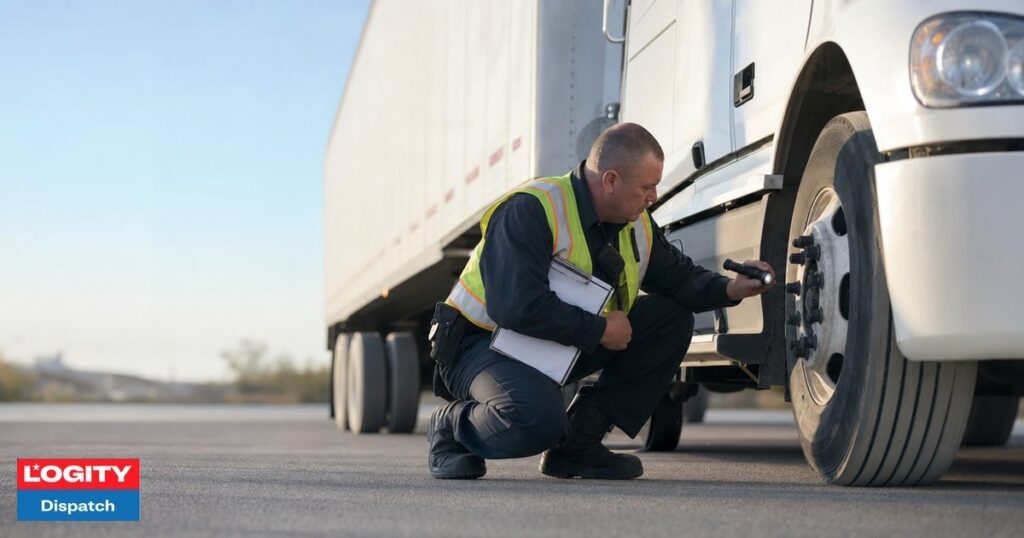
DOT inspection levels are the categories the Commercial Vehicle Safety Alliance (CVSA) uses for roadside inspections. Level I is the full driver and vehicle check, Level II is the same list without going under the truck, and Level III looks only at the driver and the paperwork. Level V checks the vehicle with no driver present. The rest are special cases: one-item studies (IV), radioactive shipments (VI), state programs (VII), electronic checks while you drive (VIII) and post-crash inspections (IX). Whatever the level, the report goes to your carrier, and any violation on it must be fixed and certified within 15 days.
What are DOT inspection levels?
Truckers say “DOT inspection”, but the levels themselves come from CVSA, the alliance of enforcement agencies that writes the North American Standard inspection procedures. State troopers and motor carrier officers use those procedures at scales, on the shoulder and during campaigns like International Roadcheck. The level written on your report tells you how much of the truck and how much of your paperwork the officer actually looked at.
The level is not a grade. A Level III with an hours of service violation is worse for you than a clean Level I. What matters is what ends up in the violation boxes.
The nine inspection levels at a glance
| Level | CVSA name | What it covers |
|---|---|---|
| I | North American Standard Inspection | Driver, documents and the full vehicle, including under the truck |
| II | Walk-Around Driver/Vehicle Inspection | Same items as Level I, only what can be checked without getting under the vehicle |
| III | Driver/ | License, medical card, logs, hours of service, seat belt, inspection reports, carrier identification |
| IV | Special Inspections | One-time check of a single item, for a study or a suspected trend |
| V | Vehicle-Only Inspection | Level I vehicle items, no driver present, at any location |
| VI | Inspection for Transuranic Waste and HRCQ Radioactive Material | Select radiological shipments |
| VII | Jurisdictional Mandated Commercial Vehicle Inspection | State or provincial programs that fit no other level |
| VIII | North American Standard Electronic Inspection | Wireless check while the vehicle is moving |
| IX | Post-Crash Inspection | All accessible Level I items after a serious crash |
Level I: the full inspection
Level I is the one most drivers mean when they say they “got a full DOT”. CVSA lists the driver side first: license, Medical Examiner’s Certificate, alcohol and drugs, record of duty status, hours of service, seat belt and vehicle inspection reports. Then comes the truck: brake systems, cargo securement, coupling devices, driveline, exhaust, frames, fuel systems, lighting, steering, suspensions, tires, van and open-top trailer bodies, wheels, rims and hubs, and windshield wipers.
Brakes are where a Level I gets long. The officer goes under the truck to measure pushrod travel, and CVSA ties the level to that measurement: “If more than 20 percent of pushrod travel on exposed pushrods cannot be measured, then the inspection would not be considered a Level I Inspection and shall be identified as a Level II Inspection.” Hazmat items are checked only by inspectors certified for them.
Level II: the walk-around
A Level II uses the same list as a Level I. The difference is in one sentence of the CVSA definition: the walk-around “will include only those items that can be inspected without physically getting under the vehicle.” So the officer still looks at your lights, tires, wheels, coupling, load securement and anything visible on the brakes, and still checks your license, medical card and logs. A Level II is not a light inspection. It only skips the parts that need a creeper.
Level III: driver and paperwork only
Level III is the paperwork stop: driver’s license, Medical Examiner’s Certificate and SPE certificate if you have one, record of duty status, hours of service, seat belt, vehicle inspection reports, and “carrier identification and status”. That last item is where operating authority and USDOT problems show up. CVSA also says mechanical violations that belong to a Level I or II should not be written on a Level III, but traffic violations can be.
Most Level III problems are avoidable before the trip. Logs that match the ELD, a current medical card and hours planned with room to spare cover most of the list. Our guide to hours of service rules goes through the limits an officer checks.
Levels IV to IX: the special cases
Level IV: special inspections
A one-time check of a particular item, “normally made in support of a study or to verify or refute a suspected trend.”
Level V: vehicle only
Every vehicle item from a Level I, “without a driver present, conducted at any location.” It is the one level that can happen while the truck is parked at your yard and you are not there.
Level VI: radioactive shipments
An enhanced Level I for transuranic waste and highway route controlled quantities (HRCQ) of radioactive material. CVSA states that carriers hauling HRCQ are “required to pass the North American Standard Level VI Inspection.”
Level VII: state programs
An inspection a state or province requires that does not meet the requirements of any other level, such as school bus, limousine or other intrastate programs. CVSA notes that “no CVSA decal shall be issued for a Level VII Inspection.”
Level VIII: electronic inspection
An inspection “conducted electronically or wirelessly while the vehicle is in motion without direct interaction with an enforcement officer.” The data points CVSA lists include who is driving, license class and status, medical certificate, record of duty status and hours of service, USDOT number, registration, operating authority, UCR compliance and federal out-of-service orders. In other words, a Level III that happens without a stop, so your ELD data and your registrations need to be right before you roll.
Level IX: post-crash inspection
Done after a crash with a fatality, serious physical injury, a high-profile crash involving a commercial vehicle, or when the jurisdiction requires it. CVSA says a Level IX “must include all accessible inspection items in a Level I Inspection Procedure.”
What happens after a roadside inspection?
You leave with a Driver Vehicle Examination Report. From there the federal rule in 49 CFR 396.9 sets the steps:
- Out of service. An officer marks a vehicle out of service when its mechanical condition or loading “would likely cause an accident or a breakdown.” It cannot be operated until the repairs on the out-of-service notice are done, and towing counts as operating unless it is done with a crane or hoist.
- Hand the report to the carrier. The driver delivers a copy at the next terminal or facility. If you will not get there within 24 hours, the rule says to “immediately mail, fax, or otherwise transmit the report” to the carrier. If you run under your own authority, that carrier is you.
- Fix and certify within 15 days. “Within 15 days following the date of the inspection,” the carrier certifies that all violations noted have been corrected by signing the carrier section of the form.
- Keep it 12 months. A copy stays at the principal place of business or where the vehicle is housed for 12 months from the inspection date, and goes back to the state agency if it asks for it.
Inspection results also feed your carrier’s safety data, which brokers and insurers look at before they work with you. We explain how they read it in CSA score 2026: how brokers and insurers actually read it. If a report has an error, the carrier can challenge it through FMCSA’s DataQs system.
Is a roadside inspection the same as the annual DOT inspection?
No. The annual inspection is a separate requirement in 49 CFR 396.17: a carrier “must not use a commercial motor vehicle” unless each component in Appendix A has passed an inspection “at least once during the preceding 12 months and documentation of such inspection is on the vehicle.” In a tractor and trailer combination, the tractor and the trailer are each inspected. A roadside inspection does not replace it, and the proof of the annual inspection has to be on the vehicle, where an officer can ask for it.
How to get through any level faster
- Do a real pre-trip every day. Lights, tires, brakes and coupling devices are on every Level I and Level II list, and our DOT pre-trip inspection checklist follows the same items.
- Keep the documents an officer asks for in one place: license, medical card, registration and annual inspection proof.
- Make sure your logs match where you actually were, so a Level III or Level VIII has nothing to find.
- Send every inspection report to whoever handles your compliance the same day, so the 15-day clock never runs out.
A dispatcher cannot pass an inspection for you, but good dispatch keeps you from the problems inspections find most often in the logbook. At Logity Dispatch we plan loads around your available hours and keep your carrier paperwork organized, so you can focus on the truck.
Frequently asked questions
Can a DOT inspection happen without the driver?
Yes. A Level V inspection covers every vehicle item from a Level I without a driver present, and CVSA says it can be conducted at any location.
What is checked in a Level 1 DOT inspection?
The driver’s license, medical certificate, logs, hours of service and seat belt, plus the full vehicle: brakes, cargo securement, coupling devices, driveline, exhaust, frame, fuel system, lights, steering, suspension, tires, trailer body, wheels and wipers.
What is the difference between a Level 2 and a Level 3 inspection?
A Level II checks the driver and the vehicle, as long as the item can be inspected without getting under the truck. A Level III checks only the driver’s credentials, logs and carrier identification, with no mechanical inspection.
How long does a carrier have to fix violations from an inspection?
Under 49 CFR 396.9, the carrier certifies that all violations have been corrected within 15 days of the inspection date and keeps a copy of the report for 12 months.
Can I drive after being placed out of service?
Not until the repairs listed on the out-of-service notice are completed. The vehicle can only be towed away by a vehicle using a crane or hoist.