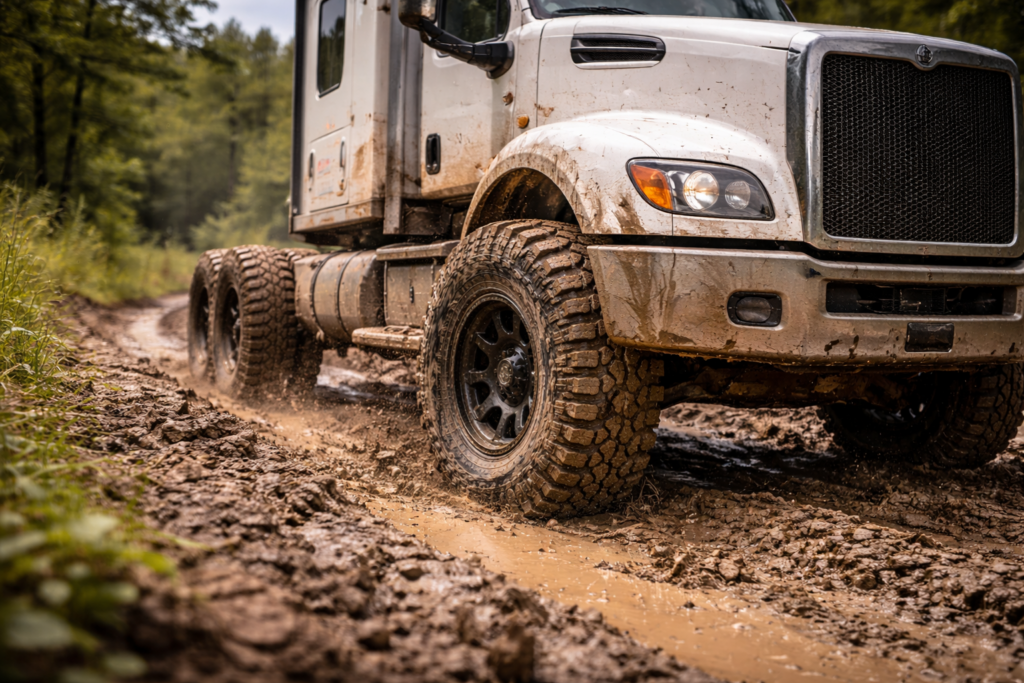
Operating in muddy, construction, oilfield, agricultural, or off-road environments places significant strain on commercial truck tires. Inadequate traction not only increases the risk of getting stuck – it also raises the probability of:
- Delivery delays
- Mechanical strain
- DOT inspection issues
- Safety incidents
Choosing the right mud-terrain tire is not just about grip – it’s about protecting uptime and controlling long-term operating costs.
This guide focuses on performance, durability, and operational considerations relevant to owner-operators and commercial fleets.
Top-Rated Mud Tires for Trucks
Just like with passenger vehicles, there are brands that produce top-rated tires for trucks. Commercial truck drivers and owners prefer them because they fulfill their primary requirements for longevity, strength, and rolling resistance. Here are some of our picks.
Mud-Terrain Tire Categories
| Brand / Model | Best For | Strength | Consideration |
|---|---|---|---|
| Michelin X Line Series | Linehaul + moderate mud | Low rolling resistance | Higher upfront cost |
| Bridgestone R197 | Mixed terrain | Long tread life | Road noise |
| BFGoodrich KM3 | Severe mud/off-road | Extreme traction | Premium pricing |
| Goodyear MT/R Kevlar | Rough terrain | Sidewall durability | Louder ride |
How to Choose Mud-Terrain Tires
Mud tires for trucks, also known as mud-terrain tires, are high-end off-road tires that are built for challenging and extreme off-road circumstances. Other names for the best mud tires for a truck are mud-terrain tires.
Even while many truck and SUV tires have some off-road capabilities, the primary focus of these tires is on their ability to perform well on the street. Mud-terrain tires, on the other hand, are intended to provide optimum performance when used off-road. It is recommended to prioritize off-road capabilities above street performance, particularly on-road comfort.
When compared to a highway tire, even the best mud tire for trucks will have plies (the panels of steel or fabric mesh that lie beneath the rubber, adding strength and puncture resistance) that are more durable, as well as a rubber tread that is thicker and designed to better withstand the cutting, tearing, and deformation caused by off-road surfaces. In addition, an all-terrain tire will have a tread that is made to better withstand the abrasion that can occur when driving on uneven terrain.
Mud-terrain performance becomes even more critical on high-risk corridors and remote routes.
Top Mud Tires for Trucks Features to Consider
Tread Pattern
The tread pattern on the tire is an important factor in all aspects of the functioning of truck mud tires. Because of this, manufacturers are working hard to perfect this particular aspect in order to boost the tire’s grip.
But regardless of the design, you have to make sure that the grip system satisfies the standards that are listed below. Each block of spikes and corners is separated by a sufficient distance from one another to provide optimal traction on muddy terrain.
It is important to make sure that the distance between the trench banks is sufficient enough so that liquids and slurries may pass through easily without being caught.
Adjust the settings of the spike system so that it meets your requirements. In addition to that, you should also think about purchasing items that have spikes that are resistant to noise well.
Best mud tires for trucks are consistently among the noisiest items available. The development of new tire compositions has also contributed to a reduction in the amount of noise produced.
It would be best if you nevertheless thought about purchasing these solutions, despite the fact that tire goods with noise-canceling spikes tend to be more costly.
Sidewall
The layer under the mud is made up of a variety of pollutants, including dirt, sand, boulders, and contaminants of many various sizes.
To be able to travel in such an unpredictable environment, the tire has to have a construction that is both robust enough and stable enough. If the stability of the tire has a lot to do with how well it grips the road, then the sidewalls will decide how stiff it is.
Therefore, you need to pay careful attention to this section in order to choose the top mud tires for trucks.
There are several manufacturers that market the best mud tire for a truck as having sturdy sidewalls. However, you have to try it out for yourself in order to understand how challenging this step is.
In order for the tire to have good movement, the sidewall of the tire has to be both strong and flexible.
If you ignore the input in favor of concentrating just on the structure, your driving experience is going to be better.
Additionally, it would be best if you chose items that make use of modern technology in the production of tires. Performance may be considerably increased with the addition of a new set of high-grip lugs or by improving the sidewalls.
Sizing
When it comes to determining the best size mud tires for a truck, there are often two different sorts of measures used. Taking the measurement of the sidewall width and calculating the tire size in terms of the circumference in inches is the approach that is most straightforward to follow.
In order to get the most precise figure possible, you should also reference the information provided by the manufacturer. After that, compare it to the size of the wheel, and choose the appropriate one.
Even the tiniest variation in size may have a negative impact on the construction and performance of the vehicle.
Load & Torque Considerations
Installing oversized mud-terrain tires affects:
- Effective gear ratio
- Fuel efficiency
- Engine RPM at highway speed
- Braking performance
Before upsizing, confirm compatibility with:
- Axle ratio
- Suspension clearance
- OEM recommendations
Improper sizing can increase fuel costs and drivetrain wear.
Taking Care of Top-Rated Mud Tires for Trucks
After making the initial purchase, you will want to ensure that your tires are properly maintained in order to get the most value out of the money you spent on them. This will allow you to get the most mileage out of your investment. Before getting behind the wheel of their vehicles and heading out onto the road, drivers for large commercial fleets as well as independent owner-operators should take the precautions that are outlined here to ensure that they are in a safe position. These precautions include making sure that they have adequate rest, ensuring that they have adequate food and water, and checking their tire pressure. You need to follow these procedures whether you are the manager of a fleet like this or an individual owner-operator operating on your own.
- Check tire pressure.
When tires are not maintained with the necessary amount of air pressure, they suffer increased wear and tear, which in turn affects the vehicle’s stability. This may be avoided by maintaining the tires with the appropriate amount of air pressure. It is possible that making this comment will seem to be stating the obvious.
Examine the items to see if they have any flaws.
Cracks, chips, and gouges in the tread, in addition to uneven tread wear, are all possible causes of major problems that might arise while driving at high speeds. Before beginning each journey, you have an obligation to inspect your tires to ensure that none of the flaws described above are present.
Routine tire inspections should be part of every pre-trip routine to prevent avoidable roadside breakdowns.
- DOT compliance and tread requirements
Commercial vehicles must comply with federal tread depth regulations:
- 4/32” minimum on steering axle
- 2/32” minimum on other positions
Mud-terrain tires with aggressive tread blocks must still meet inspection standards. Sidewall separation, exposed cords, or audible air leaks can result in:
- CSA score impact
- Out-of-service violations
- Costly downtime
Routine inspections protect both safety and profitability.
- Thoroughly clean the tires.
After every run, you should make sure that in addition to washing the rig itself, you also clean the tires by sprinkling them with the cleaning solution and spraying them down. Be careful to position yourself within the grooves so that the dirt and trash that you’ve gathered from the streets may be more easily removed. This will need some careful maneuvering on your part. It is imperative that you keep the cleanliness of your tires maintained if you want them to last as long as they possibly can.
Tire Choice Impacts Operational Planning
Poor traction affects more than safety. It influences:
- Transit time accuracy
- Fuel efficiency
- Route feasibility in rural areas
- Equipment strain
Inconsistent equipment performance can turn profitable loads into operational disruptions. Equipment reliability is part of structured operations – and small mechanical issues can quietly compound into revenue loss. To learn more on structured operations, see why good loads still turn into bad weeks.
Final Thoughts
Mud-terrain tires are not a cosmetic upgrade – they are a strategic equipment decision.
The right tire protects:
- Delivery timelines
- Compliance standing
- Vehicle longevity
- Profit margins
Operational discipline extends beyond dispatching and rate negotiation. It includes maintaining equipment that supports consistent performance in real-world conditions.
At Logity Dispatch, we work with owner-operators who understand that reliability is a competitive advantage. When operations are structured correctly – from equipment to load planning – profitability becomes predictable.