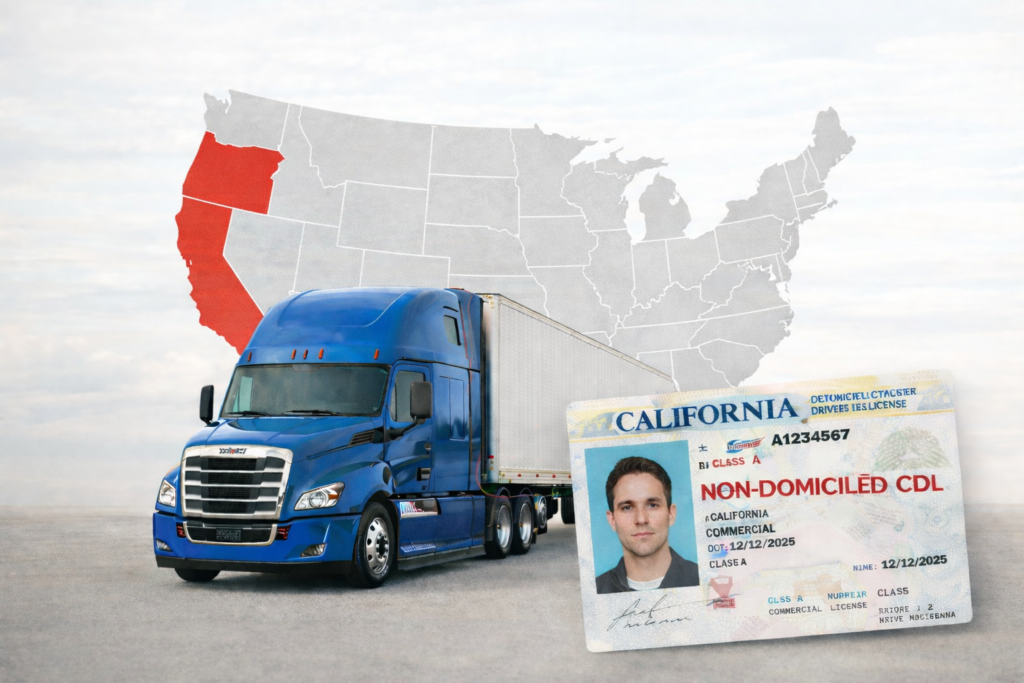
California transportation officials have confirmed plans to restore roughly 17,000 non-domiciled commercial driver’s licenses (CDLs) that were previously slated for cancellation – a significant development in the ongoing federal-state dispute over non-domiciled CDL eligibility and regulatory compliance.
The reversal comes as part of California’s response to a court stay on a nationwide FMCSA rule and follows intense pressure over compliance issues identified during federal audits.
Background: Federal Rule and Court Stay
In late September 2025, the Federal Motor Carrier Safety Administration (FMCSA) issued an emergency Interim Final Rule (IFR) titled Restoring Integrity to the Issuance of Non-Domiciled Commercial Drivers’ Licenses, intended to tighten eligibility criteria for non-domiciled CDLs nationwide.
The rule significantly limited eligibility – for example, requiring specific work visas and tighter verification of lawful presence. However, on November 10, 2025, the U.S. Court of Appeals for the D.C. Circuit issued an administrative stay of the rule, halting its enforcement pending further legal review.
Under that stay, states may continue to issue non-domiciled CDLs under pre-rule requirements – except for states under existing corrective action plans that mandate a pause until compliance is demonstrated.
Corrective Action and California’s CDL Program
Before the IFR and court stay, FMCSA auditors conducted a comprehensive review of California’s CDL program and uncovered significant problems with how the state issued non-domiciled CDLs.
A 2025 Annual Program Review found systemic policy, procedural, and programming errors. Based on this, FMCSA issued a conditional determination requiring corrective actions, including rescinding improperly issued non-domiciled CDLs and strengthening verification procedures.
As part of that process, California identified approximately 17,000 non-domiciled CDLs with expiration dates that did not align with underlying work authorizations and began issuing 60-day cancellation notices on November 6, scheduled to take effect January 6.
California’s Decision to Reissue
On December 17–18, California transportation officials confirmed that the state DMV will begin reissuing those 17,000 contested licences to immigrant drivers who received cancellation notices – citing the court’s stay of the IFR as authority for the action.
State officials have not fully clarified the process but indicate the reissued CDLs will carry corrected expiration dates based on valid work authorization.
California officials argue that the issue is largely administrative, not eligibility-related. The state views the mismatched expiration dates as clerical errors, maintains that the affected drivers still hold valid work authorization, and believes the court’s stay allows California to correct the dates and reissue compliant credentials. Federal regulators, however, have signaled that their concerns extend beyond paperwork, pointing to broader verification and compliance failures identified during earlier audits.
Federal View: Compliance vs. Court Stay
While California points to the court stay as justification, federal guidance from FMCSA stresses that states under corrective action plans must continue pauses on non-domiciled CDL issuance until they demonstrate compliance with pre-existing regulatory requirements – a standard separate from the IFR itself.
That creates a conflict: the court stay affects only the interim final rule, not the underlying corrective action obligations that predated it.
What’s at Stake: Funding and Decertification
FMCSA’s 2025 review warned that if California failed to complete required corrective actions, the agency could withhold up to 4% of certain federal highway funds and potentially pursue CDL program decertification, effectively preventing the state from issuing any commercial licenses (domiciled or non-domiciled) until compliance is verified.
If federal regulators were to take the rare step of decertifying California’s CDL program, the impact would extend far beyond non-domiciled drivers.
California would lose the authority to issue or renew CDLs altogether, meaning no renewals could be processed within the state. Drivers needing a new license or renewal would have to seek a CDL from another state, which typically requires proving legal residency there – a hurdle many drivers cannot easily clear.
The ripple effects wouldn’t stop with drivers. Carriers and brokers could face uncertainty around the acceptance of California-issued credentials, especially if other states or enforcement agencies begin questioning their validity during roadside inspections or compliance checks.
In short, decertification would disrupt the entire licensing ecosystem – not just one category of drivers.
While FMCSA has never fully decertified a state, industry observers note that the prolonged back-and-forth and public defiance of corrective action terms make the risk unusually real.
Impacts on Drivers and Carriers
Thousands of immigrant drivers – particularly those whose livelihoods depend on valid California CDLs – are watching closely. News coverage highlights how reissuance plans have provided some immediate relief, while federal action could still disrupt credential recognition across state lines.
For carriers, brokers, and dispatchers operating in or with California-licensed drivers, monitoring both FMCSA guidance and state actions remains crucial in the weeks ahead.
Looking Ahead
The situation underscores a broader national tension between federal safety standards and state licensing authority. With legal, regulatory, and economic consequences on the line, both sides appear poised for further filings, enforcement directives, and public statements as 2026 unfolds.
While regulations continue to shift, drivers and carriers still have to navigate day-to-day operations. For those reviewing operational options during periods of regulatory uncertainty, understanding how dispatch support, load coordination, and compliance-aware planning work in practice can be helpful.