Table of Content
- Cost per mile is an outcome, not a formula
- Where cost per mile quietly escalates
- What this looks like in a real week
- Why staying busy doesn’t guarantee trucking profitability
- Cost per mile as an operational boundary
- Why disciplined trucking operations often look conservative
- The cost per mile you don’t track still applies
- Operational discipline doesn’t happen by accident
- Frequently Asked Questions
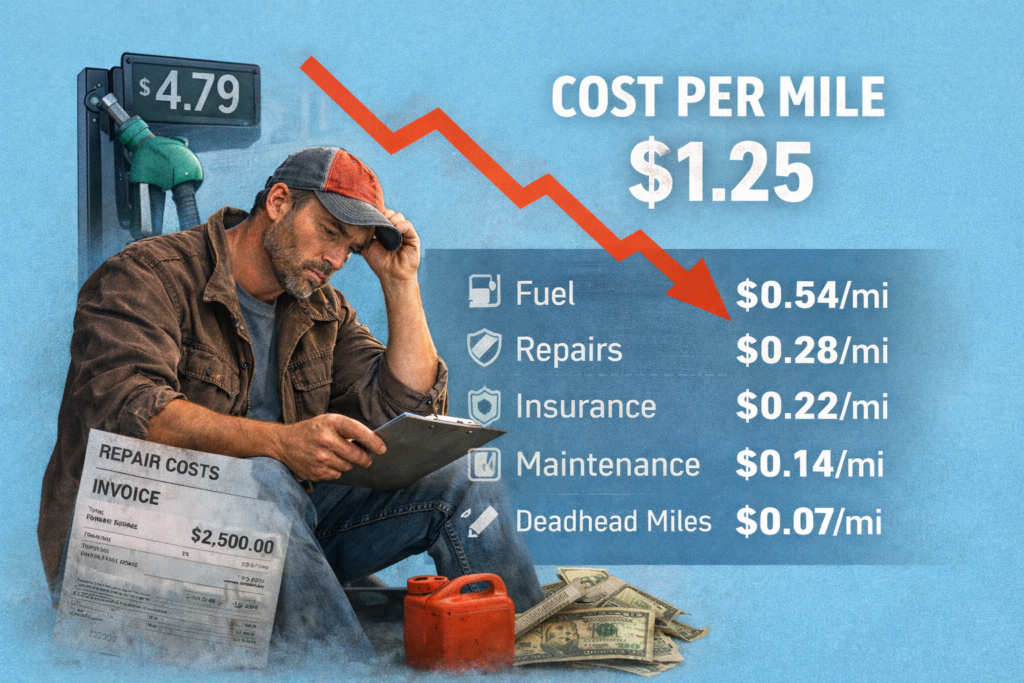
Most conversations about cost per mile in trucking start too late.
They usually begin after the week is over – when fuel receipts are added up, when maintenance gets scheduled, when the numbers don’t quite justify how busy the truck was. At that point, drivers and operators look backward, trying to understand where margin slipped away. But in practice, cost per mile is rarely decided on the road.
It’s shaped earlier – quietly – by how freight is selected, sequenced, and positioned. In other words, by dispatch decisions and operational choices that happen before the wheels ever turn.
This is not an article about how to calculate cost per mile.
It’s about why the number most drivers calculate stops matching reality once real-world trucking operations enter the picture.
Cost per mile is an outcome, not a formula
On paper, cost per mile feels straightforward. Add up expenses, divide by miles, set a floor. That math matters – but it doesn’t explain why two trucks with similar expenses can produce very different results over the same period. The difference is rarely effort. It’s structure.
From an operational standpoint, cost per mile trucking economics reflect the cumulative effect of decisions made before a load is accepted: where the truck is positioned, how it exits a market, and how many deadhead miles are required to stay productive.
Those decisions don’t feel expensive in isolation. Over time, they quietly define trucking profitability.
Where cost per mile quietly escalates
Most margin erosion doesn’t come from one bad load. It comes from patterns that feel reasonable in the moment:
- Accepting freight that pays “fine” but ends in weak outbound markets
- Prioritizing urgency over lane strategy
- Treating deadhead miles as the cost of staying busy
- Sequencing loads without considering recovery miles
None of these choices look fatal. Together, they raise effective cost per mile trucking realities without triggering immediate alarms.
This is why many owner-operators feel busy but financially constrained. The math isn’t wrong – it’s incomplete. Industry analysts have repeatedly noted the disconnect between freight rates and actual profitability across trucking, even when freight continues to move.
What this looks like in a real week
Consider a single box truck running regional freight – a common owner-operator setup.
On Tuesday morning, dispatch decision-making comes into play as two loads are evaluated.
- Load A pays $1.62 per loaded mile and delivers into a strong outbound market.
- Load B pays $1.65 per loaded mile but delivers into an area with limited reload options.
On paper, both loads clear the truck’s known cost per mile floor. The difference shows up later. Fuel alone is already a moving target, with diesel prices tracked by the U.S. Energy Information Administration fluctuating week to week before any dispatch decision even enters the picture.
After Load A delivers, the truck reloads within 40 miles. Total unpaid movement for the week stays under 100 miles. After Load B delivers, the truck sits. By Thursday afternoon, the only viable reload requires repositioning the truck 220 deadhead miles unpaid.
Nothing went wrong. No bad broker. No bad rate.
But by the end of the week, that repositioning quietly adds more than $0.20 per mile to the truck’s effective trucking cost per mile – without a single load looking bad in isolation. This is how cost per mile rises without being noticed: not through one mistake, but through sequencing.
One unpaid or fraudulent load doesn’t just hurt cash flow, it quietly blows up your cost per mile. That’s why vetting who you haul for matters just as much as the rate itself.
Why staying busy doesn’t guarantee trucking profitability
High utilization is often mistaken for efficiency.
A truck can stay loaded all week and still underperform if a meaningful share of its miles are unpaid or poorly positioned. In those cases, paid miles are forced to carry costs that don’t belong to them.
This is why owner-operators often say they need one more good load to fix the week. The week wasn’t underpaid – it was structurally inefficient.
Cost per mile didn’t spike because expenses changed. It changed because miles accumulated differently.
Cost per mile as an operational boundary
When cost per mile is treated purely as an accounting metric, it only gets reviewed after the week is over.
When it’s treated as an operational boundary, it influences dispatch decisions earlier. Loads aren’t judged by rate alone. They’re evaluated in context – where the truck is going next, how clean the exit looks, and whether the lane strategy makes sense.
At that point, cost per mile trucking math stops being theoretical. It becomes a constraint that actively shapes behavior.
Why disciplined trucking operations often look conservative
Operations built around controlling trucking cost per mile rarely look aggressive. They pass on freight that almost works. They avoid lanes that historically trap trucks. They protect exit options instead of chasing volume.
From the outside, this can look cautious. Over time, it’s what stabilizes trucking profitability.
The goal isn’t dramatic growth. It’s predictability – fewer surprise weeks, fewer pressure-driven decisions, and fewer miles that quietly undo the math.
The cost per mile you don’t track still applies
Whether or not it’s calculated, cost per mile is paid on every mile driven. It shows up in wear, in time pressure, and in decisions made under fatigue. Ignoring it doesn’t delay the cost – it only delays awareness.
That’s why cost per mile trucking analysis isn’t just a spreadsheet exercise. It’s an operational reality.
Operational discipline doesn’t happen by accident
Understanding your real cost per mile is only useful if the decisions made on your behalf respect it. Many owner-operators know their numbers – but struggle to enforce them consistently under pressure.
If you want dispatch decisions aligned with your cost structure – not fighting against it – Logity Dispatch works with operators who prioritize disciplined freight selection and clean exits.
Frequently Asked Questions
Is this article about calculating cost per mile?
No. It assumes you already understand the basic math. The focus here is why real-world decisions cause calculated cost per mile to drift away from reality.
Why does deadhead matter so much to cost per mile?
Because unpaid miles still consume fuel, time, and equipment life. They shift cost onto paid miles, raising effective cost per mile without changing expenses on paper.
Can cost per mile change even if expenses stay the same?
Yes. Changes in sequencing, lane exits, and repositioning can materially raise cost per mile even when fuel, payments, and maintenance remain stable.
Why does staying busy still feel unprofitable?
Because volume doesn’t correct structural inefficiency. More miles can amplify losses if they’re poorly positioned.
How often should operators reassess cost assumptions?
Any time fuel prices shift, lanes change, or deadhead patterns increase. Operational math is dynamic, not static.