Table of Content
- What Is a DOT Number?
- What Is an MC Number?
- What Is the Difference Between a DOT Number and an MC Number?
- Were MC Numbers Eliminated in 2026?
- Do You Need Both a DOT Number and an MC Number?
- How Do You Get a DOT Number and an MC Number?
- What Does DOT Mean in Trucking?
- Where Does the MC Number Go on the Truck?
Short answer
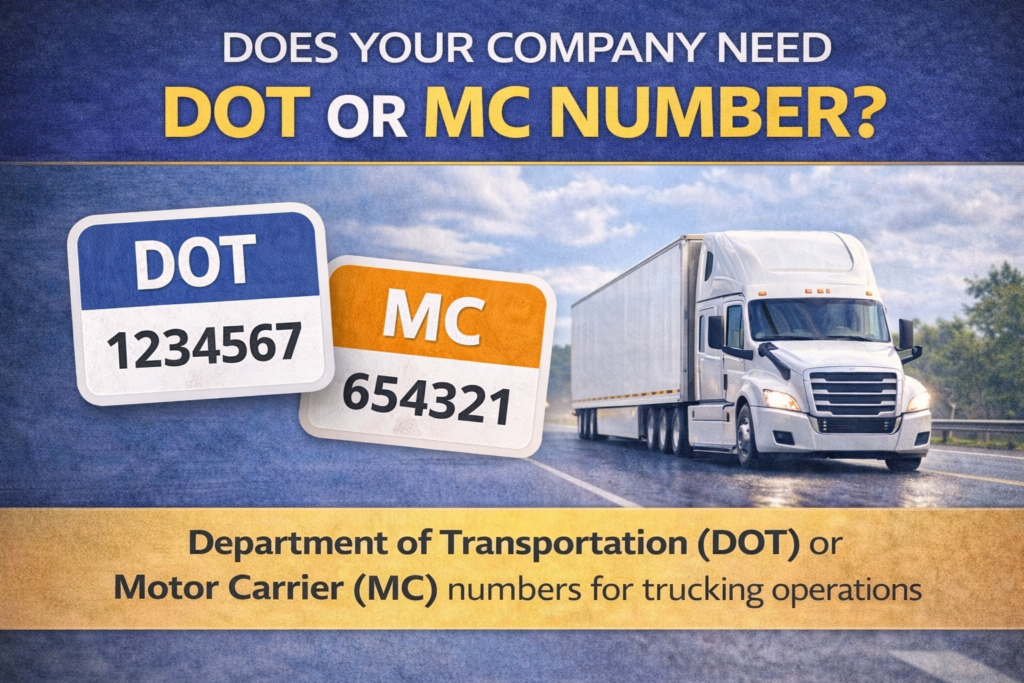
A USDOT number identifies your company to FMCSA. An MC number is operating authority — permission to haul regulated freight for hire. Despite widespread reports that MC numbers were retired, FMCSA stated in the Federal Register on 29.04.2026 that eliminating MC and FF docket numbers is not part of the Motus Phase II release.
If you have read that the MC number is gone, you have read something the agency’s own filing does not support. This page separates the two numbers, says exactly what FMCSA has and has not changed, and gives the thresholds that decide whether you need either one.
What Is a DOT Number?
USDOT number
The unique identifier FMCSA assigns to a company that operates commercial motor vehicles, used to track that company’s safety record — inspections, crashes, audits and compliance reviews — across its entire life.
A USDOT number is an identity, not a permission. Holding one says the agency knows who you are and is keeping a safety file on you. It does not say you are allowed to haul anyone’s freight for money.
The identity function is the part that survives every system change FMCSA is making. In the notice announcing the new Motus registration system, the agency wrote that it “will continue to identify all regulated entities by a USDOT Number as the unique identifier that the Agency issues as part of the registration process” (Federal Register, 91 FR 23144, 29.04.2026).
What Is an MC Number?
MC number
A Motor Carrier docket number issued by FMCSA that grants interstate operating authority — the legal right to transport regulated commodities for hire across state lines, or to broker or forward freight.
An MC number is a permission. Where a USDOT number answers “who are you?”, an MC number answers “are you allowed to be paid to move this?” That is why a private fleet hauling its own goods can need a USDOT number and no MC number at all, and why a freight broker who owns no trucks needs authority and never marks a tractor.
The MC number is also the number your trading partners check. A shipper or broker vetting you looks at whether your authority is active and whether your insurance is on file against it. That is a business-transaction function, and it is the reason the number has proved hard to retire.
What Is the Difference Between a DOT Number and an MC Number?
| USDOT number | MC number | |
|---|---|---|
| What it is | Identity | Operating authority |
| What it grants | Nothing — it registers you | Permission to haul regulated freight for hire interstate |
| Who needs it | Anyone operating a commercial motor vehicle in interstate commerce, including private fleets | For-hire carriers of regulated commodities, brokers and freight forwarders |
| Goes on the truck? | Yes — legal marking on both sides of the power unit | Not required for vehicle marking |
| Tied to | Your safety record: inspections, crashes, audits | Your authority status and your insurance filings |
| Can you hold one alone? | Yes — a private carrier commonly holds only a USDOT number | No — an MC number always sits alongside a USDOT number |
The short version: the USDOT number is who you are and the MC number is what you may do. Most for-hire interstate carriers hold both, and they are not interchangeable in any document that asks for one specifically.
Were MC Numbers Eliminated in 2026?
No — not as of 30.08.2026, and this is the single most misreported fact in the category.
Here is what FMCSA actually filed. The agency is replacing its registration systems with a new one called Motus. Phase I went live on 08.12.2025, opening accounts to supporting companies only — BOC-3 blanket filers, insurance and surety filers, and service providers who register on behalf of carriers. Phase II, which opens Motus to all regulated entities, was planned for the second quarter of 2026.
The plan originally did include retiring the MC and FF docket numbers in favour of USDOT number suffixes. It was pulled. From the notice, verbatim:
“Stakeholders expressed concerns in three core areas: the introduction of safety registration, the elimination of the Motor Carrier (MC) and Freight Forwarder (FF) Docket Numbers, and changes to the process for the Form BOC-3 to be filed with the Agency. In response to stakeholder feedback, the Phase II release of Motus will not include the implementation of safety registration, the elimination of MC/FF numbers, or changes to the Form BOC-3 filing process. FMCSA will take a measured approach to implement these changes in later releases.”
— Federal Register vol. 91 no. 82, page 23144, 29.04.2026 (docket FMCSA-2026-1255, corrected at 91 FR 24643 on 06.05.2026).
What that means in practice, as of 30.08.2026:
- The retirement is deferred, not cancelled. FMCSA says it will implement these changes “in later releases”. No date has been published for that.
- USDOT number suffixes exist but are internal. The notice says the new suffixes indicating each registration type are “only visible in the system for ease of use at this time” and “will not change in formal Agency correspondence documents”.
- The old forms are still accepted. OP-1, OP-1(P), OP-1(FF), OP-1(NNA), OP-1(MX), MCS-150, MCS-150B, MCS-150C, MCSA-5889, OCE-46 and BOC-3 remain acceptable “until a regulatory change eliminates references to these forms”.
- The rule that would end them has not appeared. FMCSA said it anticipated issuing a rulemaking in spring 2026 to require Motus and eliminate those forms. Checking every FMCSA document published in the Federal Register from 29.04.2026 through 25.08.2026 — 61 of them — none does that.
If a service provider tells you your MC number is void or that you must convert it, ask them for the Federal Register citation. There is not one.
Do You Need Both a DOT Number and an MC Number?
Two separate tests, answered in order.
Test one — do you need a USDOT number? It turns on whether you operate a commercial motor vehicle in interstate commerce. The regulation defines that vehicle at 49 CFR 390.5T as one used on a highway in interstate commerce to transport passengers or property when it:
- has a gross vehicle weight rating or gross combination weight rating, or gross vehicle weight or gross combination weight, of 4,536 kg (10,001 pounds) or more, whichever is greater; or
- is designed or used to transport more than 8 passengers including the driver, for compensation; or
- is designed or used to transport more than 15 passengers including the driver, not for compensation; or
- is used to transport hazardous material in a quantity requiring placarding.
(49 CFR 390.5T, CFR 2025 annual edition. Note that many states additionally require a USDOT number for purely intrastate operation — that is a state rule, not this one.)
Test two — do you need operating authority? You do if you are paid by someone else to transport regulated commodities across state lines, or if you arrange that transportation as a broker or freight forwarder. You generally do not if you haul only your own goods, or only exempt commodities, or only within one state.
The combinations, in plain terms:
- Private fleet crossing state lines — USDOT number, no MC number.
- For-hire carrier crossing state lines — both.
- Broker or freight forwarder — operating authority; no trucks to mark.
- Intrastate-only carrier — usually neither federally, but check your state.
How Do You Get a DOT Number and an MC Number?
Both come from one application to FMCSA, and in 2026 that application is moving between systems, so the honest answer includes what we could and could not verify.
The application collects who owns the business, what you will haul, where you will operate, and how many vehicles and drivers you have. Operating authority additionally requires two filings before it activates: proof of insurance at the level required for your commodity, and a BOC-3 blanket designation of process agents in every state you operate in. Authority is granted but does not go active until those filings are in.
Three things are worth planning around:
- Identity verification is now part of registration. FMCSA partnered with IDEMIA in April 2025 for identity document capture and verification, and states that all new applicants will be required to pass identity proofing. Have government-issued ID ready for the person applying.
- Paper is slower and FMCSA says so. Applications submitted on the legacy forms carry “a minimum timeframe of eight business days for the initial review and processing” — before any additional time if the application is flagged for further vetting.
- Fees are paid online through Pay.gov for registration transactions where fees apply. We have not verified the current fee amounts from a primary source and are not going to print a number we could not check — confirm the amount at the point of payment.
BOC-3
A blanket designation of process agents filed with FMCSA naming who may be served legal process on your behalf in each state where you operate. Operating authority does not go active without it, and it is filed by a blanket company on your behalf rather than by you directly.
What Does DOT Mean in Trucking?
DOT is the United States Department of Transportation. In everyday trucking usage the letters get attached to several different things, and the difference matters when a form asks for one:
- DOT number — shorthand for USDOT number, your company identifier.
- DOT inspection — a roadside or annual inspection against the Federal Motor Carrier Safety Regulations.
- DOT physical — the medical examination a commercial driver must pass.
- FMCSA — the agency inside DOT that actually administers motor carrier registration and safety. Your registration is with FMCSA, even though everyone says “DOT number”.
Where Does the MC Number Go on the Truck?
It does not have to go anywhere on the truck. Federal marking rules require the legal name or trade name of the operating carrier and the USDOT number on both sides of the power unit, legible from fifty feet in daylight. The MC number is not part of the required marking.
Many carriers add it anyway, because brokers and shippers use it to look up authority, and because some states and some shipper gate procedures ask for it. Adding it is allowed. Substituting it for the USDOT number is not.
What is an MC number in logistics?
In logistics an MC number identifies a company’s interstate operating authority with FMCSA — its legal permission to haul regulated freight for hire, or to broker or forward it. Brokers check it, along with insurance on file, before tendering a load.
What is MC in truck dispatching?
In dispatching, “MC” is the carrier’s operating authority number. A dispatcher uses it to confirm the carrier’s authority is active and properly insured before booking freight, and brokers require it on carrier packets and rate confirmations.
What is a motor carrier number?
Motor carrier number is the full name of the MC number — the docket number FMCSA issues to grant interstate operating authority. It is distinct from the USDOT number, which identifies the company and carries its safety record.
How do you get an MC number for trucking?
Apply to FMCSA for operating authority alongside your USDOT number, pass identity verification, then file proof of insurance at the required level and a BOC-3 designation of process agents. Authority is granted but stays inactive until those two filings are on record.
What are the USDOT and MC number requirements?
A USDOT number is required for interstate operation of a vehicle meeting the 49 CFR 390.5T commercial-motor-vehicle test — 10,001 lb or more, more than 8 passengers for compensation, more than 15 passengers, or placardable hazmat. An MC number is additionally required to be paid to transport regulated commodities interstate, or to broker or forward freight.
Written by Alex Morgan, Logity Dispatch. Verified 30.08.2026 against Federal Register vol. 91 no. 82 p. 23144 (29.04.2026, docket FMCSA-2026-1255, corrected 91 FR 24643) and 49 CFR 390.5T (CFR 2025 annual edition, govinfo.gov). FMCSA’s own website could not be reached from our environment at the time of writing, so no figure on this page is sourced from fmcsa.dot.gov page copy, and no application fee amount is stated. Confirm fees and current system status at the point of application.