Table of Content
- What is double brokering?
- Why does a double-brokered load put your money at risk?
- What does the paperwork look like when a load has been re-brokered?
- What can you check before you accept the load?
- Let a Dispatcher Do the Broker Talking
- What record is the broker required to keep, and can you see it?
- It already happened and nobody is paying. What does federal law give you?
- Can you claim against the broker’s bond?
- Should you contact the shipper directly?
- What should you do in the first 48 hours?
- Where does a dispatcher fit into this?
- Frequently asked questions
Short answer
A double-brokered load is one that the company you booked with handed to someone else without telling you, so the party that owes you money is not the party holding the shipper’s money. The tell is in the paperwork: the rate confirmation, the load board post and the bill of lading name companies that do not all match. Federal law is on your side after the fact. Under 49 U.S.C. 14916, anyone who arranges transportation without broker registration and security is liable to you “for all valid claims incurred without regard to amount”, and that liability reaches the company’s individual officers, directors and principals personally.
Written by the Logity Dispatch team for owner-operators and small fleets. We book freight for carriers who run into this every month, and we pull the authority record before we pass a load to a driver. Every legal point below was checked against its own primary source on 22 September 2026: 49 U.S.C. 13901, 13906 and 14916 as published by the Legal Information Institute, and 49 CFR part 371 as served by the eCFR API at its 18 September 2026 issue date. Where we could not source a number, we say so instead of printing one.
What is double brokering?
Double brokering is when the load you accepted gets handed to a second party, and you are not told. You booked with company A. Company A passes the load to company B. Somewhere in that chain a bill of lading gets signed, a truck moves, and the money takes a different route home than the freight does.
It comes in two flavours and they are not equally serious. In the first, an authorized broker re-brokers a load to another authorized broker. That may be a contract problem, since most broker-carrier agreements forbid it outright, but both parties are registered and both carry financial security. In the second, a company holding only carrier authority takes the load as a carrier and then arranges for someone else to haul it. That is brokerage, and doing it without broker registration is what the statute prohibits.
The rule in one sentence
49 U.S.C. 14916(a): a person may provide interstate brokerage services as a broker only if that person is registered under section 13904 and has satisfied the financial security requirements under section 13906.
Co-brokering is the legitimate cousin. Two brokers work a load together with everyone’s knowledge and consent, and it is written into the agreement. The difference is not the number of companies in the chain. It is whether you were told and whether every party arranging transportation is licensed to arrange it.
Why does a double-brokered load put your money at risk?
Follow the money instead of the freight. The chain runs shipper, then broker, then the company that took the load from that broker, then you. The shipper pays the broker. The broker pays the company it contracted with. That company is supposed to pay you.
Your right to be paid sits in one link of that chain, and it is the weakest one. You have no contract with the original broker. You never signed anything with the shipper. If the middle company takes the broker’s payment and disappears, the broker’s position is that it already paid for the load, which is often true. You delivered freight for a company that no longer answers the phone.
Two things make it worse than an ordinary slow payment. The broker may have no record of your company at all, because as far as its file shows, a different carrier was hauling. And the middle company, if it was brokering without authority, has no bond behind it, because the financial security requirement applies to registered brokers.
What does the paperwork look like when a load has been re-brokered?
You almost never get told. You get a set of documents that do not quite line up, and the mismatch is visible before the wheels turn if you lay the documents next to each other.
| What you are looking at | Booked direct with the company that holds the load | Load that has already been re-brokered |
|---|---|---|
| Name on the rate confirmation | Matches the company on the load board post and the authority record you checked | Three names, three documents, and at most two of them match |
| Authority the company actually holds | Broker authority, active, with financial security on file | Carrier authority only, or authority that is inactive, while the company is arranging transport for you |
| Carrier named on the bill of lading | Your company, spelled the way you spell it | Another carrier’s name, or a blank that somebody fills in after you leave the dock |
| Who the shipper is expecting | Your truck, your driver, your MC number at the gate | A company nobody at the gate can match to your truck |
| Remit-to address for payment | Belongs to the company that signed the rate confirmation | Belongs to a third company, or to a factoring account under a name you have not seen before |
| How they contact you | The phone number in the public authority record | Mobile number and free email only, and the listed line never rings back |
| Rate against the market | In the range for the lane | Noticeably above it, booked fast, with pressure to sign quickly |
None of these is proof on its own. A company can change its remit-to for honest reasons and a good lane can pay well. Two or three of them together on the same load is your signal to stop and make a phone call before you dispatch a truck.
What can you check before you accept the load?
The checks that catch this are the boring ones, and they take about ten minutes.
- Check which authority the company holds, not just that it has one. A company arranging your transportation needs broker authority. Carrier authority is not a substitute, and 49 U.S.C. 14916(a) is the reason that distinction matters to you rather than only to the regulator.
- Call the number in the public record, not the one in the email. Ask for the person who sent you the rate confirmation by name. Impersonation of a real, solvent company is the common version of this, and the real company’s switchboard is where it falls apart.
- Ask, in writing, who the shipper is and whether the load is being re-brokered. A straight answer costs an honest broker nothing. A refusal is information.
- Read the bill of lading at pickup before you sign it. If the carrier field carries someone else’s name, that is the moment to raise it, at the dock, with the load still on the ground.
- Ask for the transaction record. This one is a legal right and almost nobody uses it. See the next section.
These checks overlap with general broker vetting, and we are not going to retype that list here. If what you are really asking is whether a broker is real and whether they pay, the warning signs and the vetting routine are in how owner-operators protect themselves from freight broker scams. This article assumes the load itself is the problem.

What record is the broker required to keep, and can you see it?
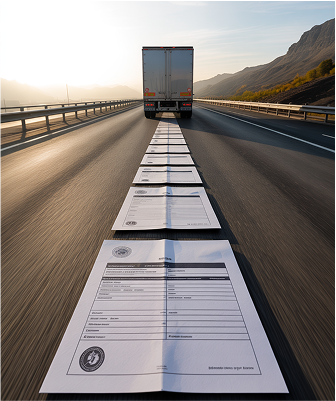
Yes, and this is the most underused paragraph in the federal regulations for a small carrier. Under 49 CFR 371.3(a), a broker must keep a record of each transaction showing, among other things, the name, address and registration number of the originating motor carrier, the bill of lading or freight bill number, the compensation the broker received and who paid it, and the amount of any freight charges collected by the broker and the date of payment to the carrier.
Those records have to be kept for three years under 371.3(b). And 371.3(c) says it plainly: “Each party to a brokered transaction has the right to review the record of the transaction required to be kept by these rules.”
Read what that gives you. If you hauled the load, you are a party to the transaction, and you can ask to see which carrier the broker thinks it hired, when the broker paid, and how much. That single document answers the question every double-brokering argument turns on: has the money already left the broker, and who received it.
One more rule worth knowing while you are reading part 371. Under 49 CFR 371.7(b), a broker shall not, directly or indirectly, represent its operations to be that of a carrier, and any advertising has to show its broker status. A company posting loads as though it runs the trucks, while it is in fact arranging for other people to run them, is on the wrong side of that sentence.
It already happened and nobody is paying. What does federal law give you?
More than most carriers think, and the useful part is not the government’s penalty. It is the private one.
49 U.S.C. 14916(c) says that any person who knowingly authorizes, consents to or permits a violation of the registration and security requirement, directly or indirectly, alone or with anyone else, is liable on two separate counts: to the United States government for a civil penalty “in an amount not to exceed $10,000 for each violation”, and to the injured party “for all valid claims incurred without regard to amount”.
The second half is the one that concerns you. It is not capped at a bond amount and not capped at a schedule. It is your claim, in full.
Then 14916(d) closes the escape hatch that makes this fraud attractive in the first place. Liability for those penalties and claims applies jointly and severally, both to the corporate entity or partnership involved and “to the individual officers, directors, and principals of such entities”. Dissolving the company does not take the people who ran it out of reach.
We are describing what the statute says, not telling you how your case will go. Collecting is a different problem from being owed, and the point at which this stops being an article and starts being a lawyer’s job is the point at which you have a claim worth more than the fee.
Can you claim against the broker’s bond?
Sometimes, and it is worth understanding what that bond is before you count on it.
Under 49 U.S.C. 13906(b)(3), every broker subject to the requirement must provide financial security of $75,000, and the statute adds “regardless of the number of branch offices or sales agents of the broker”. That is the whole security for the whole company, not per load and not per claimant.
The bond is available to pay a claim arising from the broker’s failure to pay freight charges, under 13906(b)(2)(A), in three situations: the broker consents to the payment subject to the surety’s review, or the broker does not respond to adequate notice and the surety decides the claim is valid, or the claim is not resolved in a reasonable time and you reduce it to a judgment against the broker.
Two procedural details are worth writing on the wall next to your desk. The surety must respond to your claim on or before the 30th day after it receives notice, and if it denies the claim it must set out the grounds for denial in writing, under 13906(b)(2)(B). And under 13906(b)(2)(C), in an action against a surety provider to recover on such a claim, the prevailing party is entitled to recover its reasonable costs and attorney’s fees. That provision is why a valid bond claim is worth pursuing at freight-invoice scale rather than writing off.
If the broker collapses, the timetable is set out too. Under 13906(b)(6), the surety must file a cancellation notice, publicly advertise for claims for 60 days from the date the cancellation notice is published, and then pay within 30 days of the end of that window: all uncontested claims, or a pro rata share if the claims add up to more than the security available. Cents on the dollar is a real outcome. Watching the cancellation notices, which the statute requires the Secretary to post publicly, is how carriers hear about it in time to file.
Here is the part nobody likes. If the company that gave you the load was brokering without registration, there is no bond, because the security requirement attaches to registered brokers. In that case 14916(c) and (d), the claim against the entity and its principals personally, is the route you have.
Should you contact the shipper directly?
Often yes, and earlier than most carriers do it. The shipper’s name is on the bill of lading in your hand, and the shipper is the one party in the chain with no incentive to hide the structure of the deal. In many cases the shipper does not know its freight was re-brokered either.
Keep the first call factual. You hauled this load on this date under this bill of lading number, you have not been paid, and you are trying to establish who the shipper contracted with. You are asking for one piece of information: the name of the company the shipper hired. Put that name next to the name on your rate confirmation and the chain is on the table.
What we are not going to tell you is to hold the freight, refuse to deliver, or assert a lien as leverage. Whether any of that is available to you depends on your state, the bill of lading and facts we cannot see from here, and getting it wrong turns a collection problem into a cargo claim against you. Deliver, document, then pursue.
What should you do in the first 48 hours?
- Freeze the file. Rate confirmation, load board screenshot, every email and text, the signed bill of lading, the delivery receipt, and the phone log. Screenshots of the load board post matter, because posts come down.
- Write to the party that booked you asking for the transaction record under 49 CFR 371.3(c), naming the load and the date. In writing, so the request has a date on it.
- Identify the shipper’s actual counterparty from the bill of lading and one call, as above.
- Notify the surety if the party that owes you is a registered broker, and start the 30-day clock in 13906(b)(2)(B).
- File a complaint with FMCSA through the National Consumer Complaint Database. It does not collect your money, and we are not going to suggest that it does. It is how the pattern behind a repeat offender gets recorded.
- Decide about counsel while the paperwork is fresh, especially if 14916(d) puts named individuals in reach.
Where does a dispatcher fit into this?
Honestly, in the ten minutes before the load is accepted. That is the only moment when any of this is cheap. Checking which authority a company holds, calling the number in the public record rather than the one in the signature block, and reading the rate confirmation against the load board post are not clever tricks. They are a routine, and a routine is exactly the thing that falls apart when you are the driver, the dispatcher and the accountant in the same cab.
That is the part we do. Our dispatch service vets the party before the load is booked and keeps the paperwork in one place where a mismatch is visible, and rate negotiation is where a rate that is suspiciously above the lane gets questioned rather than celebrated. If you would rather run those checks yourself, run them. The loads that go wrong are the ones nobody checked.
Frequently asked questions
What is double brokering in trucking?
It is when the company you booked a load with passes that load to another party without your knowledge or consent. The freight moves on your truck, but the contract the shipper paid against names someone else, so the money and the delivery travel different routes.
Is double brokering illegal?
Arranging transportation without broker authority is prohibited. Under 49 U.S.C. 14916(a) a person may provide interstate brokerage services only if registered under section 13904 and secured under section 13906. Re-brokering between two authorized brokers is usually a breach of contract rather than a violation of that section, because most broker-carrier agreements forbid it.
Who pays me if my load was double brokered?
Whoever arranged the transportation owes you. Under 49 U.S.C. 14916(c)(2) a party that brokered without authority is liable to the injured party for all valid claims incurred without regard to amount, and under 14916(d) that liability applies jointly and severally to the entity and to its individual officers, directors and principals.
Can I claim against a freight broker’s bond?
You can if the party that owes you is a registered broker and the claim arises from its failure to pay freight charges. The security is $75,000 for the whole company under 49 U.S.C. 13906(b)(3), the surety must answer your claim within 30 days and give written grounds for any denial, and the prevailing party in an action against the surety can recover reasonable costs and attorney’s fees.
Can I ask a broker to show me the record of my load?
Yes. Under 49 CFR 371.3(c) each party to a brokered transaction has the right to review the record the broker is required to keep, and under 371.3(a) that record shows the originating motor carrier, the bill of lading number, the broker’s compensation, and the amount and date of the payment made to the carrier.
Sources checked on 22 September 2026: 49 U.S.C. 13901, 13906 and 14916, read in full at law.cornell.edu; 49 CFR part 371, retrieved from the eCFR API at title 49’s 18 September 2026 issue date. Quoted phrases are quoted from those texts. This article explains what the statute and the regulations say. It is not legal advice, and what a specific claim is worth depends on facts we cannot see from here.