Table of Content
- Is Invoice Factoring and Freight Factoring the Same Thing?
- How Freight Factoring Works for Owner-Operators
- Who Can Use Freight Factoring?
- Do I Need a Factoring Company for Trucking?
- How Much Do Factoring Services Cost for Trucking?
- Which Freight Factoring Services Offer Same-Day Funding?
- What Is a Buyout With a Factoring Company for Trucking?
- How to Get Rid of an Old Factoring Company
- Why the Broker on the Load Decides Your Factoring Terms
- Factoring, Grants and the Other Ways to Fund a Truck
Short answer
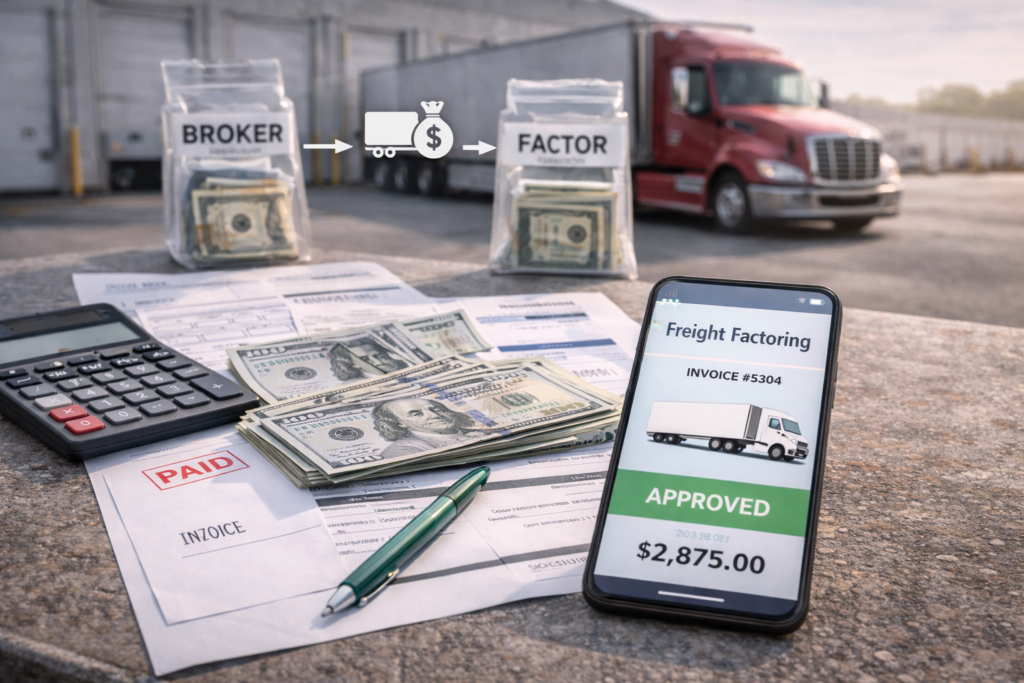
Freight factoring is selling your unpaid freight invoice to a third party for cash now instead of waiting 30 to 60 days for the broker to pay. You get an advance (a percentage of the invoice) and the factor keeps a fee plus, usually, a reserve it releases when the broker pays. It is not a loan and it does not price your credit; it prices the credit of whoever owes the invoice. Whether it is worth it depends on one comparison only: the fee against what the cash earns you in the days you got it early.
Almost every page written about factoring explains what it is. Very few tell you the three things that actually decide the outcome for a one-truck or five-truck operation: what the full cost is once the fee schedule is added up, whether you need it at all given how your loads actually pay, and what it takes to leave a factor once you have signed. This page is those three things.
Two notes before the detail. We are not printing a “typical rate”, not because it is a secret, but because every published band we could find is unsourced, and an unsourced number on a money decision is worse than no number. And the legal facts on this page come from the Code of Federal Regulations with the section cited, so you can check them yourself.
Is Invoice Factoring and Freight Factoring the Same Thing?
Yes: freight factoring is invoice factoring applied to freight bills. The mechanism is identical: you sell a receivable at a discount. The freight version has three habits of its own.
Freight factoring
The sale of an unpaid freight invoice to a third party (the factor) at a discount, in exchange for immediate payment of most of its face value. The factor then collects from the broker or shipper who owes the money.
It is priced on the debtor, not on you. A bank lends against your credit. A factor buys a receivable, so what it underwrites is the payer’s likelihood of paying. This is why a new authority with no credit history can factor loads that no bank would lend against, and why the same operation gets different terms depending on which brokers it hauls for.
It is a sale, not a loan. That distinction is not cosmetic. Nothing is being repaid, so there is no interest rate in the legal sense, and the cost is expressed as a discount off the invoice. It also means the factor takes a security interest in your receivables and files it publicly: more on that under the buyout question below, because it is the reason leaving is harder than joining.
The advance and the fee are two different numbers. People collapse them constantly. The advance is what percentage of the invoice hits your account today. The fee is what the factor keeps. A 95 % advance with a 4 % fee and a 90 % advance with a 2 % fee are not comparable until you know when the remaining 5 % or 10 % comes back, and whether it comes back at all.
How Freight Factoring Works for Owner-Operators
The sequence for a single load, start to finish:
| Step | What happens | Who holds the money |
|---|---|---|
| 1 | You haul the load and get a signed BOL / POD | Nobody: you are out of pocket |
| 2 | You send the invoice and paperwork to the factor, not to the broker | Broker owes the invoice |
| 3 | Factor verifies the load with the broker | n/a |
| 4 | Factor advances you a percentage of the invoice | You have most of it |
| 5 | Broker pays the factor on the broker’s own terms | Factor holds the rest (the reserve) |
| 6 | Factor releases the reserve minus its fee | You have the rest |
Two of those steps are where the surprises live.
Step 3 is a gate, not a formality. Verification is the factor calling the broker to confirm the load was delivered and the invoice is approved. If the broker disputes anything (a late delivery, a detention line, a lumper receipt) verification stalls and so does your advance. This is why paperwork discipline matters more under factoring than without it.
Step 5 is not on your calendar. You got paid early; the broker still pays on the broker’s terms. If that broker pays slowly, or not at all, what happens next is decided entirely by whether your agreement is recourse or non-recourse, which is a whole decision of its own, and we have written it up separately in recourse vs non-recourse freight factoring.
Who Can Use Freight Factoring?
The eligibility question has a shorter answer than most pages give it, because the factor is underwriting your customers, not you.
What generally qualifies you: active operating authority, insurance in force, invoices owed by commercial payers (brokers, shippers) rather than individuals, and clean delivery paperwork. A brand new authority with zero payment history is normal in this market: that is much of the point.
What generally disqualifies an invoice: it is already pledged to someone else, it is owed by a payer the factor has blacklisted for slow payment, or the load has an unresolved dispute attached. Note that the disqualifier attaches to the invoice and the payer, not usually to you.
What is worth checking before you assume you are eligible: whether the factor works with your equipment class at all. Box-truck and straight-truck operations are a real search (`factoring company for box trucks`) and not every factor takes them, because the invoice sizes are smaller and the per-invoice cost of verification does not shrink with the invoice.
Do I Need a Factoring Company for Trucking?
Here is the decision, and it does not depend on any market rate.
Factoring is worth it when the cash arriving early earns you more, or costs you less, than the fee you paid for it. That is the whole test. So write down four of your own numbers:
| Your number | Where to get it |
|---|---|
| A: average invoice you send | Your last 20 loads |
| B: days you actually wait for payment today | Your last 20 loads, invoice date to deposit date, not the broker’s stated terms |
| C: the factor’s advance rate and total fee, all line items | The fee schedule, not the headline |
| D: what you do with the money B days early | Fuel bought at cash price, a load you could not otherwise take, a payment that would have gone late |
If D is “it sits in the account until the truck payment”, factoring is costing you money for nothing and the right answer is probably no. If D is “I take another load I would have had to turn down”, factoring is buying you a load margin for a fee, and the arithmetic usually clears easily.
The failure mode we see most often is not paying too much for factoring. It is factoring every load out of habit, including the ones from brokers who pay in a week anyway. Many agreements let you choose which invoices to submit; if yours does, the brokers with the fastest actual payment history are the ones to keep off the factor.
How Much Do Factoring Services Cost for Trucking?
We are not going to print a rate band, and we want to be straight about why: every published band we could find is unsourced, and rates on this product genuinely move with invoice size, monthly volume, recourse terms and who your payers are. A number invented for a web page cannot survive contact with your actual fee schedule.
What we can give you is the arithmetic and the full list of what has to go into it.
The formula. For one invoice:
Cash you actually keep = Invoice × Advance rate + (Invoice × Reserve rate − Fees) ← released later, if released Total cost = Invoice − Cash you actually keep Effective cost = Total cost ÷ Invoice
Worked, on numbers you can swap for your own. These are illustrative inputs, not our quote and not a market rate, the point is the shape of the calculation:
| Offer 1 | Offer 2 | |
|---|---|---|
| Invoice | $2,000 | $2,000 |
| Advance rate | 95 % | 90 % |
| Advanced today | $1,900 | $1,800 |
| Discount fee | 3.0 % → $60 | 1.5 % → $30 |
| ACH / same-day transfer fee | $15 | $30 |
| Reserve released | $100 − fees | $200 − fees |
| Total kept | $1,925 | $1,940 |
| Effective cost | 3.75 % | 3.00 % |
The headline rate said Offer 2 was half the price of Offer 1. The fee schedule said the gap was 0.75 points. That is the reason this section is a formula and not a number.
The line items that turn a headline into a price. Ask for every one of these in writing before you sign:
- the discount fee and whether it is flat or steps up the longer the invoice is unpaid
- the advance rate, and what triggers a lower one
- the reserve: what percentage, and what conditions release it
- transfer fees: ACH, wire, same-day, and per-invoice
- a monthly minimum volume and what it costs you in a slow month
- the term, the auto-renewal, and the notice period to leave
- who pays for the UCC filing and its termination
- whether fuel advances carry their own fee, and how much
- what happens on a non-payment: this is the recourse question, and it is the largest number on the page if it ever fires
A factor that will not put all nine in writing has answered your question about them.
Which Freight Factoring Services Offer Same-Day Funding?
We are not naming providers or promising a clock, because funding speed is not really a provider property. It is the product of three things, and two of them are yours:
- Your paperwork completeness. Missing POD, missing rate confirmation, missing lumper receipt: the file does not move.
- Broker verification. The factor has to confirm the invoice with the payer. A broker who answers the same day funds the same day; a broker whose AP inbox runs 48 hours does not.
- The transfer rail. ACH is not instant. Same-day usually means a wire or a same-day ACH, and that is normally a per-transaction fee: see the fee list above.
So the honest answer to “who funds same day” is: ask what the cutoff time is, what has to be in the file by that cutoff, and what the same-day transfer costs. Those three answers predict your outcome better than any advertised turnaround.
What Is a Buyout With a Factoring Company for Trucking?
This is the question almost nobody answers, and it is the one that costs money.
Factoring buyout
The process of moving from one factor to another, in which the new factor pays off the outstanding balance owed to the old factor and takes over the first-position claim on your receivables.
When you sign with a factor, it takes a security interest in your accounts receivable and records it publicly with a UCC-1 financing statement at the state level. That filing is what tells the rest of the world that your invoices are already claimed. It is not private and you can look yours up: the state Secretary of State runs the search, for example the Texas UCC search at `sos.state.tx.us/ucc` or the California business search at `bizfileonline.sos.ca.gov/search/ucc` (both live as of 31.08.2026).
That filing is why you cannot simply start sending invoices to a new factor. The new one will not advance against receivables another party has first claim on. So the exit has a shape:
- Read your termination clause first. The notice period and the renewal date decide your timeline, not your enthusiasm.
- Get a payoff figure from the current factor: outstanding advances, unreleased reserves, any minimum-volume shortfall, any termination charge.
- The new factor pays the old one and the two settle between themselves. This is the buyout.
- The old UCC-1 is terminated and the new one filed. Confirm the termination actually posted; a stale filing will block your next move too.
- Only then does the new advance rate apply to your invoices.
Two practical warnings. A buyout offer that covers your balance is a real benefit, but it is a cost someone is carrying and it usually shows up in the first months’ terms: compare the whole term, not the first invoice. And auto-renewal clauses are the most common reason an exit slips a full contract year; the notice window is often measured in weeks before a renewal date, not from the day you decide.
How to Get Rid of an Old Factoring Company
Same mechanics as the buyout above, minus the new factor. If you are leaving factoring altogether: you still need the payoff figure, you still need the UCC-1 terminated, and you need enough working capital to cover the gap between your last advance and your first self-collected payment, which is the full B days you wrote down earlier. That gap is the reason most operations move to a new factor rather than off factoring, and it is worth planning for a quarter ahead rather than a week.
Why the Broker on the Load Decides Your Factoring Terms
This is the part of factoring that is actually written into federal regulation, and it explains more about your rate than anything on your own side of the ledger.
A broker’s ability to pay you is backed by a $75,000 bond: that is the floor, and it is a floor shared with everyone else the broker owes. 49 CFR 387.307(a) is explicit:
“A broker must have a surety bond or trust fund of $75,000 in effect. FMCSA will not register a broker until a surety bond or trust fund for the full limits of liability prescribed herein is in effect. The broker registration shall remain in effect only as long as a surety bond or trust fund remains in effect… The surety bond or the trust fund shall ensure the financial responsibility of the broker by providing for payments to shippers or motor carriers if the broker fails to carry out its contracts, agreements, or arrangements for the supplying of transportation by authorized motor carriers.”
Three things follow that matter to you directly. The bond is filed on Form BMC-84 (surety) or Form BMC-85 (trust fund), and a trust fund’s assets must be liquidatable to cash within 7 calendar days. The bond can only be cancelled on 30 days’ written notice to FMCSA. And $75,000 is the total for all claimants: if a broker fails owing twenty carriers, that is the pool, not your share of it. This is precisely the risk a non-recourse agreement prices, and why a factor cares which brokers you haul for.
You have a statutory right to see what the broker was paid on your load. 49 CFR 371.3 requires a broker to keep a record of each transaction showing, among other items, “the amount of compensation received by the broker for the brokerage service performed and the name of the payer” and “the amount of any freight charges collected by the broker and the date of payment to the carrier”. Those records must be kept three years, and subsection (c) is one sentence long:
“Each party to a brokered transaction has the right to review the record of the transaction required to be kept by these rules.”
You are a party to that transaction. Whether exercising the right is good for the relationship is a commercial judgement. But the right exists, in the regulation, and the date-of-payment line in (a)(6) is the one that documents how slowly a broker actually pays.
Know whether the entity you are hauling for is a broker or a carrier, because it changes who owes you and what backs it. 49 CFR 371.2 defines a broker as a person who, for compensation, arranges transportation by an authorized motor carrier, and specifically excludes carriers arranging shipments they are themselves authorized and legally bound to transport. 49 CFR 371.7 then forbids a broker from operating under any name other than the one its registration was issued in, and from representing its operations to be that of a carrier: “Any advertising shall show the broker status of the operation.” If the name on the rate confirmation does not match the registered name, that is a regulatory problem and a credit problem at the same time.
One more, for anyone hauling for an outfit that also does something else: 49 CFR 371.13 requires a broker that runs another business to keep the brokerage revenues and expenses segregated from the rest, and to be “prepared to explain the basis for the allocation” of shared costs.
Factoring, Grants and the Other Ways to Fund a Truck
Factoring solves exactly one problem: the gap between delivering a load and being paid for it. It is not capital. If your problem is a down payment, a repair you cannot cover, or the first three months of an authority, factoring is the wrong instrument and an expensive one.
| Instrument | Solves | Priced on | Get it when |
|---|---|---|---|
| Factoring | The 30 to 60 day payment gap | Your broker’s credit | Loads are running and cash timing is the constraint |
| Fuel advance | Cash before delivery, on a booked load | The load | Fuel out of pocket exceeds what you have today |
| Line of credit | Irregular short-term gaps | Your credit | You have history a lender can read |
| Equipment loan | Buying the truck or trailer | Your credit + the asset | The asset itself is the purchase |
| Grants | Capital you do not repay | An application process | You qualify and can wait out the timeline |
Grants and SBA programmes are their own subject with their own eligibility, and we have written them up separately in grants to start a trucking company.
If what you need is the invoice side handled rather than financed, that is a different service too: see trucking invoice service.
And if after the four-number test above the answer is that factoring earns its fee for your operation, our own freight factoring service is where to start.
The owner-operators page covers what else sits around it.
Is invoice factoring and freight factoring the same?
Yes. Freight factoring is invoice factoring applied to freight bills. You sell the unpaid invoice to a third party at a discount and get most of its value immediately. The freight version is priced on the credit of the broker or shipper who owes the invoice, not on yours, and it is a sale rather than a loan.
Do I need a factoring company for trucking?
Only if the cash arriving early is worth more to you than the fee. Write down your average invoice, the number of days you actually wait for payment today, the factor’s full fee schedule, and what you would do with the money that many days early. If the money would sit idle, factoring is a cost with no return. If it lets you take a load you would otherwise turn down, it usually clears easily.
How much do factoring services cost for trucking?
There is no single rate, and the headline rate is not the price. What decides the cost is the combination of discount fee, advance rate, reserve terms, transfer fees, monthly minimums and termination charges. Two offers with rates of 3.0 % and 1.5 % can end up 0.75 points apart once the advance rate and transfer fees are included. Get all of it in writing and run the arithmetic on your own invoice size.
How does freight factoring work for owner-operators?
You haul the load, send the invoice and paperwork to the factor instead of the broker, the factor verifies the load with the broker and advances you most of the invoice, then collects from the broker on the broker’s terms and releases the remaining reserve minus its fee. The two steps that surprise people are verification, which stalls on incomplete paperwork, and what happens if the broker never pays, which is decided by whether your agreement is recourse or non-recourse.
Who can use freight factoring?
Carriers with active operating authority and insurance in force, invoicing commercial payers rather than individuals. Because the factor underwrites your customers rather than you, a new authority with no payment history is normal. Invoices already pledged elsewhere, invoices owed by payers the factor has blacklisted, and loads with open disputes are the usual exclusions.
What is a buyout with a factoring company for trucking?
A buyout is the new factor paying off what you owe the old one so it can take first-position claim on your receivables. It is necessary because your current factor has filed a UCC-1 financing statement against your accounts receivable, and a second factor will not advance against invoices someone else has already claimed. Check your notice period and renewal date before anything else: auto-renewal is the most common reason an exit slips a year.
How do I get rid of my old factoring company?
Get the payoff figure (outstanding advances, unreleased reserves, minimum-volume shortfall and any termination charge), give notice inside the contractual window, and confirm the UCC-1 termination actually posted with your state’s Secretary of State. If you are leaving factoring entirely rather than switching, plan for the full payment-wait gap in working capital before the last advance runs out.
Which freight factoring services offer same-day funding for invoices?
Same-day funding is less a provider feature than the product of three things: a complete file (POD, rate confirmation, receipts), a broker who verifies quickly, and a same-day transfer rail, which normally carries its own fee. Ask any factor what the daily cutoff is, what must be in the file by it, and what the same-day transfer costs. Those answers predict your outcome better than an advertised turnaround.
Written by Alex Morgan, Logity Dispatch. Regulatory citations verified 31.08.2026 against the CFR 2025 annual edition, title 49 volume 5 (revised 01.10.2025), govinfo.gov: 49 CFR 387.307, 49 CFR 371.3, 49 CFR 371.2, 49 CFR 371.7 and 49 CFR 371.13. The live eCFR API returned 503 on that date, so the annual edition was used. No market factoring rate, industry-adoption share or funding turnaround time is stated on this page: none of them is available from a source we can stand behind, and the figures in the worked example are illustrative inputs, not quotes.