Reading the truck isn’t intuition. It’s the result of running the same equipment on the same lane in roughly the same conditions every week for years. The baseline is what makes the drift readable. When the MPG drops a tenth on a load that would normally produce the same number it has produced fifty times, the operator who has the baseline notices, and the drift gets read against repetition rather than against feeling.
Two and a half years on the same primary lane. Same shipper, same destination, same approximate load weight, same speed range, same routing through familiar terrain. The operator knows what the fuel gauge does between any two points on this lane within a couple of gallons. He doesn’t think about it most weeks because there’s nothing to think about. The numbers come in where they always come in.
This week the numbers came in a little lower. Not a lot – about a tenth of a mile per gallon below the running average for this load on this lane in this season. That kind of drift is sometimes weather. Sometimes a fresher fuel batch from the same pump that the operator’s been using runs cleaner or dirtier. Sometimes it’s noise. And sometimes it’s the first weak signal of something that will become a roadside event in three weeks if the operator doesn’t read it.
Why the baseline is the engine
The reason the operator can notice a tenth-of-a-mile drift isn’t sensitivity. It’s familiarity. The same lane every week produces a fuel burn within a narrow band, and after enough repetitions the band sits clearly enough in the operator’s memory that a number outside it registers without effort. The same lane run for the first time wouldn’t register. Driven once a quarter wouldn’t register. Familiarity over repetition is what makes the signal readable, not any particular skill.
The same logic applies to the rest of the truck’s behavior. Idle time. Regen frequency. Engine sound on a known grade. Boost pressure on a known acceleration. The operator who runs the same configuration for years builds up a baseline for each of these without ever consciously cataloging them. The baseline isn’t in a notebook. It’s in the operator’s working memory of what the truck does when nothing is wrong, and a deviation from that working memory is what reads as a signal.
What the fuel drift can mean
A tenth-of-a-mile MPG drop on a known lane in known conditions can mean a lot of things. A clogging fuel filter. A boost leak the operator hasn’t noticed yet. A tire on the trailer running at lower pressure than the operator has been compensating for. An injector starting to underdeliver. A turbo stage starting to lose efficiency. Or, much more commonly, none of those things – just a colder week, a different fuel batch, a slightly heavier load than the operator estimated, a longer idle stretch at the receiver yard.
The operator doesn’t try to diagnose from one week of drift. What he does is start watching the next week’s numbers more carefully and pair them with the other baselines. If the MPG drop is alone – no idle change, no regen change, no engine sound change, no boost-gauge change – it’s probably noise. If it shows up alongside a regen cycle that ran ten minutes earlier than the operator was expecting, it’s probably worth looking at. If it shows up alongside two of the other baselines, the operator stops at the next yard and pulls the engine bay open.
Idle time is the second baseline
The operator has a rough sense of how long the truck idles in a typical week – DOT yard, fuel stops, traffic, sleep cycles, receiver dwell. The number lives in a band the operator could state to within thirty minutes if asked. When the band drifts up by an hour or two over a couple of weeks without an obvious reason, the truck is doing something different at low load. Sometimes that’s a thermostat starting to fail and the truck running longer to maintain temperature. Sometimes it’s noise.
The signal isn’t in the absolute number. It’s in the deviation from a working memory the operator built across years. A driver who’s only had this truck for three months can’t read this signal yet because the baseline isn’t there. The signal will be there for him in a year if he stays with the same equipment and the same lane.
Regen cycles and engine sound
The third and fourth baselines are tighter. Regen cycles on a clean exhaust system in normal conditions land at a roughly predictable cadence. The operator who runs the same lane every week knows when the regen tends to fire and what duration it tends to run. A regen that fires earlier than expected, or runs longer, is one of the more reliable early signals that something in the aftertreatment side is starting to drift. Not necessarily failing. Drifting.
Engine sound on a known grade is the most subjective of the baselines and the hardest to articulate, but it’s also the one that experienced operators tend to read first. The truck has a sound on the long climb out of the operator’s home market. The sound is the same week after week. When it changes – slightly louder, slightly different timbre, slightly off – the operator usually doesn’t know what’s making it different. He knows it’s not what it was. That alone is enough to start looking.
If the truck’s behavior is starting to drift in ways that show up only against a baseline you’ve built over years → free up the attention to read those signals by handing the dispatch friction to a desk that runs it for you.
What the operator does with a converging signal
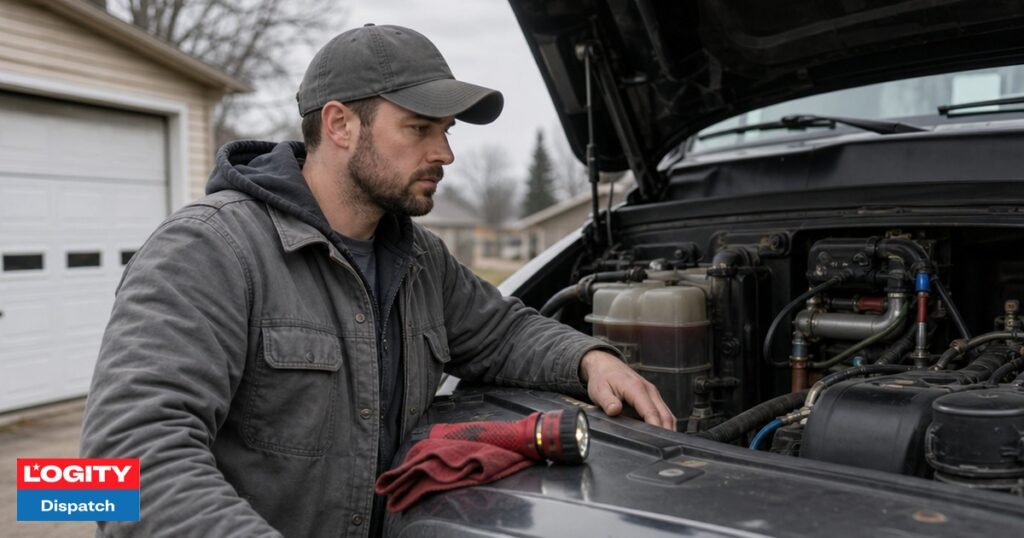
If two or three baselines drift in the same direction over the same couple of weeks, the operator stops at the next available yard with shop access and looks at the truck with a different posture than the routine PM. Not the calendar work – that’s separate. This is targeted, signal-driven. Pull the fuel filter and look at it. Check boost lines for evidence of seepage. Pressure-test the trailer tires. Listen to the engine cold-start and on cold-cycle versus warm. Read the ECM data for any pending faults that haven’t tripped a dash light yet.
Most of the time the targeted look produces nothing definitive. The operator finds a slightly clogged filter that wouldn’t have been changed for another two thousand miles. He swaps it, watches the numbers for the next week, and the baseline returns. Sometimes the targeted look produces something more – a fuel line starting to weep, a turbo stage with measurable shaft play, a sensor reading just outside spec. The repair lands as a planned event in a yard rather than as a roadside problem 380 miles from home at 9 PM Wednesday.
The version where the signal was real
Operators who read the truck this way usually catch one or two events a year that would otherwise have become roadside problems. The cost difference between a planned shop visit and an unplanned one is usually substantial – sometimes a multiple. The operator never knows for sure whether the truck would have failed if the signal had been ignored. He knows the repair landed cheaper because the signal was caught early.
The version where it was noise
Most weeks the signal turns out to be noise. The MPG drift was weather. The idle creep was a longer dwell at one receiver. The regen cycle was a cold morning. The operator looked, found nothing, and moved on. The cost of having looked is a couple of hours and a small filter expense. The cost of not having looked, in the version where the signal had been real, would have been an order of magnitude higher.
The discipline isn’t being right about every signal. It’s checking the convergent ones reliably enough that the real signals don’t get missed.
What signal-reading actually requires
The capacity to read the truck this way isn’t a skill the operator picked up in school. It’s the byproduct of years of repetition with the same equipment and the same routing, plus the attention bandwidth to actually notice the deviations as they happen. The bandwidth is the part most operators run short on. A driver who is also handling the dispatch – load-board scrolling, broker negotiations, follow-up calls, paperwork – has less attention left for the truck’s behavior than a driver whose dispatch friction is being handled by someone else. The signals are still there. They’re just harder to register against the cognitive load of running the rest of the operation.
The trade most operators are making – between attention spent on freight management and attention left for the truck – is one of the quieter ones in the operating system. A desk that handles the dispatch side doesn’t make the operator better at reading the truck. It returns the attention bandwidth that the reading already requires. The signals were always there. The operator who has the bandwidth to notice them is the operator who catches the drift before it becomes a roadside event.