Table of Content
- What Does a Semi Truck Lease Payment Actually Depend On?
- What Is the Real Cost of Running the Truck the Lease Sits Inside?
- How Do You Convert a Lease Quote Into Cost Per Mile?
- What Down Payment Should You Expect on a Semi Truck Lease?
- Is Leasing or Buying Better in the 2026 Market?
- Which Class of Truck Are You Actually Leasing?
- What Should You Ask a Lessor Before You Sign?
Short answer
There is no national price for a semi-truck lease — quotes swing on truck age, term, mileage cap and your credit. What is fixed is the test: a lease works only if the payment per mile leaves room inside your total cost per mile, which ATRI measured at $2.336 in 2025 and which diesel has pushed higher since.
Every page that answers this question with a single monthly range is guessing, including the version of this page you may have read before. Lease quotes are built from four inputs, and three of them are public. This page gives you those three with the date they were measured, the arithmetic that turns any quote into a number you can compare, and the threshold a quote has to clear before it is worth signing.
What Does a Semi Truck Lease Payment Actually Depend On?
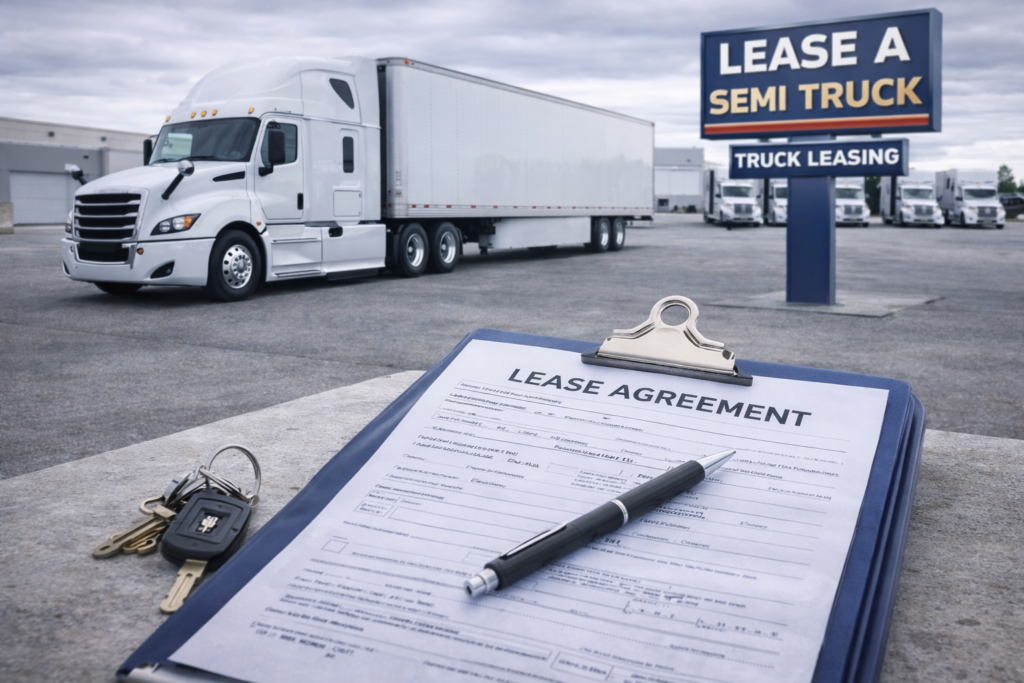
A lease payment is the truck’s price, minus its residual value at the end of the term, spread across the term, plus finance cost and whatever services are bundled in. Change any one and the payment moves:
- Equipment price. A three-year-old sleeper and a new one are different loans wearing the same word.
- Term. The same truck over 36 months and 60 months produces two very different payments and two very different total costs.
- Residual. A full-payout lease and a fair-market-value lease with a balloon are not comparable on monthly payment alone.
- Finance cost. Equipment quotes are priced off a benchmark. The Federal Reserve’s H.15 release put the bank prime loan rate at 6.75% and the effective federal funds rate at 3.63% for the week through 27.08.2026. A lessor’s rate to an owner-operator sits above prime, and how far above is a credit question.
- Mileage cap and maintenance. A bundled maintenance lease costs more per month and less per breakdown. A mileage cap you exceed converts into a per-mile penalty at the end.
Full-payout lease
A lease structured so the payments cover the equipment’s full cost over the term, leaving a nominal buyout — economically a purchase loan. A fair-market-value lease covers only part of the cost and ends with a market-price buyout or a return, which lowers the monthly payment and removes the equity.
What Is the Real Cost of Running the Truck the Lease Sits Inside?
This is the number that decides whether a lease payment is affordable, and it is measured rather than guessed. The American Transportation Research Institute released the 2026 Analysis of the Operational Costs of Trucking on 15.07.2026, covering the 2025 data year:
| Measure | 2025 | Change on 2024 |
|---|---|---|
| Industry-average cost to operate a truck | $2.336 per mile | +3.4% — highest in the report’s history |
| Same, excluding fuel | $1.854 per mile | +4.2% |
| Tolls | — | +13.2% |
| Repair and maintenance | — | +8.6% |
| Driver benefits | — | +6.6% |
| Tires | — | +6.4% |
Source: ATRI press release, 15.07.2026. Only two line items rose at sub-inflationary rates in 2025 — fuel, and for the second year running, driver pay.
The fuel line is where 2025 data stops describing 2026. ATRI’s fuel cost works out to $0.482 per mile ($2.336 minus $1.854). Since that data year, the pump has moved: the US average on-highway diesel price was $5.652 per gallon in the week ending 24.08.2026, against $3.708 in the same week of 2025 (US Energy Information Administration, both figures read 30.08.2026).
At an illustrative 6.5 mpg — your figure, not a measured industry average — that is $0.87 per mile in fuel today against $0.57 a year ago. Substituting it into ATRI’s structure puts the all-in cost near $2.72 per mile as of 30.08.2026, with every non-fuel line also up. Run your own mpg through the same arithmetic before you use this number for anything.
How Do You Convert a Lease Quote Into Cost Per Mile?
One division, and it is the only way two quotes become comparable:
Monthly payment ÷ monthly miles = equipment cost per mile.
A quote of $2,200 per month against 9,000 miles a month is $0.244 per mile. The same $2,200 against 6,000 miles is $0.367 per mile — the same lease, half again as expensive, because the truck sat. This is why a lease that works for a driver running long lanes fails for one running regional.
Then do it again with everything the lease bundles or excludes. A maintenance-inclusive lease at $2,600 is cheaper than a bare lease at $2,200 if your repair and maintenance line runs above $400 a month — and ATRI measured repair and maintenance rising 8.6% in 2025, faster than every line except tolls.
What Down Payment Should You Expect on a Semi Truck Lease?
Lessors set this against credit, time in business and the equipment, and no public source publishes a national figure — we could not verify one, so this page does not print one. What we can tell you is what the down payment is doing in the deal, which is the part that changes your decision.
A down payment reduces the financed amount, so it reduces every subsequent monthly payment and the total finance cost. It is also the least recoverable money in the transaction: on a fair-market-value lease you do not get it back and it buys you no equity. Ask the lessor for the same deal quoted at two different down payments and compare the total of payments, not the monthly. If the total barely moves, the down payment is buying approval, not price.
Is Leasing or Buying Better in the 2026 Market?
The market conditions ATRI measured argue for flexibility over commitment, and it is worth being precise about why.
Carriers cut freight capacity in 2025 by the largest amount since the freight recession began in 2022 — truck counts down 2.4%, with a further 10% of trucks unseated on average. Average truck age and annual mileage both rose, and non-driver staffing was cut 7.8%. Profitability stayed poor: operating margins in truckload and refrigerated improved slightly but stayed below 1.0%, tank carriers averaged 4.0%, and flatbed carriers ran an average operating loss of −0.5%. Only LTL and fleets over 1,000 trucks held healthy margins.
One line from that report matters directly to this decision: small fleets spent less on trucks and trailers in 2025 than in 2024, while truckload fleets with more than 1,000 trucks spent 16.1% more. Large fleets bought into the downturn. Small operators did not, and the equipment they are running is therefore older.
Read against that, the case for leasing is that it keeps capital free and caps your exposure to a truck you may not want in 24 months. The case for buying is that a lease payment is fixed while freight is not, and ATRI’s margin figures show how little room there is to absorb a fixed payment through a soft quarter. Neither is right in general. Both resolve to the same test: what the payment costs per mile at the miles you will actually run.
Which Class of Truck Are You Actually Leasing?
The queries that reach this page mix three different pieces of equipment, and they do not price alike.
| Equipment | What it is | Payment driver |
|---|---|---|
| Day cab tractor | Class 8 tractor, no sleeper | Lowest equipment price of the three; regional and drayage work, lower annual miles |
| Sleeper tractor | Class 8 tractor with sleeper berth | Highest equipment price; long-haul miles spread the payment thinnest |
| Tractor–trailer / 18-wheeler | Tractor plus a trailer | Two pieces of equipment, often two agreements; a trailer lease is a separate and much smaller line |
If a quote seems far below what you expected, check whether it covers the trailer. “18-wheeler” and “tractor” are the same word to a search engine and different line items to a lessor.
What Should You Ask a Lessor Before You Sign?
- Is this a full-payout lease or a fair-market-value lease, and what is the buyout at the end?
- What is the total of all payments over the term, including the down payment?
- What is the annual mileage cap and the per-mile charge above it?
- What is included in maintenance, and what is specifically excluded?
- What is the early termination charge, in dollars, at month 12 and at month 24?
- Is the interest rate fixed for the term, and what is it, stated as a rate rather than a payment?
Question two is the one that separates comparable offers. A lower monthly payment over a longer term routinely costs more in total, and the monthly figure is the only one most quotes lead with.
How much does it cost to lease an 18 wheeler?
No national figure exists — the payment is set by equipment price, term, residual, finance rate and mileage cap, and quotes for an 18-wheeler often cover the tractor only. Divide any quote by your monthly miles to get cost per mile, then check it against your all-in operating cost.
How much down payment do you need to lease a semi truck?
Lessors set it individually against credit, time in business and the equipment, and no public source publishes a national figure. Ask for the same deal at two down payments and compare the total of all payments — if the total barely changes, the down payment is buying approval rather than a better price.
What is the average semi truck lease payment?
There is no verified national average. What is measured is the cost the payment has to fit inside: ATRI put the industry-average cost to operate a truck at $2.336 per mile in 2025, and diesel has risen since. Convert your quote to cost per mile before comparing it to anything.
How much does it cost to lease a sleeper truck?
A sleeper tractor carries the highest equipment price of the common configurations, so it produces the highest payment — but it is normally run at the highest annual mileage, which spreads that payment across more miles. Judge it per mile, not per month.
What is the difference between renting and leasing a semi truck?
A rental is short-term, priced daily or weekly, with no buyout and no long commitment. A lease runs for a fixed term of typically 36 to 60 months, has a defined end position — return, buyout or balloon — and is underwritten against your credit.
Written by Alex Morgan, Logity Dispatch. Figures as of 30.08.2026. Operating cost data: American Transportation Research Institute, 2026 Analysis of the Operational Costs of Trucking, released 15.07.2026 (2025 data year). Diesel: US Energy Information Administration, week ending 24.08.2026. Interest rates: Federal Reserve H.15, week through 27.08.2026. Where a figure could not be verified from a public source — lease payments and down payments — this page says so rather than estimating.