Table of Content
- The Hidden Math of “Saving Money”
- The Real Cost of DIY Load Finding
- Case Study – The $1,200 Shift
- What You’re Actually Buying with a Dispatch Service
- The Financial Breakdown (DIY vs. Dispatch)
- The 3 Biggest Fears About Dispatch Services (And Why They’re Myths)
- How to Test the Waters Without Risk
- Your Wheel, Their Screen
The Hidden Math of “Saving Money”
“You saved $300 on dispatch fees this week – which feels like a smart financial move for an owner-operator trying to cut costs. But what if that ‘savings’ quietly cost you $1,200 in lost revenue because you spent 15 hours finding loads instead of driving?
Most owner-operators don’t look at it that way. Dispatch is often treated as an optional expense – something you can handle yourself as long as load boards are open, phones work, and you’ve got experience under your belt. And to be fair, many drivers can find loads on their own. That’s not the issue.
In our latest article, How to Vet Freight Partners: Red Flags Every Owner-Operator Should Know, we walked through how to identify risky brokers and avoid obvious scams when you’re handling vetting yourself. And today we are answering a more uncomfortable question:
why spending 10-15 hours a week finding, vetting, and negotiating loads yourself may be one of the biggest hidden costs in your operation.
Because when you break it down honestly, you’re not just finding loads. You’re doing sales, negotiation, risk assessment, paperwork, and follow-ups. Every hour spent on those tasks is an hour your truck isn’t moving – and an hour it isn’t producing revenue.
You became an owner-operator to drive, not to sit parked refreshing load boards, chasing brokers, or second-guessing rate confirmations. Yet that’s exactly where many otherwise profitable operators leak time, energy, and money.
This article breaks down the real economics behind using a dispatch service for owner operators – not the marketing pitch, but the math. We’ll show why trying to “save” on dispatch often costs far more than it saves, and why experienced drivers eventually decide to stop finding their own loads, not to work less, but to earn more consistently.
The Real Cost of DIY Load Finding
The 15-Hour Workweek (You Didn’t Sign Up For)
Let’s start with a realistic time audit – not best-case, not worst-case. Just average.
For most owner-operators running spot freight, finding a single load isn’t a five-minute task. Between scanning load boards, vetting brokers, negotiating rates, and confirming details, each load typically takes two to three hours to lock in properly. Multiply that by three to four loads per week, and you’re already looking at nine to twelve hours gone before the truck even moves.
And that’s only the visible part of the work.
Once the load is booked, the “invisible” tasks start stacking up. Rate confirmations need to be reviewed and signed. Insurance documents get requested. Brokers follow up – or don’t, forcing you to chase them. Payments get delayed, disputes drag out, and factoring companies need updates. Your phone keeps buzzing with emails, texts, and “just checking in” calls that break up your day and your focus.
Very quickly, that time audit stretches past the initial estimate. What started as nine or ten hours quietly becomes fifteen or more hours every single week.
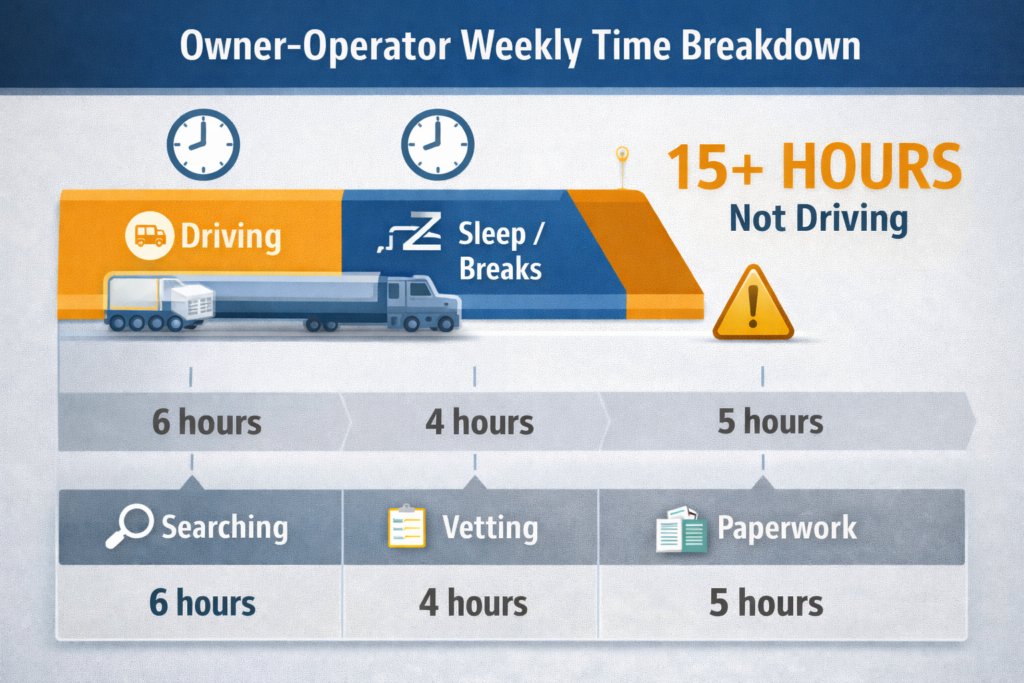
That’s fifteen hours you’re not driving.
Fifteen hours your truck is sitting.
Fifteen hours you never planned for when you bought the truck and decided to run your own operation.
The Opportunity Cost Formula Most Drivers Ignore
This is where the math changes everything. This opportunity cost for truck drivers is rarely calculated, but once you see the real hourly rate of DIY load searching, the decision becomes clear.
Take a conservative, realistic example. Let’s say your truck grosses $4,000 in a week. Between driving and administrative work, you’re putting in about 70 total hours. When you divide revenue by actual time worked, your real hourly rate isn’t your CPM. It’s closer to $57 an hour.
Now look at those fifteen hours again – the hours spent finding and vetting loads instead of driving.
Every one of those hours carries a $57 opportunity cost. Over the course of a week, that adds up to roughly $855. Not because you did something wrong, but because that time couldn’t be spent producing revenue. This is also why relying entirely on load boards often feels productive on the surface but inefficient over time. We break that tradeoff down in detail in our comparison of load boards vs dispatch, including where DIY sourcing quietly erodes both time and margins.
And that’s before you factor in the secondary effects most drivers recognize immediately: missing better-paying lanes because you ran out of time to search, deadhead miles caused by rushed load sequencing, loads declined simply because you were too tired to evaluate them properly, and decisions made at the end of long days when judgment is already worn thin.
The Mental Load Nobody Prices In
There’s also a cost no spreadsheet captures.
When you handle everything yourself, the work never really stops. There’s the constant low-level phone anxiety, the feeling that you can’t fully disconnect even when you’re home. There’s decision fatigue at the end of long driving days, when one more call or rate decision feels heavier than it should. And there’s the ongoing stress of wondering whether a broker will pay on time – or at all.
This is why so many drivers feel busy but not productive. The days are full, the weeks are packed, yet the results don’t always reflect the effort. They’re working in the business every hour, reacting to tasks as they come up, but rarely working on it in a way that creates leverage.
And this is where the question quietly shifts.
It’s no longer just “How do I save money?”
It becomes: how to save time as truck driver – and turn that time into revenue instead of stress?
Case Study – The $1,200 Shift
From Broker Dialer to Highway Driver
This scenario will feel familiar.
You run one truck. You know how to find loads, negotiate rates, and manage paperwork. You value independence and you don’t like unnecessary middlemen.
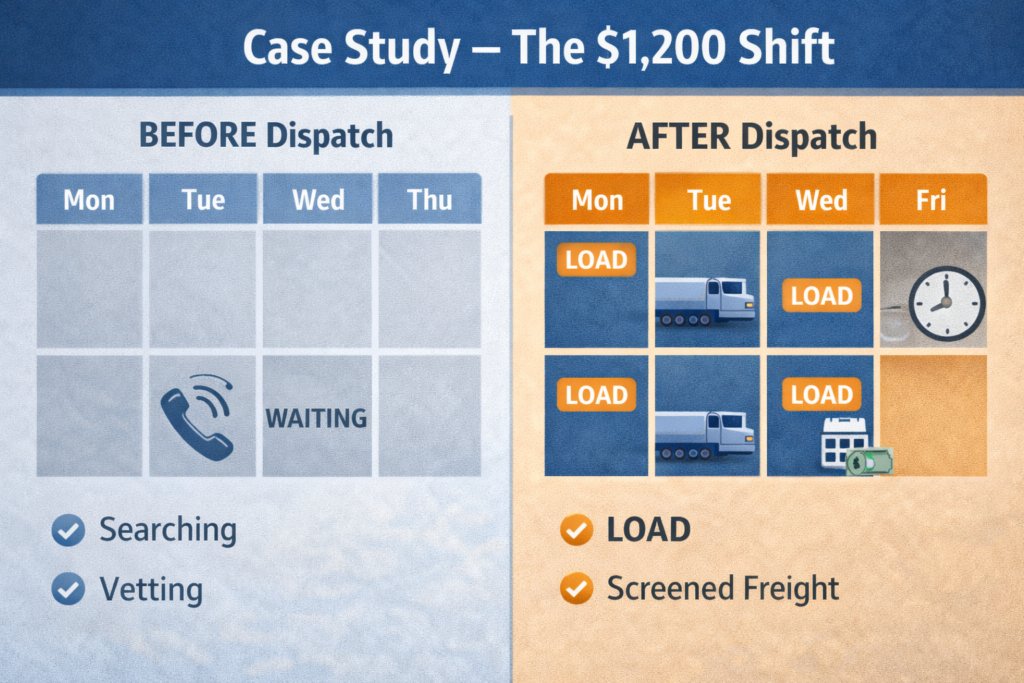
Before dispatch, you spend about 15 hours per week finding and vetting loads. You average three loads per week, each paying around $1,200, for a weekly gross of $3,600. There are no dispatch fees, and every decision stays in your hands.
On paper, that looks fine.
In reality, the week rarely runs clean. Mondays start slow while you search. Fridays feel rushed. The truck sits longer than it should, and you’re often choosing between an “okay” load now or waiting and hoping something better appears.
When dispatch enters the picture, the structure of the week changes.
Instead of spending hours searching and negotiating, you spend about two hours per week reviewing and approving loads. The dispatcher handles sourcing, vetting, and negotiation. With better sequencing, you average four loads per week at the same $1,200 per load, pushing weekly gross to $4,800.
The numbers make it clear. Revenue increases by $1,200 per week. After a typical $300 dispatch fee, the net gain is $900, along with 13 hours reclaimed.
Nothing magical happened. No secret lanes. No new equipment. Just better use of time.
That’s the practical answer to the question is a truck dispatcher worth it – not emotionally, but economically.
“Most drivers tell us the same thing after a few weeks: ‘I didn’t realize how much time I was spending just trying not to make a bad decision.’”
If this math looks familiar, it’s because most owner-operators already feel it – they just haven’t put numbers to it.
Want to see what this would look like using your last 30 days? Try us with one load – CLICK HERE.
What You’re Actually Buying with a Dispatch Service
Beyond Load Boards: The 4 Things Dispatchers Actually Do
Many drivers assume dispatch means someone else scrolling the same load boards. That’s not what a real dispatch service for owner operators does.
The difference isn’t convenience – it’s leverage. A professional freight dispatcher does more than just search load boards – they provide market access, broker vetting, and rate negotiation that most independent drivers can’t match alone.
Dispatch operates with established broker relationships, repeat lanes, and pricing context built over time. You negotiate as one truck. Dispatch negotiates as a network.
Vetting is systematic, not hopeful. Carrier411 reports, TIA watchlists, and payment history databases are checked to reduce exposure to non-payment, last-minute cancellations, and rate changes after pickup.
Negotiation improves with repetition. Dispatchers know which lanes are paying this week, when to push, and when to walk away. They negotiate fresh, not between drives.
Paperwork doesn’t disappear either. Rate confirmations, broker communication, payment follow-ups, and disputes are handled end-to-end.
That alone answers how to save time as truck driver better than any productivity hack ever will.
Learn how this works in detail: CLICK HERE
The Myth of Losing Control
You still approve every load. You see every rate. You set lanes, minimums, regions, and equipment preferences. Dispatch executes inside those boundaries.
You don’t lose control. You lose busywork.
The Financial Breakdown (DIY vs. Dispatch)
The Calculator That Changed Our Clients’ Minds
Let’s put emotion aside and compare outcomes.

This isn’t theoretical.
This is why operators who ask “Should I stop finding my own loads?” often answer their own question once they see the math.
The 3 Biggest Fears About Dispatch Services (And Why They’re Myths)
What’s Really Holding You Back
The first fear is control. In reality, dispatch adds strategic control by removing execution noise.
The second fear is incentive misalignment. But bad loads lose clients. One bad load can undo weeks of trust. Long-term relationships matter more than quick fees.
The third fear is cost. If dispatch finds one extra load per month that covers the fee, everything else is profit. Most operators see ROI in the first week.
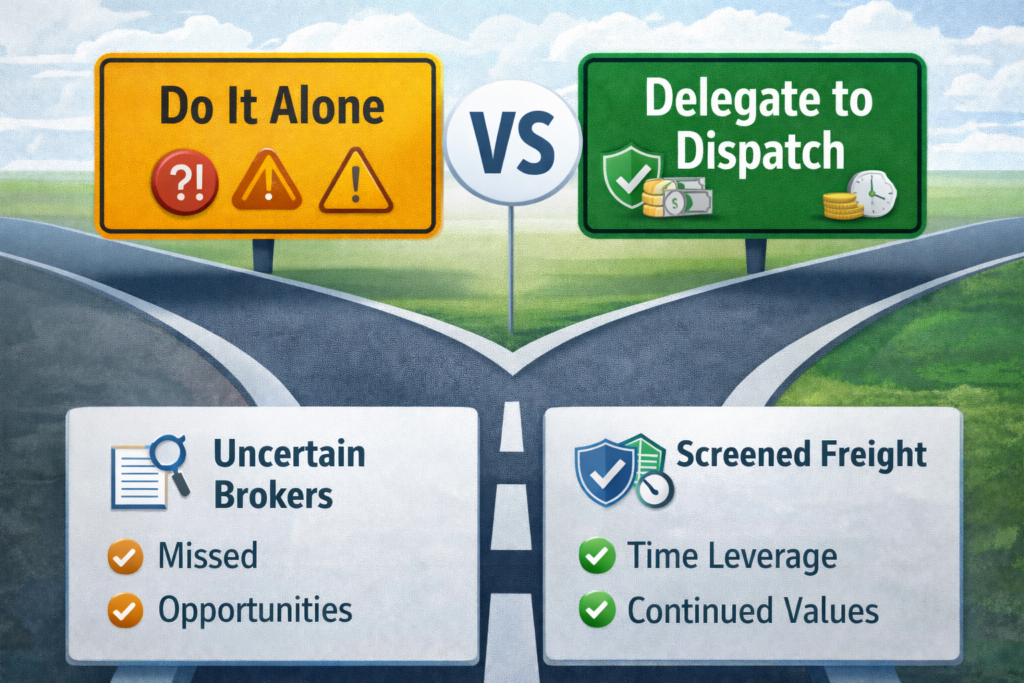
That’s why the real question isn’t is a truck dispatcher worth it – it’s how long you can afford to keep absorbing the cost of doing everything yourself.
How to Test the Waters Without Risk
Your First Step: The 1-Load Experiment
You don’t need to commit blindly.
Track a normal week. Note hours spent, loads booked, and revenue earned. Then try dispatch with one load in a lane you already know. Compare the rate, and compare the time spent.
The difference becomes clear quickly.
Try us with one load. If we don’t beat what you could have found yourself – after our fee – the next week is on us.
Your Wheel, Their Screen
Time to Choose Your Focus
For owner-operators wondering how to increase weekly revenue without adding more miles, the answer often lies in delegating load finding to a professional dispatch service. You didn’t become an owner-operator to be a full-time salesperson, accountant, and risk analyst.
Right now, you’re trading 15 hours a week for the illusion of savings. In reality, those hours could be converted into $1,000+ in additional weekly revenue.
That’s what a dispatch service for owner operators really offers: not convenience, but leverage.
Ready to stop searching and start driving? See how a dedicated dispatch service for small fleets and single trucks can turn your wasted hours into real revenue. – Click HERE
Common Questions from Owner-Operators Like You
Answers you need before choosing a dispatch service.
Can a dispatch service really help a one-truck operation?
Absolutely. Most of our clients run solo. Dispatch scales to your size – the leverage comes from our network, not your fleet size.
Will I lose control over which loads I run?
No. You set your minimum rates, preferred lanes, home time, and equipment specs. We present options – you approve every load.
How quickly will I see a return on investment?
Most cover our fee with one extra load per month. Many see ROI in the first week from time saved and better-loaded miles.
What if I already have broker relationships?
We’ll work with them. Good dispatch strengthens your existing connections – we don’t replace them.
Do you work with specialized equipment (flatbed, reefer, etc.)?
Yes. We match freight to your rig – not the other way around.
How do I know you’ll find better loads than I can?
Try the 1-Load Experiment. If we don’t beat what you’d find yourself (after our fee), the next week is on us.