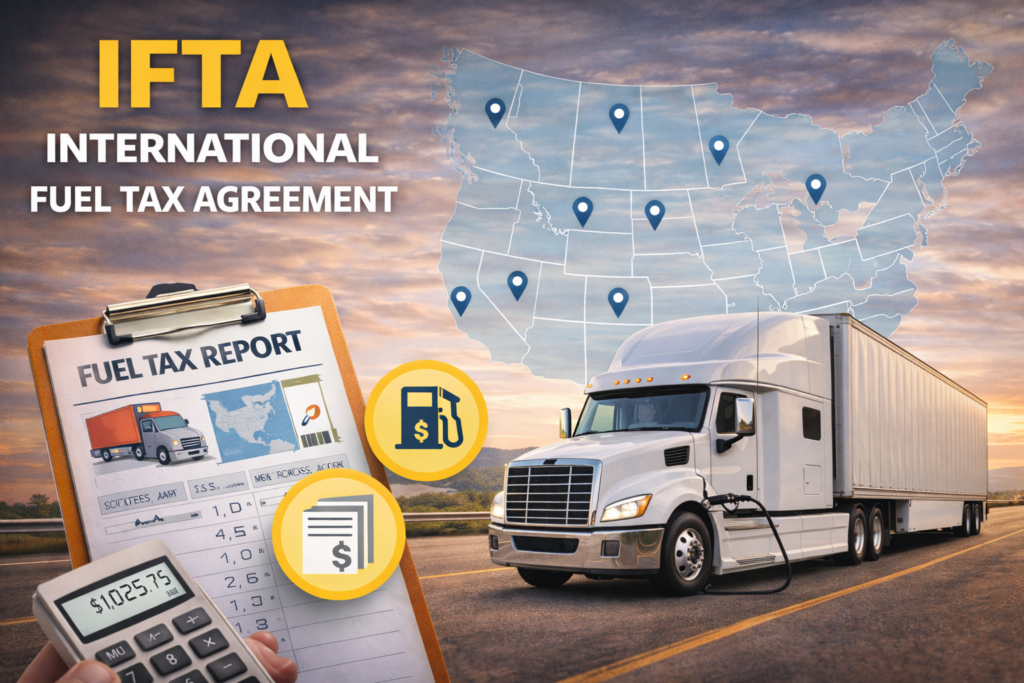
IFTA (International Fuel Tax Agreement) is a system that helps trucking companies and owner-operators report and pay fuel taxes correctly when they run in more than one state. Instead of filing separate fuel tax reports everywhere you travel, IFTA lets you file one quarterly report through your base state, and the taxes get distributed to the right jurisdictions.
If you operate a qualified truck across state lines, understanding IFTA is important — not just to stay compliant, but to avoid fines, audits, and paperwork problems that can slow down your business.
For those engaged in the transportation industry, understanding “What is IFTA for trucking?” is crucial. IFTA for trucking serves as a fundamental tool, streamlining the reporting and payment processes for fuel taxes when traversing different states.
To partake in this agreement, truckers necessitate an IFTA fuel tax license. This license is the key to compliance with IFTA regulations, enabling truckers to report and pay their fuel taxes to a single base jurisdiction. This base jurisdiction then effectively distributes the funds to the appropriate states or provinces. So, What is an IFTA fuel tax license? It is the authorization that empowers truckers to adhere to IFTA regulations and efficiently manage their fuel tax responsibilities.
In the past, the payment of fuel taxes was a time-consuming task, compelling truckers to halt at a port of entry to procure a permit. The revenues generated through IFTA play a pivotal role in upkeeping the roadways essential to everyone. Given that heavy commercial vehicles significantly contribute to wear and tear on these roads, IFTA ensures a just system for collecting funds to support road maintenance.
What are the Reporting Periods?
Licensees under the fuel tax agreement are obligated to submit reports on a quarterly basis. The reporting periods are as follows:
- January to March (Reports due by April 30)
- April to June (Reports due by July 31)
- July to September (Reports due by October 31)
- October to December (Reports due by January 31)
The Advantages of IFTA for Drivers
It’s safe to say that not many truck drivers entered the profession due to a passion for paperwork. Thanks to the International Fuel Tax Agreement (IFTA), drivers can now breathe a sigh of relief as it significantly reduces the burden of tax-related paperwork. This translates to time savings, improved compliance, and a reduction in errors.
Before the implementation of IFTA, truckers and trucking companies faced the challenge of dealing with multiple jurisdictions to fulfill fuel tax obligations. The regulations in different regions often contradicted each other, leading to stress for everyone involved. Truckers had to acquire fuel tax licenses for every state they traversed. The transition to a single permit simplified their paperwork considerably.
In addition to the time saved and simplified paperwork, IFTA brings financial benefits. Compared to the varying durations of temporary permits and the fragmented process of obtaining them, the cost could quickly surpass that of paying the fee charged by one’s home state for a fuel tax license.
How Does it Work?
To comply with the International Fuel Tax Agreement (IFTA), drivers must diligently record both their fuel consumption and the distance covered in each applicable jurisdiction, including states, territories, and provinces. Quarterly, businesses submit reports based on this information, and the resulting tax revenue is distributed among the participating jurisdictions.
This arrangement benefits member jurisdictions by ensuring sufficient funds for the maintenance of roads heavily used by commercial vehicles.
Annual license renewal is a requisite, and quarterly reports must be submitted, even if operations were exclusively within the home state.
It’s crucial to note that IFTA pertains not to individual drivers but to the trucks or power units they operate.
Understanding IFTA Requirements
To comply with the International Fuel Tax Agreement (IFTA), the initial step involves completing an application. This application process is initiated through your base jurisdiction or base state. It is applicable to owners or operators of a Qualified Motor Vehicle (QMV) engaged in travel between two or more jurisdictions in the United States or Canada. QMVs are characterized by having two axles with a gross vehicle weight exceeding 26,000 lbs, possessing three or more axles, or a combination of both.
Subsequently, it is imperative to affix an official IFTA decal or sticker to your truck at all times. Compliance also entails the submission of a completed report every 90 days, coupled with the timely payment of all IFTA taxes due.
Ensuring the accuracy and accessibility of your historical records is crucial. IFTA mandates that drivers maintain all fuel tax records for a minimum of four years. Your office should have these records readily available, and you must grant DMV auditors access to your records upon their request.
What Vehicles are Covered?
Tracking mileage for the fuel tax agreement is commonly achieved through two methods: smartphone apps and trip sheets. The use of smartphone apps is widespread and relatively straightforward for many qualified motor vehicle operators. Despite the simplicity, it’s crucial to input comprehensive information due to the intricacies involved.
Trip sheets, on the other hand, hearken back to the bygone era of long-haul trucking, living up to their name as drivers manually enter information into designated fields. In acknowledgment of the 21st century, there’s now an electronic version available. Whether in paper or digital form, trip sheets inherently pose a higher risk of errors compared to modern methods that automate the final calculations, relieving drivers of that responsibility.
T tax data, providing a time-saving tool for both drivers and back-office personnel.
Potential Consequences for a License in the Worst-Case Scenario
Beyond financial penalties, IFTA members face the risk of losing their fuel tax agreement license under certain circumstances. License revocation typically occurs for failure to pay taxes, neglecting to file fuel tax reports, or non-compliance with the record-keeping requirements outlined in the agreement.
In such situations, leveraging technology becomes invaluable to maintain operational order. A reliable fleet management solution proves especially beneficial when precision and efficiency are paramount.
Losing your IFTA license can create bigger problems than a penalty — it can lead to delays, compliance stress, and downtime when you’re trying to stay on the road and keep revenue consistent. That’s why keeping clean records and filing on time matters.
If you’re also trying to stay compliant on the road, understanding DOT rules like HOS can help you avoid costly mistakes.
How to Drive More and Manage Paperwork Less?
IFTA paperwork can feel overwhelming — especially when you’re running multiple states and trying to stay focused on loads, appointments, and profit.
Logity Dispatch helps owner-operators stay organized on the road by supporting load planning, scheduling, and communication — so compliance tasks don’t turn into last-minute stress. If you’re trying to run more efficiently and keep your week moving, our team can help you build a smoother routine around the work.
Want to spend less time chasing paperwork and more time driving? Talk to Logity Dispatch.