Not all truck driving jobs are built the same. Choosing between OTR, regional, local, or dedicated trucking affects:
- Income potential
- Home time
- Fatigue levels
- Compliance risk
- Reload timing
- Long-term profitability
This isn’t just a lifestyle decision. It’s an operational structure decision. Before choosing a lane style, understand what each one actually demands.
What is OTR in trucking?
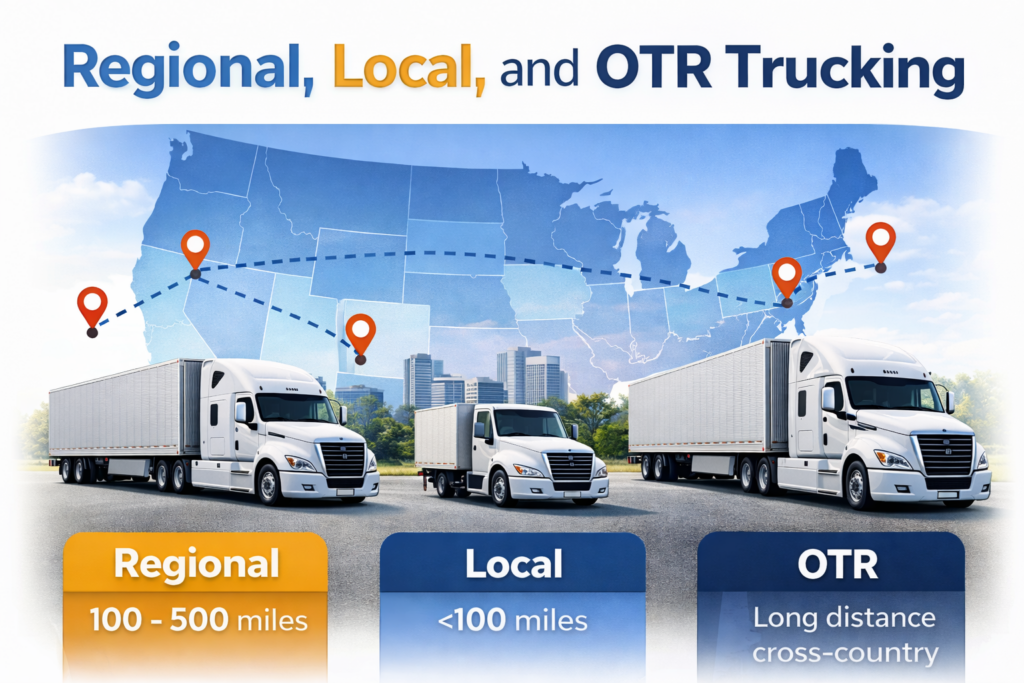
What is the meaning of OTR trucks? It is an abbreviation for “over the road,” which describes truck drivers who transport freight over extensive distances and spend three to four weeks at a time away from home. OTR truck drivers are required to travel across the whole of the United States and Canada. OTR truck drivers are responsible for transporting a wide variety of goods, including large freight, machinery, building materials, and other forms of equipment.
OTR (Over-the-Road) drivers operate long-haul routes across multiple states – often coast-to-coast.
Typical OTR structure:
- 2-4 weeks on the road
- Multi-state or cross-border freight
- Higher weekly mileage
- Longer reset cycles
OTR drivers commonly haul:
- Dry van freight
- Refrigerated loads
- Flatbed machinery
- Contract freight across large regions
OTR Advantages
Higher Gross Potential
More miles = more revenue opportunity. Experienced OTR drivers often out-earn local drivers.
Freight Diversity
Access to broader freight markets reduces dependency on one region.
Capacity Stability
National demand protects against regional slowdowns.
OTR Challenges
Extended Time Away From Home
2–4 weeks out is common.
Schedule Variability
Freight cycles and HOS pressure can create inconsistent weekly patterns.
If OTR loads are poorly sequenced, strong miles still result in unstable weeks. (See: Why Good Loads Still Don’t Mean Good Weeks)
What does regional truck driving mean?
The region of the nation across which a truck driver transports products and resources is referred to as “regional trucking.” It is often divided into parts such as the Northeast and the Midwest and is typically contained within a radius of one thousand miles. Both over-the-road (OTR) and regional truck drivers follow a schedule that is essentially the same. After being on the road for a certain period of time, drivers return to their homes for a predetermined amount of time, which is determined by the guidelines given out by their employers. The fact that regional truck driver days often fall on weekends is one of the primary reasons why people choose this kind of route over OTR.
Regional trucking operates within a defined multi-state area – typically within 500-1,000 miles.
Examples:
- Midwest loop
- Southeast regional freight
- Northeast corridor
Regional drivers usually:
- Return home weekly
- Run predictable corridors
- Operate consistent shipper lanes
Regional Advantages
Weekly Home Time
Balanced lifestyle compared to OTR.
Market Familiarity
Knowing brokers and shippers improves negotiation leverage.
Reload Efficiency
Familiar lanes reduce deadhead risk.
Regional Limitations
Lower Mileage Than OTR
Less distance can mean lower gross — unless rate-per-mile is strong.
Market Exposure
If the region slows, freight tightens quickly.
Strong regional structure requires careful lane planning to avoid revenue volatility.
What is local truck driving?
Trucking locally means that the driver may be at home with their family every night, which is a significant perk for those who have a family. The routes are local, and the normal work day lasts between 8 and 10 hours and covers a radius of less than 200 miles. Due to the nature of the profession, local trucking might be more challenging than over-the-road (OTR) trucking or regional trucking. Because you will need to be able to navigate smaller roads on a regular basis rather than the highway, as well as, backing into tight loading docks multiple times a day, many local truck driving companies require that applicants have at least one year of CDL driving experience. If you are interested in the local trucking, you can find more information here.
Advantages of Local Driving
- Home Every Night: You get to spend every night with your family after a long day on the road because you get to park your rig and go home. Individuals with families, as well as those who are unable or unable to spend time away from home, are ideal candidates for local trucking jobs.
- Set Routine: Your path will almost always be the same from week to week. This ensures that your daily routine and workplace will remain consistent. Because you will be a regular customer at the businesses along your route, you will have the opportunity to develop cordial relationships with their staff.
Disadvantages to Local Driving
- Lower Pay: OTR drivers often bring in much more money than local truckers. Although a local truck driver may expect to make $45,000 per year on average, it will take some time before they reach that level of pay.
- Harder to Find a Job: Local truck driver opportunities are far more difficult to come by compared to over-the-road employment opportunities. As a result, you may first need to put in some time doing some over-the-road driving before you can secure a local contract.
What is a Dedicated Route?
When a trucking firm frequently provides service to the same company or area, this is known as a dedicated route. The majority of the time, a truck driver will pick up cargo from a consistent spot, and then drive it to a certain customer’s address to drop it off.
Pros of a dedicated route
- Safety: Because drivers often follow the same loads and routes, it might be easier to organize stops, traffic patterns, and general safety.
- Consistency: Drivers may establish rapport with passengers and work to maintain regular appointments or timetables.
- Efficiency: Knowing which routes are the quickest and being able to finish loads more quickly will assist enhance efficiency and increasing mileage revenue.
- Stability: What happens if your carrier’s capacity to win freight is impacted by the spot market? The carrier’s contract with the consumer provides you with security.
Cons of a dedicated route
- Undiversified routes: There are more opportunities for a range of locations and consumers while traveling inside a certain area (for example, the Midwest).
- Fewer miles: Compared to dedicated drivers, non-dedicated drivers have shorter wait times for pickup and delivery. More driving distance translates into less sitting.
You need the appropriate training in order to become a local driver, a regional driver, or an over-the-road (OTR) driver. CDL training and specialized OTR training are also available from truck driving schools. There are CDL schools that provide financial aid to help students afford the cost of tuition, and if you are hired by a trucking firm, that employer could also pay for your training fees. Before deciding on a school, it is important to confirm that the institution in question provides practical training and to inquire as to whether or not graduates are provided support in finding employment.
| Category | OTR | Regional | Local |
|---|---|---|---|
| Home Time | 2–4 weeks | Weekly | Daily |
| Weekly Mileage | High | Moderate | Low |
| Gross Potential | High | Medium | Lower |
| Fatigue Risk | Higher | Moderate | Lower |
| Reload Planning | Complex | Structured | Tight schedule |
| Market Exposure | National | Regional | Local economy |
Compliance and HOS Impact
Regardless of type: All drivers operate under Hours of Service regulations. HOS mismanagement impacts:
- CSA score
- Audit exposure
- Insurance underwriting
If you’re unsure how drive-time limits structure your schedule, review: How Many Hours Can a Truck Driver Drive?
For authority holders, route type influences compliance pressure.
OTR + poor sequencing = HOS stacking risk.
Local + tight schedules = short-haul log issues.
Regional + weather disruptions = adverse condition misuse.
Operational structure determines compliance exposure.
Which Trucking Type Is Best for Owner-Operators?
The “best” type depends on:
- Risk tolerance
- Home-time priority
- Equipment type
- Market knowledge
- Dispatch structure
OTR maximizes reach. Regional balances life and revenue. Local maximizes routine. Dedicated maximizes predictability. But none work without structure.
Final Takeaway: Route Type Is a Business Model
Choosing OTR, regional, or local isn’t about preference.
It’s about:
- Revenue stability
- Load sequencing
- HOS efficiency
- Risk management
- Operational maturity
The most profitable drivers aren’t the ones driving the furthest. They’re the ones running the most structured lanes.
Drive With Structure, Not Guesswork
Logity Dispatch helps owner-operators:
- Plan lane strategy
- Sequence loads efficiently
- Protect HOS windows
- Reduce deadhead
- Improve revenue consistency
Because freight type alone doesn’t determine success. Structure does.
Contact Logity Dispatch to build a route strategy aligned with your goals.