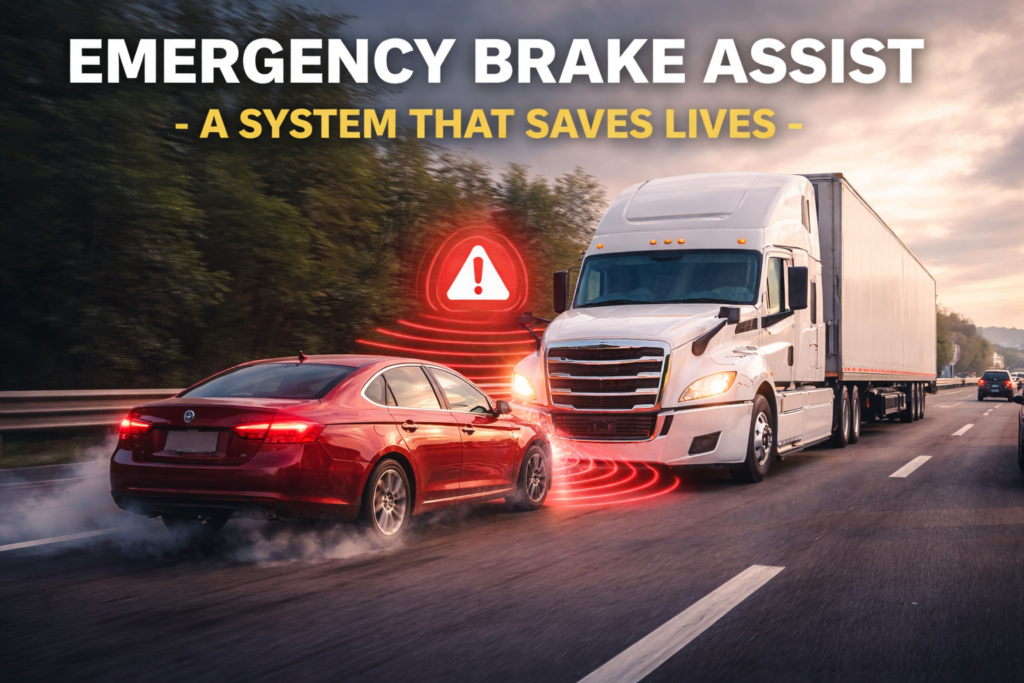
Trucks move nearly 70% of U.S. freight – and carry a proportionate share of road risk.
For carriers and owner-operators, one preventable rear-end collision can mean:
- Insurance premium increases
- CSA score impact
- Legal exposure
- Weeks of downtime
Emergency Brake Assist (EBA) systems are not just safety upgrades – they are operational risk management tools.
What Is Emergency Brake Assist? (Technical Overview)
A braking assist is a device that slows or stops a vehicle without human intervention. This happens when the braking assist detects obstacles on the truck’s path, such as animals, vehicles, and pedestrians. The detection is done by multiple technologies, including LIDAR, radar, cameras, and sensors.
Before the automatic braking assist slows or stops the vehicle, it will warn the driver through an audio or visual signal. In some instances, the automatic assist can add extra power to the braking system after the driver engages the brakes. If the driver doesn’t brake within a specified period, the truck will slow down or stop automatically. Nevertheless, some automatic braking assist systems can stop the car without warning the driver.
The assist mechanism can be placed at the front, side, or rear of the truck. Radar sensors are usually placed at the air vents or bumper while cameras are inside or behind the windshield. The software will then analyze the collected data and identify potential crashes.
Types of Advanced Driver Assistance Systems (ADAS)
Each brake assist system in vehicles uses multiple software and tools to predict and stop truck accidents. Some of the types of automatic brake assist systems are:
- Anti-Lock Braking System: This system can identify sudden braking or skidding by monitoring wheel movement.
- Emergency Brake Assist: This system can increase the braking power during an emergency stop when the applied pressure is insufficient.
- Forward Collision Warning: This system calculates forward collision probability and warns the driver when the collision risk increases.
- Forward Collision Mitigation: This system calculates the vehicle’s situation, applies the brakes, and simultaneously warns the driver.
- Forward Collision-Avoidance: This system employs assisted driving and anti-lock brakes to prevent a crash.
- Reverse Automatic Braking Assist: This system can detect stationary or moving objects behind the car when backing up. It will then alert the driver and may stop the vehicle on its own.
How Brake Assist Reduces Liability Exposure
Installing an automatic braking system has many benefits, such as:f
Avoid Collisions
The automatic braking assist continuously measures the distance between the car and the vehicle in front of it. Once the braking software determines that the vehicle in front is dangerously near the vehicle, it will warn the driver and activate the partial braking assist. This boosts the braking power when the driver steps on the brake pedal. If the driver doesn’t react or the deceleration is not enough, it will automatically slow or stop the car to prevent a collision. Rear-end collisions are among the most common violations reviewed during roadside inspections.
Ease Reversing
Inattention and inability to see objects behind the car can cause collisions and accidents during reversing. An automatic braking assist for a truck can acquire, classify, and track rear objects via its camera sensor. This provides an accurate picture of the truck’s surroundings during backing up.
Prevent Accidents During Turning
A driver needs to know the speed and location of other vehicles and objects when turning the truck. If the driver gets it wrong, the truck may cause an accident. Preventative inspection routines (see our pre-trip brake inspection checklist) also reduce the likelihood of mechanical brake failure. An automatic braking assist can prevent this accident by stopping the truck once it detects a potential collision.
Operational and Financial Impact for Owner-Operators
A collision doesn’t only damage equipment.
It can result in:
- Missed delivery appointments
- Detention penalties
- Insurance claim reviews
- DOT inspection scrutiny
- CSA score deterioration
For owner-operators, that may mean losing preferred broker relationships. Advanced braking systems help reduce those downstream risks – not just the initial crash.
Technology improves safety – but structured operations improve consistency.
Safety Systems Are Only Part of the Strategy
Emergency Brake Assist reduces crash probability.
But safety performance also depends on:
- Structured route planning
- Fatigue management
- Equipment inspections
- Broker selection
- Realistic scheduling
At Logity Dispatch, we work with drivers who understand that profitability and safety are connected. Structured dispatching reduces rushed deliveries, unsafe routing, and operational stress.
Safer operations are more profitable operations.