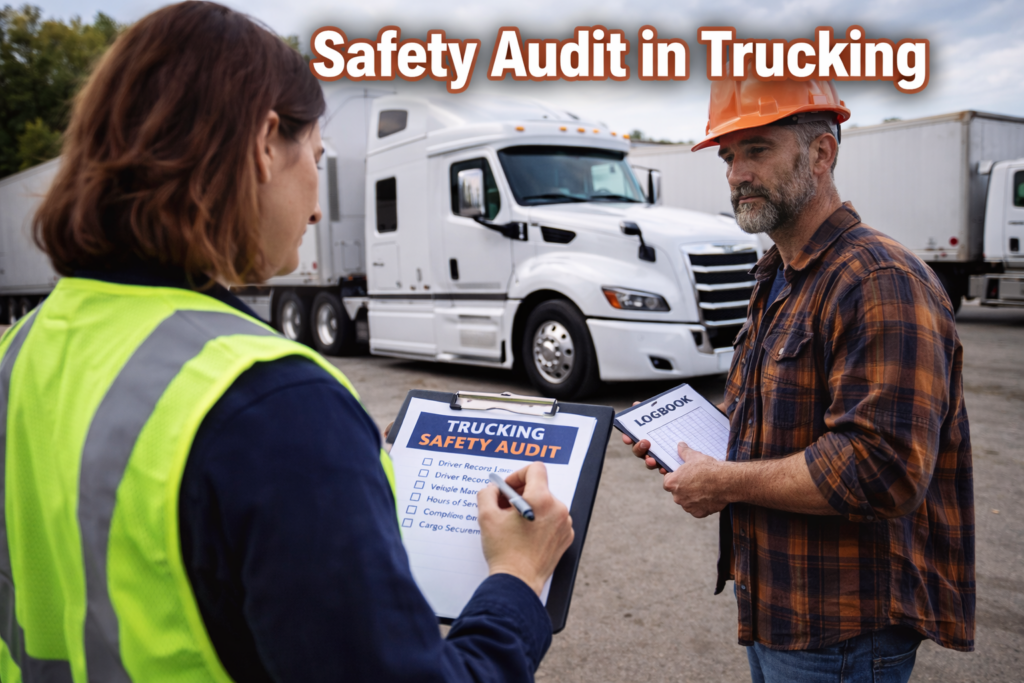
The Safety Inspection and Safety Audit in Trucking
In trucking, safety isn’t just a regulatory requirement – it’s a business survival metric.
The FMCSA safety audit process determines whether a carrier can legally operate, maintain authority, and stay insurable. A failed audit doesn’t just mean paperwork problems. It can mean suspended authority, lost contracts, higher insurance premiums, and damaged CSA scores.
If you operate under your own authority – or plan to – understanding the FMCSA safety audit process is non-negotiable.
Let’s break down what audits are, how they’re scored, and how to prepare before the DOT ever shows up.
Why Safety Audits Matter Beyond Compliance
Many new carriers think safety audits are just about passing paperwork checks.
They’re not.
Your safety rating affects:
• Insurance rates
• Broker load access
• Contract eligibility
• CSA visibility
• Long-term operating authority
A “conditional” rating can quietly reduce your access to high-paying freight. An “unsatisfactory” rating can shut you down completely.
Compliance isn’t paperwork.
It’s operational stability.
FMCSA Safety Audits
There are three main types of Department of Transportation (DOT) safety audit:
- New Entrant. In order to complete the New Entrant Program, all motor carriers with a company must submit to a safety audit within the first 12 months of that company’s operation. This is to ensure that prior to engaging in long-term business, the company’s motor carriers are complying with all relevant regulations with respect to Federal Motor Carrier Safety and Hazardous Materials — as well as record-keeping requirements.
- Targeted. If a company has failed audits or has not adhered to driving regulations, it will have an elevated Compliance, Safety, and Accountability (CSA) score. The DOT may target this company and require it to undergo a safety audit to gauge whether the company is doing what it needs to do. Before the actual audit, the company will usually receive multiple warnings.
- Compliance. Compliance safety audits are done either randomly or because there have been reports about safety issues with your company or its fleet. There will always be some notice provided by phone before auditors show up and conduct a compliance review.
Your Compliance, Safety, and Accountability (CSA) score and carrier reputation directly influences how brokers evaluate your risk profile.
Difference Between New Entrant and Other Safety Audits
Safety audits are done to make sure that companies maintain safety requirements for their own drivers, other drivers on the road, and with respect to loads being transported. Whether you are considered safe to stay on the road depends on what is revealed in company driving records, evidence of driver behavior, and other inspections (such as the annual safety lane/vehicle inspection) that have been conducted. The main difference between the New Entrant audit and the other types of safety audit is the “outcomes” associated with the particular audit.
New Entrant audits result in either a “pass” — indicating that your company adheres to the FMCSA requirements and you can register with the FMCSA and could be subject to targeted or compliance reviews in the future — or a “fail.” If you get a failing score, you will have to file a “corrective action plan” that shows how you will remedy whatever it is that made you fail. If you don’t submit a corrective action plan (or don’t follow through with it), you could lose your registration with the FMCSA, without which you cannot do business. You will receive the outcome of your New Entrant safety audit within 45 days of the review.
For targeted and compliance safety audits, the outcomes are one of the three following ratings: satisfactory, conditional, or unsatisfactory.
- A “satisfactory” rating means your company has shown it is doing everything to maintain the proper safety standards and has a good safety record.
- A “conditional” rating means that your company may not have shown any problems but has failed to follow all the FMCSA safety requirements, which could lead to a potential safety problem in the future.
- An “unsatisfactory” rating means that there were already safety problems on the company’s record and your company has not complied with all the standards. Depending on your classification/load type, you will be given 45 to 60 days to raise your score.
How the Safety Rating Is Calculated
The main factors that will determine your safety rating appear in §385.7 of the federal transportation regulations:
- Whether your safety management controls are adequate or “substantially below the norm” compared to similar companies. Things like prior accidents, violations, or safety “incidents” could be considered to be evidence of lax or inadequate controls.
- Number, frequency, and severity of (federal) regulatory violations
- Number, frequency, and severity of violations of state regulations that are compatible with federal rules
- Number, frequency, and severity of roadside/safety lane inspection violations that have been identified during prior inspections
- Number, frequency, and severity of driver/vehicle violations (such as out-of-service drivers and vehicle violations)
- Number and frequency of vehicle accidents and safety incidents, how preventable they were, and whether they have increased or decreased over time
- Trends in relation to compliance violations over the years and whether they are increasing or decreasing
FMCSA doesn’t just look at isolated violations. They look at patterns.
Trends in violations, accident frequency, and corrective actions matter more than one-off events. A carrier that documents corrective action consistently often performs better than one that ignores minor violations until they escalate.
Audit outcomes reward documentation discipline.
How to Do Safety Audit in Trucking
Preparing for a safety audit is all about getting the required documentation and materials for the auditors, including:
- Driver qualification files and documents — things like driver logs, driver employment applications, previous employers of drivers, clear substance use test results from former employment, state agency location/criminal/driving history inquiries, medical examination certificate, road test results and certification, driver’s certificate of violations and road reviews.
- Vehicle documents — things like records of inspections the vehicle has had, records about any repairs the vehicle needed and received to resolve past violations, and driver post-trip inspections.
- Proof of insurance — to show adequacy of and proper coverage. The insurance required for each vehicle depends on your business, the vehicle classification, and what/who it is allowed to transport. You must maintain at least the minimum coverage for each vehicle.
- Drug and alcohol testing program information — as outlined in Part 382 of the federal regulations. Every company must implement a drug and alcohol testing program to randomly check workers for substance abuse.
- Accident register — including copies of all accident reports that outline the driver’s name, incident date, fatalities or injuries, where these incidents occurred, and whether there were any hazardous materials released as a result of the accidents.
In general, when you are thinking of how to do a safety audit in trucking businesses, you want to provide auditors with as much paperwork showing that you have the FMCSA safety mandates in place, make an effort to get and keep your drivers ready to drive safely, and address and correct any violations you have had quickly and competently.
Maintaining accurate Hours of Service documentation is one of the most common audit triggers for small carriers.
Safety Lane Inspection for Trucks
What is a safety lane inspection for trucks? When someone talks about a “safety lane inspection for trucks,” they could be referring to any safety inspection required by the DOT or state authorities.
At the federal level, every CMV — which includes each vehicle in a combination — is required to undertake a yearly inspection by a qualified inspector (a trained/certified inspector from the DOT or a state police officer, usually). The inspector will be looking for any violations outlined in the CMV Step, Handhold, and Deck minimum requirements in the federal regulations. A CMV cannot be used unless each of those listed components, parts, and accessories has passed inspection during the past 12 months. Furthermore, the documentation of this inspection must remain in that vehicle.
New carriers preparing for their first audit should understand how the New Entrant Program works before launching operations.
Different states may have different requirements regarding the frequency and scope of safety inspection. Still, the intention is the same: to ensure that the vehicle is safe for the road and that the driver adheres to safety requirements.
There are six main types or levels of inspection you may encounter:
- North American Standard Inspection — The inspector checks driver documents and looks for drugs, alcohol, or hazardous materials being transported. Driver documents include driver’s license, daily log/hours of service, Driver and Vehicle Inspection Report, and medical certificate/waiver. They will be specifically looking at: seatbelts, brakes, brake lamps, cargo securement, coupling devices, exhaust system, emergency exits, frame, fuel system, headlamps, lamps on projecting loads, safe loading, steering mechanism, stop lamps, suspension, tail lamps, tires/wheels as well as rims and hubcaps, trailer bodies, turn signals, and windshield wipers. In buses, they will also look at electrical cables/systems in the engine and battery compartments.
- Walk-Around Driver and Vehicle Inspection — This is almost identical to the North American Standard Inspection, except that the inspector won’t be checking parts that require them to get under the vehicle.
- Driver-Only Inspection — This is an in-depth examination of the driver’s license, medical card/certificate, daily log, and incident history, as well as the Driver and Vehicle Inspection Report and any applicable Hazmat requirements.
- Special Inspection — This is a one-time inspection on a particular feature of the CMV, usually to support or refute a previous claim about this CMV, a study, or what is suspected to be a “trend” (as described earlier).
- Vehicle-Only Inspection — This includes everything in the North American Standard Inspection but without the driver present.
- Enhanced NAS Inspection for Radioactive Shipments — This is for all CMVs that carry “highway route controlled quantities” of radioactive material. The inspection includes everything in the North American Standard Inspection, as well as looking into particular radiological requirements (shipments, inspection procedures, enhancements, and out-of-service criteria).
The Difference Between Passing and Operating Smart
Passing a safety audit means you met minimum federal standards.
Operating smart means you:
• Track violations before they become patterns
• Maintain updated driver qualification files
• Monitor roadside inspection data
• Correct issues before CSA trends develop
Audits are predictable.
They become dangerous only when carriers ignore small compliance gaps for too long.
Stay Audit-Ready – Before the DOT Calls
Safety audits aren’t random events. They’re the natural outcome of how a trucking operation manages compliance daily.
Owner-operators and small fleets that build document discipline early avoid emergency corrective action plans later.
At Logity Dispatch, we support carriers with dispatch systems that align with FMCSA standards.
Because protecting your authority protects your revenue.
If you want help structuring your operation to stay audit-ready year-round – contact Logity Dispatch today.