Table of Content
- How Many Hours Can Truck Drivers Drive Under HOS?
- What a 10-Hour Break Really Means
- What a 10-Hour Break Really Means
- 2020 HOS Rule Updates (Still Active)
- Log Duty Status: Where Drivers Make Mistakes
- Exceptions to the HOS Rules
- What is the ELD Mandate?
- Penalties for Truck Drivers Who Violate HOS Rules
- Operational Reality: HOS Is a Planning Tool
- Final Takeaway: Compliance Protects Revenue
- Drive Within the Rules. Operate With Structure.
Hours of Service (HOS) rules are not suggestions.
They determine:
- Whether you stay in service
- Whether you pass audits
- Whether your CSA score stays clean
- Whether insurance rates increase
- Whether your authority remains stable
Understanding how many hours a truck driver can legally drive isn’t just about avoiding tickets. It’s about protecting your operation.
How Many Hours Can Truck Drivers Drive Under HOS?
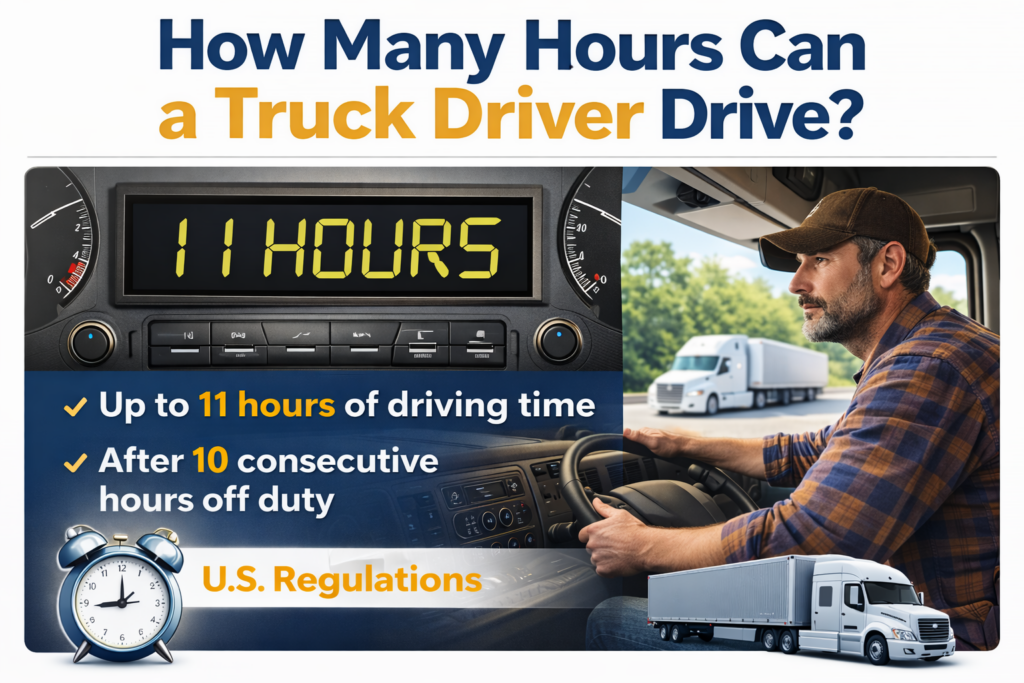
The quick answer to this question is that commercial truck drivers are permitted to drive for 11 hours before they must take a 10-hour rest break. That is the simplified version of HOS. Here is a breakdown of the HOS mandate in its entirety.
For property-carrying drivers operating in interstate commerce:
The 11-Hour Driving Rule
You may drive up to 11 hours after 10 consecutive hours off duty.
The 14-Hour On-Duty Window
Once you begin your shift, you have 14 consecutive hours to complete your driving.
You cannot extend this window (except under specific exemptions).
Even if you only drove 8 hours, once the 14-hour window closes, driving stops.
The 30-Minute Break Rule
After 8 cumulative hours of driving, you must take a 30-minute break.
This break:
- Can be on-duty or off-duty
- Must be a break from driving
- Can be spent in the sleeper berth
The 60/70-Hour Weekly Rule
You cannot exceed:
- 60 hours in 7 days (if your carrier operates 7 days/week), or
- 70 hours in 8 days
You may reset this limit with a 34-hour restart.
Split Sleeper Berth Rule
Drivers may split their 10-hour rest into:
- One segment of at least 7 hours
- One segment of at least 3 hours
Used correctly, this can preserve drive time.
Used incorrectly, it creates violations.
If you operate under your own authority, misuse of split sleeper can affect compliance exposure during an FMCSA safety audit process
What a 10-Hour Break Really Means
The HOS 10-hour break period is an important part of the mandate about how many hours a truck driver can drive in a day. There are specific guidelines about how truck drivers must spend the 10 hours. They must be fully off-duty, which means they cannot engage in paperwork or any other work-related tasks during this period. Their 10-hour break can be taken in the sleeper berth of their truck or while pursuing their own interests completely free from any trucking duties. Any combination of these is also acceptable.
What a 10-Hour Break Really Means
A 10-hour break must be:
- Fully off-duty
- Free from work tasks
- Free from paperwork
- Free from dispatch-related activities
You cannot “sort paperwork” and call it rest.
Improper break logging is one of the fastest ways to trigger roadside violations.
2020 HOS Rule Updates (Still Active)
FMCSA introduced flexibility in 2020:
Short-Haul Exception
- Expanded to 150 air miles
- Extended shift window from 12 to 14 hours
Adverse Driving Conditions
Allows up to 2 additional driving hours in qualifying conditions.
30-Minute Break Flexibility
Break can now be taken on-duty (not driving).
These changes increased flexibility – but they did not remove compliance responsibility.
Log Duty Status: Where Drivers Make Mistakes
There are four duty statuses:
- Off-duty
- Sleeper berth
- Driving
- On-duty, not driving
The most common violations occur in:
- Mislabeling on-duty as off-duty
- Improper personal conveyance use
- Failing to record non-driving tasks
Personal conveyance misuse is one of the most misunderstood HOS areas.
Exceptions to the HOS Rules
As we previously mentioned, there are some exceptions to the HOS rules about how many hours truckers can drive. It is up to commercial drivers to understand how each of these exceptions applies to ensure they comply with all HOS guidelines. Exceptions include:
Personal conveyance (strictly defined)
- Yard moves
- Short-haul exemption
- Adverse driving conditions
- Emergency declarations
Emergency exemptions apply only during officially declared emergencies.
They do not apply to “tight delivery schedules.”
What is the ELD Mandate?
On February 16, 2016, the ELD Mandate became law. It requires the electronic monitoring of how many hours a truck driver can drive in a day before they must take a break. ELD is short for electronic monitoring devices. Commercial truckers must use an ELD to monitor their on-duty hours to prove compliance with HOS regulations. ELDs replace the paper logs and Automatic On-Board Recording Devices (AOBRD) commercial drivers previously used to track their on-duty hours.
ELDs were necessary to ensure the accuracy of driving records. Human error in calculating driving time, plus pressure from employers to manipulate paper-log documentation, led the FMCSA to require ELDs.
ELDs (Electronic Logging Devices) automatically record:
- Engine hours
- Vehicle movement
- Drive time
Paper logs are no longer the primary system. The ELD mandate exists because:
- Paper logs were manipulated
- Fatigue-related crashes increased
- Compliance audits lacked reliable documentation
ELD violations now directly affect CSA scoring.
If you’re unsure how CSA scoring impacts your business long-term, review: What Is a CSA Score in Trucking?
Penalties for Truck Drivers Who Violate HOS Rules
How many hours a truck driver can drive safely is taken seriously by the FMCSA. It expects drivers to strictly adhere to the rules and is swift to punish those who do not. Commercial truck drivers who fail to follow a HOS regulation are subject to fines and may be placed out of service. Law enforcement officers who discover a commercial truck driver violating a HOS rule can immediately put the driver and his or her truck out of commission.
Violations can result in:
- Immediate out-of-service order
- Fines from $1,000 to $16,000+
- CSA score impact
- Increased insurance underwriting risk
- Audit exposure
Repeated violations can threaten operating authority.
Compliance patterns are reviewed during audits, especially if your fleet shows fatigue-related incidents.
If drivers or carriers are caught manipulating driving logs to skirt HOS mandates, their Compliance, Safety, and Accountability (CSA) score may be impacted. Civil penalties are also possible depending on the severity of the action and whether the driver or carrier are repeat offenders.
Operational Reality: HOS Is a Planning Tool
Professional operators don’t view HOS as a restriction.
They use it to:
- Structure reload timing
- Protect revenue predictability
- Reduce fatigue risk
- Avoid last-minute scrambling
If your weekly structure constantly pushes your 14-hour window, your issue isn’t HOS.
It’s planning.
For deeper operational strategy, review: How Weekly Planning Beats “Good Load
Final Takeaway: Compliance Protects Revenue
How many hours can a truck driver drive?
- 11 driving
- 14 on-duty window
- 60/70 weekly
- 10 consecutive off-duty
But the better question is:
Are you planning your operation around these rules – or fighting them every week?
Professional dispatch structure reduces:
- HOS violations
- Fatigue stacking
- Missed reloads
- Stress-based decision making
Drive Within the Rules. Operate With Structure.
At Logity Dispatch, we help owner-operators:
- Structure loads around legal drive time
- Reduce last-minute HOS pressure
- Protect CSA standing
- Maintain compliance discipline
Because stable gross requires stable compliance.
Contact Logity Dispatch to build a schedule that works within the rules – not against them.