Dispatch isn’t about moving freight. It’s about deciding which freight not to run, how risk is managed, and who carries the consequences when something goes wrong.
Why Brokers Are Not a Dispatch Strategy
Freight brokers play an important role in the trucking ecosystem — but they are not a substitute for dispatch. Confusing the two often leads to hidden costs that only show up after the week is over.
The difference isn’t personal. It’s structural.
Brokers optimize for margin, not your cost per mile (CPM)
A broker’s job is to move a shipper’s freight at the lowest acceptable price while protecting their spread. Even good brokers negotiate from that position. Your fixed costs, fuel burn, insurance, maintenance schedule, and cash-flow timing are not part of their decision model – and cannot be. Which is why operators must first know their cost per mile before evaluating whether any load actually makes sense.
Brokers don’t plan your week — only the next load
Each load is treated as a standalone transaction. There is no responsibility for how today’s delivery affects tomorrow’s reload, your deadhead exposure, or whether the lane works over time. The result is often a sequence of “decent” loads that don’t add up to a profitable week. It’s a common scenario where good loads don’t always create good weeks because no one is managing sequencing or lane continuity.
Brokers don’t absorb deadhead or positioning risk
If a reload falls through, a lane dries up, or a market shifts mid-week, the cost of repositioning lands entirely on the carrier. Deadhead miles, wasted hours, and fuel burn are invisible to the broker once the load is delivered.
Brokers disappear after delivery
Once paperwork is submitted, the relationship pauses until the next transaction. There is no continuity, no accountability for downstream effects, and no operational memory carried forward into future decisions.
None of this makes brokers “bad.” It simply means they are not designed to manage a trucking business.
Dispatch is a system. Brokerage is a transaction.
Owner-operators who rely on brokers alone often stay busy while quietly losing control over lanes, margins, and planning. Understanding that difference is the first step toward building a more stable operation.
In-House Dispatching: The Benefits and Challenges
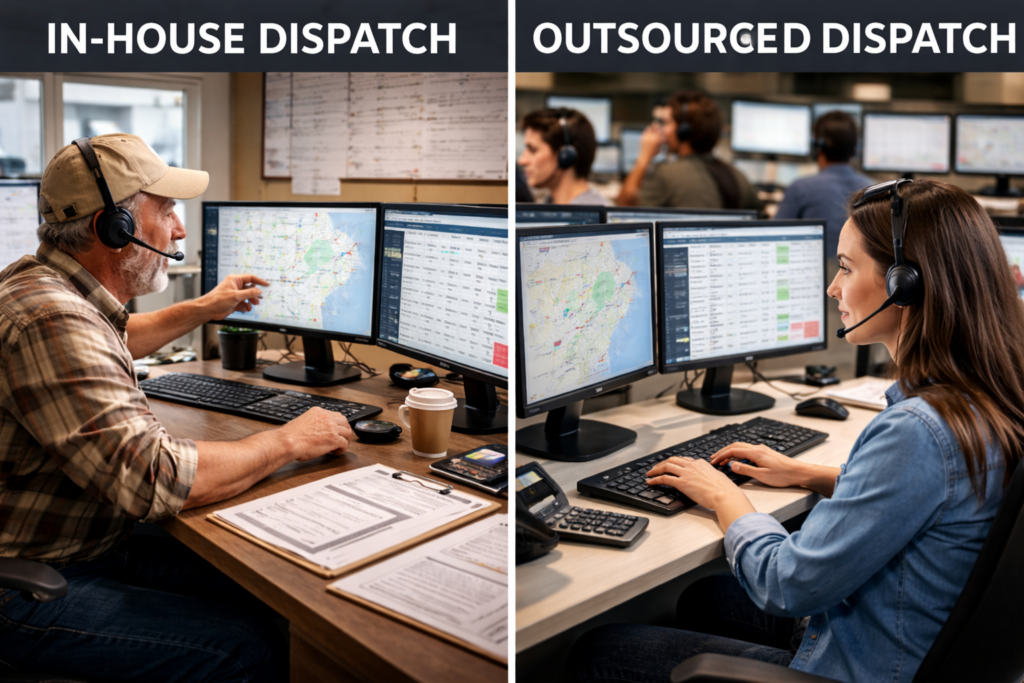
In-house dispatch means managing your dispatching operations with an internal team or alone. This approach has some benefits, but it also presents challenges.
For instance, internal dispatching offers more control, while involving additional costs and challenges. Thus, assessing the benefits and potential issues is important before making the final decision.
Benefits of In-House Dispatching
- Full management. With an internal team, you have complete management over handling your dispatch operations. You can adapt it quickly to changes, adjust plans, and make decisions without waiting for an external party. This can be important if you have specific needs or work in a niche market.
- Close to your business. An internal dispatching team understands the inner workings of your business. They’re familiar with your customers, delivery requirements, and transport routes, which helps ensure that things run smoothly.
- Better communication. With a company-based dispatch team, communication is more direct and immediate. If issues arise, such as last-minute changes, your team can address them immediately. There’s no waiting for an outside company to respond.
- No outsourcing fees. One of the main advantages of in-house dispatching is that you don’t have to pay fees for an outsourced dispatch service. However, keep in mind that you still have expenses related to salaries, benefits, and technology.
Challenges of In-House Dispatching
- High costs. While internal dispatching can save you money on outsourcing fees, it involves high upfront costs. This includes paying salaries, providing dispatch systems, and maintaining technology like route planning software. These costs can quickly add up, especially if you need specialized equipment or employees.
- Limited resources. One downside of the in-house option is that your team may struggle during busy periods. A small in-house team might not have the capacity to handle the increased volume of deliveries, find loads, or manage delivery services on tight deadlines.
- Managing everything. In addition to dispatching, your team may be responsible for other administrative duties, such as handling paperwork, managing customer calls, or maintaining your dispatch system. These additional tasks can be overwhelming and affect overall efficiency.
- Risk of mistakes. With a small in-house team, there’s a greater risk of errors. A team that’s overworked may make mistakes in route planning, finding loads, or managing time-sensitive deliveries. These errors can negatively impact your customer relationships.
Outsourced Dispatching: What It Brings to the Table
Outsourced dispatching means hiring a dispatching company to handle your needs instead of managing them yourself. Many trucking companies and owner-operators choose this option because it helps them reduce time and operational costs and focus on their core business. However, like any solution, it has both benefits and challenges.
Before deciding, trucking businesses should consider their business goals, budget, and need for partners to ensure stable operations.
Benefits of Outsourced Dispatching
- Cost savings. By outsourcing, you don’t need to worry about paying salaries, providing training, and investing in a dispatch system. You only pay for the truck dispatch services.
- Expert team and advanced technology. A reputable company has a dedicated team of dispatchers who know the industry well and have established connections with freight brokers and shippers. They understand finding loads, planning the best routes, and handling time-sensitive or expedited deliveries. They use multiple load boards and real-time visibility tools to track shipments and avoid unexpected delays.
- Flexibility to grow. With dispatch outsourcing, you can adjust your services based on your business goals. During peak periods, a dispatching company can provide extra support without you needing to hire new employees. This helps trucking companies increase their scalability without added stress.
- More time for your business. Running a trucking business means dealing with various tasks like customer calls, handling paperwork, and managing delivery services. A dedicated dispatch team takes care of these, so you can focus on growing your company.
- Reliable support. Many dispatch services provide constant support. This ensures uninterrupted communication with drivers and clients, improving customer satisfaction and stable operations.
Challenges of Outsourced Dispatching
- Less power. When you outsource your dispatching, you rely on a truck dispatching company to make important decisions. While they are experienced dispatchers, you may not have as much supervision over things like customer relationships, scheduling, and problem-solving as you would with an in-house team.
- Potential hidden cost. Although outsourcing truck dispatch services can lead to reduced expenses, it can involve additional costs. Additional fees for extra loads, last-minute changes, or special requests can add up. It’s important to work with a reputable company that offers clear pricing.
- Finding a suitable partner. Not all dispatching companies offer the same level of service. Some may lack experience, use outdated dispatch systems, or fail to provide uninterrupted communication. Choosing the right truck dispatching company is key to avoiding poor service that could hurt your business.
Comparison: In-House vs. Outsourced Dispatching
Choosing between in-house dispatching and outsourced dispatching depends on your needs. Both options have pros and cons, so choosing the one that best fits your business goals is important.
Factor | In-House Dispatching | Outsourced Dispatching |
Cost | High, involving salaries, training, software, and other costs | Lower involves fees for the truck dispatch services |
Flexibility | Scaling up requires hiring and training new staff | Adjustable services based on business goals |
Risk Management | You handle unexpected delays and dispatch needs | Experienced, qualified dispatchers help reduce errors |
Supervision | Full command over dispatching, customer relationships, and decision-making | Less direct command with more reliance on a truck dispatching company |
Technology and Expertise | Requires investment in dispatch systems and ongoing training | Access to expert teams with the latest dispatch technology without extra costs |
Thus, in-house dispatching may be a better choice if you want full supervision and have the budget for a dedicated dispatch team. At the same time, if you want fewer expenses, flexibility, and access to expert dispatchers, outsourcing can help improve efficiency while reducing workload.
Logity Dispatch: A Reliable Partner for Outsourced Dispatching
Running a trucking company is not easy. Managing dispatch processes, finding loads, and ensuring on-time deliveries takes a lot of effort. At this moment, Logity Dispatch can assist. We provide professional dispatch services so you can focus on driving and growing your trucking operations.
Why Choose Logity Dispatch?
- Reliable and transparent pricing. Hiring and training an in-house team can be expensive. With Logity Dispatch, you pay for the truck dispatch services you need, helping you cut down on operational expenses.
- Experienced team. Our qualified dispatchers have industry experience and know how to plan routes, find the best loads, and handle unexpected issues or delays to keep your operations running smoothly.
- 24/7 support. Unlike an internal team that works during regular business hours, our dedicated dispatchers are available around the clock. This ensures uninterrupted communication with drivers and customers, leading to a better customer experience.
- Advanced technology. We use modern systems to provide real-time tracking of your shipments. This helps you track delivery timelines and avoid delays.
- More time for you. Handling customer calls, paperwork, and administrative tasks can take up your time. Outsourcing to Logity Dispatch gives you ample time to focus on expanding your business and achieving your goals.
Whether you are an owner-operator or manage a fleet, our truck dispatch services can help you improve efficiency, increase customer retention, and reduce stress.
Conclusion
If your dispatch decisions are costing more time and money than the freight returns, it may be time to rethink who carries that responsibility.
Logity Dispatch supports owner-operators who prioritize structured planning, controlled lane strategy, and consistent margins over constantly reacting to whatever freight appears next.