Table of Content
- Truck Classes
- Training and Licensing
- Driving a Truck vs. Operating as a Professional Driver
- CDL and Industry Training
- Is it Hard to Be a Truck Driver? Learning Specific Driving Skills
- Challenges of Truck Driving
- Rewards of Truck Driving
- Is Truck Driving Hard – Or Is It Structured Discipline?
- Want to Focus on Driving – Not Administrative Chaos?
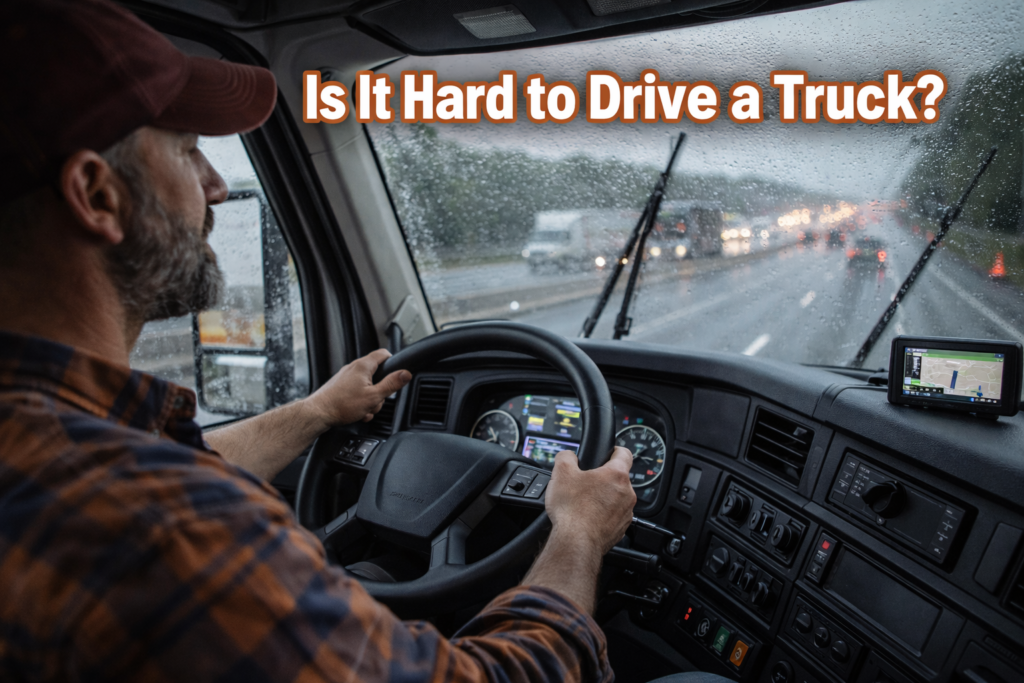
Are you considering a career in trucking and wondering: is truck driving hard?
The honest answer is this: learning to drive a truck is one challenge – building a stable, profitable trucking career is another.
Operating a commercial vehicle requires skill, discipline, and training. But long-term success depends just as much on understanding regulations, managing fatigue, planning loads, and structuring your weeks correctly.
Let’s break down what’s physically difficult, what’s mentally demanding, and what separates new drivers from long-term professionals.
Truck Classes
Is driving a truck hard? What is there to know before starting a new career? Yes, it is hard to be a truck driver. But before we dig into the difficulties of truck driving, it’s important to understand the differences between vehicles. There are currently 8 classes of trucks listed in the United States, with a 9th super-heavy-duty class classified by the Department of Transportation’s Federal Highway Administration.
Class numbers are based on the gross vehicle weight rating (GVWR), which is a safety standard used to ensure vehicle safety and prevent overloading. The GVWR is the maximum safe operating weight, including the net weight of the vehicle along with all drivers, passengers, fuel, and cargo.
There are 9 truck classes:
- Class 1 – the light-duty capacity to a maximum of 6,000 pounds;
- Class 2 – light-duty capacity between 6,001 and 10,000 pounds;
- Class 3 – medium-duty capacity between 10,001 and 14,000 pounds;
- Class 4 – medium-duty capacity between 14,001 and 16,000 pounds;
- Class 5 – medium-duty capacity between 16,001 and 19,500 pounds;
- Class 6 – medium-duty capacity between 19,501 and 26,000 pounds;
- Class 7 – heavy-duty capacity between 26,001 and 33,000 pounds;
- Class 8 – heavy-duty capacity between 33,001 and 60,000 pounds;
- Class 9 – super-heavy-duty capacity above 60,001 pounds.
Training and Licensing
Before you get behind the wheel of a big rig, you need to learn how to control both the truck and the trailer. While you can use your standard license for class 6 trucks and below, a special license is needed for all heavy-duty trucks. Much like motorbikes, you can’t start at the top, with three separate truck licenses available based on the capacity of the vehicle.
In the United States, truck drivers need to obtain a commercial driver’s license (CDL) to get a job. The following 3 licenses are available:
- Class A CDL – Required to operate any vehicle above 26,000 pounds (tractor-trailers);
- Class B CDL – Required to operate single vehicles above 26,000 pounds not hitched to a trailer (buses, box trucks);
- Class C CDL – Required to transport 16 or more occupants or hazardous materials in a vehicle below 26,000 pounds.
The CDL is issued by the Department of Transportation (DOT), and the minimum age is 18 for intra-state driving and 21 for inter-state driving. Specific CDL training programs are available prior to the examination, with students needing to pass a written test while also showcasing their practical driving skills.
Before choosing a CDL path, it’s also important to understand how federal compliance affects daily operations. For example, understanding Hours of Service compliance requirements can prevent costly violations early in your career.
Driving a Truck vs. Operating as a Professional Driver
There’s a difference between learning to control a vehicle and learning to operate within the trucking system.
Driving is technical:
- Shifting
- Backing
- Mirror control
- Brake timing
Operating is strategic:
- Managing Hours of Service
- Planning reload timing
- Reducing unpaid deadhead
- Protecting your CDL
- Maintaining equipment
Many new drivers struggle not because driving is impossible — but because the operational side isn’t taught clearly enough during CDL training.
Understanding how weeks are structured, how loads connect, and how compliance impacts your income often determines whether trucking feels “hard” or simply disciplined.
CDL and Industry Training
Is truck driving hard? Only if you don’t have the right training. Training programs are available from community colleges, truck driving schools, and trucking companies. There are pros and cons associated with each provider, with schools run by trucking companies generally more expensive but also more comprehensive.
If you need help getting your first job, private truck driving schools and trucking companies sometimes offer financial assistance and help hard with job placement. Training programs can last anywhere from two weeks to six months, with the most intensive training programs typically available from trucking companies.
Is it Hard to Be a Truck Driver? Learning Specific Driving Skills
As one of the biggest and most complex vehicles on the road, there is a lot to learn when you first get behind the wheel of a big rig.
Maneuvering
Learning how to back up takes considerable practice because you have to turn your vehicle in the opposite direction of where you want to go. While this might be somewhat intuitive for boat or trailer owners, the substantial size of commercial trailers demands a whole new level of patience and practice. You need to leave more space just to make simple driving moves, including simple maneuvers like turning and reversing.
Visibility
One of the hard challenges associated with commercial truck driving is the lack of visibility. While a standard car almost feels like an extension of your body, a heavy-duty 18-wheeler is an entirely different experience. You need to manage all of your turns and moves solely with your mirrors, as you can’t look behind an 18-wheel truck. Some larger trucks barely fit on smaller roads, so you need to develop special mirror skills around intersections and access points.
Transmission
Commercial vehicles also have a vastly different transmission than regular cars, with 10 to 18 gears commonplace. The sheer number of gears changes the nature of the driving experience, and the gears are often synchronized for an additional challenge. Not only do you need to know how to double clutch, you also need to know how to recover from a missed gear to keep your vehicle moving. While this all becomes second nature after a while, there will be a few hiccups and headaches along the way.
Brakes
Most commercial trucks are equipped with air brakes instead of standard hydraulic brakes. While stopping the vehicle in a controlled manner is the same end goal, more time is required to bring the vehicle to a complete stop. While air brakes are not difficult to use, you do need to develop different driving habits. For example, when you are driving a heavy-duty truck, you will need to slow down at least a quarter mile before you want to stop.
Challenges of Truck Driving
While learning to drive a truck is not particularly challenging, getting a full-time truck driver job can be difficult for other reasons. Life on the road may seem romantic, but it can also be lonely, sedentary, and open to danger. Fatigue and poor weekly structure often overlap. Many drivers discover that “hard” weeks are not about driving skill – but about poor load sequencing and inconsistent planning.
The following challenges are common:
Solitude and Loneliness
Make no mistake, life on the open road is very much a solo adventure. While there is a community of truckers, and you may be able to take your partner on the occasional trip, driving a truck is an isolated adventure. On a good day, long episodes of solitude can lead to serenity and self-awareness. On a bad day, you may get eaten up by loneliness and self-doubt.
Time away from home
Even if you enjoy being alone, extended time away from home can be hard for anyone. Whether you’re leaving behind your partner, kids, or parents, truck driving involves lots of hard goodbyes and plenty of happy reunions. The amount of time you spend away from home differs widely between jobs, from a night or two to a week or more.
Discomfort
Excessive sedentary time can be uncomfortable, with long hours behind the wheel leading to both physical and mental stress. Full-time truck drivers should always take time to stretch, walk around, and move their bodies to avoid the issues associated with excessive sitting. Long hours can also lead to accidents, and when you’re driving an 18-wheeler, that’s something you always want to avoid.
Rewards of Truck Driving
Despite the challenges and risks associated with truck driving, life behind the wheel is also full of rewards and opportunities. Workplace freedom increases significantly when drivers understand how dispatch structure influences stability and earnings.
The following pros are more than enough for many people:
Workplace Freedom
If you don’t like having a boss breathing behind your neck, truck driving may be the job for you. While you still have to meet deadlines and fill in paperwork, you work very much on your own terms. While modern truck drivers are limited to a maximum number of hours behind the wheel, there is still a lot of flexibility regarding when you work and for how long.
Travel and Adventure
Driving a commercial heavy-duty truck is an endless adventure across the United States. From north to south and east coast to west, you are likely to learn about this country from the inside out. When you witness the ever-changing colors of the natural landscape from an elevated big rig seat, things like TV will never seem exciting again.
Lack of Physical Labor
While driving a commercial truck can be hard on your body due to repetition and lack of movement, it’s a long way from physical labor. If you’re accustomed to working on building sites or in warehouses, sitting down all day can seem like a dream. Once again though, movement is crucial, so take regular breaks and stretch your legs to keep your body in tip-top shape.
Is Truck Driving Hard – Or Is It Structured Discipline?
Truck driving isn’t “easy.” But it isn’t mysterious either.
The mechanical skills can be learned in months. The operational discipline takes longer – but that’s where professional drivers separate themselves.
Most people who fail in trucking don’t fail because they can’t drive. They struggle because they lack structure, planning, or support.
If you’re willing to train properly, respect compliance, and build operational awareness, truck driving becomes less about difficulty – and more about consistency.
Want to Focus on Driving – Not Administrative Chaos?
At Logity Dispatch, we provide dispatching services for owner-operators who want structure behind their wheels.
We help with:
• Load planning
• Rate negotiation
• Compliance support
• Weekly revenue stability
So you can focus on driving – while your operation runs intelligently behind the scenes.
Contact Logity Dispatch today and turn hard work into structured income.