Trucking moves the economy – but not all miles carry equal risk.
Certain corridors in the United States consistently show higher crash rates, infrastructure deficiencies, extreme weather exposure, or traffic density that increases accident probability for commercial vehicles.
For owner-operators and carriers, a single accident can mean:
- Downtime
- Insurance premium increases
- CSA score impact
- Lost broker relationships
Understanding high-risk trucking corridors is not about fear – it’s about operational awareness and strategic planning. This is especially critical for drivers operating in over-the-road (OTR) environments, where extended mileage and unfamiliar territory increase exposure to risk.
Why Some Roads Are Riskier for Trucks
While additional attention is necessary on hazardous shipping highways, safe driving techniques should be used wherever you are. By observing these safety precautions, truckers may help prevent collisions and incidents anywhere:
- Even if it appears safe to do so, avoid speeding.
- Even if you’re alone, avoid driving aggressively or carelessly.
- Do be aware of potential risks and make plans on how to avoid them.
- Always be aware of your surroundings; never drive while inattentive.
- Watch how other drivers are driving; they often have a greater understanding of the region than you do.
- Do stock up on emergency supplies including additional clothes, food, and water as well as first aid kits, maintenance tools, and a communication device.
- Don’t forget about common safety precautions like buckled seatbelts.
- Before you go, do some research on your route to understand more about the routes you’ll be on.
A structured pre-trip inspection checklist further reduces mechanical failure risk before entering high-congestion or mountain corridors.
The Most Dangerous Roads That Truckers Face in the U.S.
We’ll now examine some of the most hazardous truck routes in America. But why are they so concerning, exactly? Many truckers who consider dangerous roads base their choices simply on the region’s fatality rate. While taking this into account, we also examine the underlying causes of a pavement section’s risk:
- High congestion corridors
- Mountain passes with grade & curvature risk
- High-speed rural highways
- Extreme weather exposure zones
- Infrastructure deterioration zones
The American West Dangerous Roads
| Corridor Type | Route | Key Risk Factors | Operational Impact |
|---|---|---|---|
| High Congestion Corridor | Interstate 95 (East Coast) | • Dense multi-state traffic• Frequent merging zones• High crash volume• Urban bottlenecks | • Delivery delays• Elevated rear-end collision risk• Increased insurance exposure |
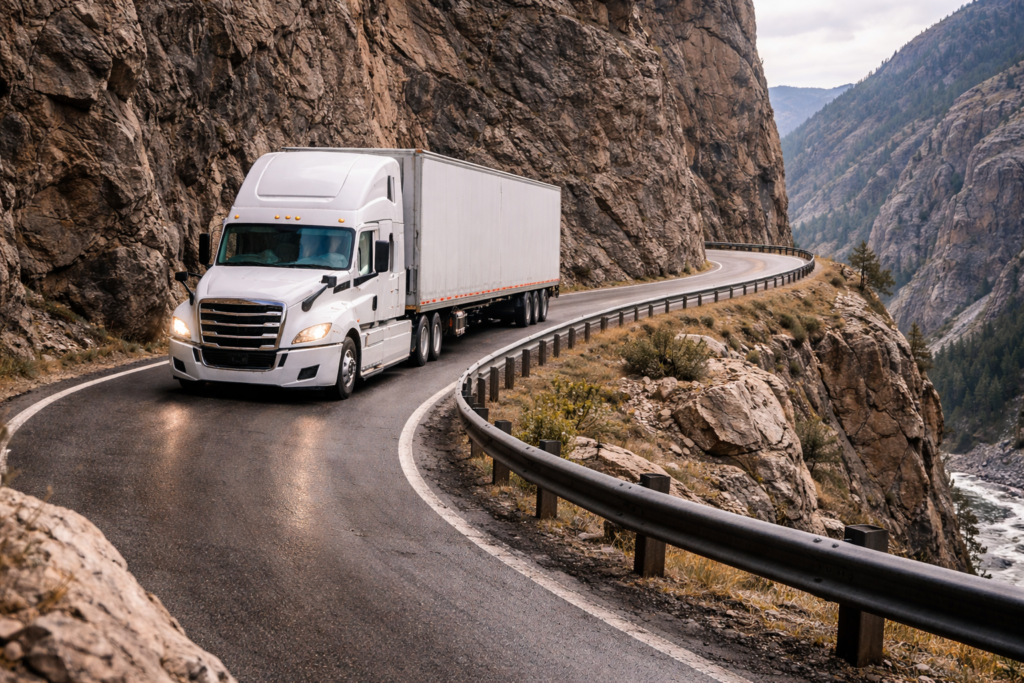
| Mountain & Grade Risk Route | U.S. 550 – Million Dollar Highway (CO) | • Steep grades• No guardrails• Sharp hairpin turns• Winter avalanche risk | • Requires disciplined brake management• Increased mechanical strain• Weather-dependent routing decisions |
| Remote & Rural Risk Zone | U.S. Highway 2 (Montana) | • Sparse traffic (false sense of security)• High speed limits• Limited emergency services• Severe winter storms | • Delayed emergency response time• Increased fatigue risk |
Unsurprisingly, the West has numerous dangerous roads for truckers because of its dense population, various scenery, and unpredictable weather. The top selections are listed below.
U.S. Highway 2 in Montana
Although this route passes through numerous states, the part in Montana, where it has one of the worst accident and fatality rates in the country, is the most hazardous. This is one of the most hazardous truck routes on our list because of its high-speed restrictions, low population, absence of other motorists, and the possibility of hazardous weather conditions.
The Million Dollar Highway/Route 550
This road winds through Colorado’s stunningly beautiful mountains, but it’s not a good idea to stop and take in the amazing scenery while you’re driving. This area is notorious for its steep, sheer drop-offs, guardrail-free hairpin corners, restricted roads, absence of guardrails, bad weather, icy snow, and even avalanches. Truckers using this road should be careful.
California Deathway/Route 138
Route 138 in California, sometimes referred to as “Blood Alley” and the “Highway of Death,” made our list due to the sheer number of hazardous conditions it has. This route presents several hazards for truckers, including congested metropolitan roadways and winding, narrow mountain routes. And even while Route 138 has seen improvements over the last two decades, safe navigation still needs a lot of concentration.
Interstate 15
From San Diego, California, to the Canadian border, this roughly 300-mile route travels through Nevada, Arizona, Utah, Idaho, and Montana. I-15 often experiences traffic, which increases the likelihood of accidents. It is clear why considerable care is necessary for this situation when you consider the strong wind conditions along a few parts of I-15, the high-speed restrictions (75 mph or more), and the many animal crossings that litter rural regions.
The Eastern United States Dangerous Roads
Even while the East Coast and its neighboring states might be beautiful places to travel, they are not always the safest, particularly for truckers. There are a lot of hazardous trucking highways in this area.
Interstate 95
Veterans in the trucking industry concur that Interstate 95 is one of the most dangerous trucking roads in South Carolina. From Miami, Florida, to the Houlton-Woodstock Border Crossing in Maine, this is the nation’s longest north-south highway. One of the busiest roads in the nation, it travels across 15 states and several large cities. It is hence prone to traffic bottlenecks and negligent driving. This is one of the most hazardous routes in the United States for truckers due to the risk of curving and twisting drives, steep hills, and little law enforcement on certain portions.
Interstate 4
I-4 is only one of the worst highways in America that are found in Florida. Due to its high number of fatal collisions, it has in the past been referred to as the most deadly roadway in America. Truckers using this road should be on the lookout for any possible risk areas.
The Tail of the Dragon/U.S. 129
U.S. 129 in North Carolina may be excellent for a compact vehicle but demands careful driving if you’re a trucker with over 300 twists in only 11 miles. And it’s simple to see why driving around these blind bends might result in disaster even for the most cautious trucker when you consider the hazardous design, the fact that this region is favored by fast sports cars and bikers, and the lack of gas stations or rest areas.
The Cross Bronx Expressway
For a combination of reasons, this major roadway in the Bronx is at the top of our list of the most dangerous trucking roads in New York. It ranks as the second-most hazardous place in the nation in 2019. In addition to being one of the most crowded places in the nation, it also has inadequate maintenance, small lanes, and a high number of accidents.
The Middle of the U.S. Dangerous Roads
The majority of hazardous roads in the United States are centered around the country’s periphery, but that doesn’t mean the interior states don’t have some of their own. In the heart of America, you’ll discover several hazardous roads for truckers, including the ones listed below.
Interstate 10 in Arizona
I-10 in Arizona may be challenging to drive because of the absence of barriers, dense traffic, and few services. Even so, that’s not the end of it! Long desert stretches may also lull truckers and other drivers into a false feeling of security, allowing them to speed up or drive more recklessly than they normally would. This is always a formula for tragedy.
Interstate 45
Currently, driving in Texas seems dangerous, and truckers on I-45 are particularly at risk. This is regarded as the most dangerous trucking road in Texas and stretches from Galveston to Dallas. It should come as no surprise that Interstate 45 was formerly called the deadliest route in the United States given the volume of traffic, speeding, and careless drivers that use it.
The Killway/U.S. 24 Fort Wayne to Toledo
You are aware that driving carefully is necessary on a route called “The Killway.” This section of Route 24 is the primary route for the movement of commercial goods, while being just a few hundred miles long, making the small lanes all the more out of place. This one makes our list because of the high volume of truck traffic, blind corners, and tight turns.
Non-Contiguous States Dangerous Roads
There are hazardous shipping highways across the world, not only in the continental U.S. Even though they do not fall inside the lower 48 states, Alaska, Hawaii, and other U.S. islands nonetheless have certain noteworthy regions that truckers need to be aware of.
Dalton Road
The fact that this state has very hazardous weather shouldn’t come as a surprise, but there are other factors that put Dalton Highway on our list. It’s called the loneliest road for nothing; there are very few people and even fewer facilities along these 414 miles of rural terrain, and you won’t likely see anyone else for a very long time. Dalton Road has several unpaved or poorly maintained areas, and there are often animals there. Be careful to have emergency supplies on hand if you’re a trucker traveling this route in case you need to wait for help in the freezing weather.
Kamehameha Highway
To put it mildly, Hawaii’s transportation business is distinctive. This growing state has many locations where a bicycle, much less a heavy-duty rig or light vehicle, wouldn’t be a good idea. However, trucks must continue, right? Although Kamehameha Highway is one of Hawaii’s major thoroughfares, it is one of the most dangerous roads for trucks to drive on. A risky drive might result from the combination of twists, curves, visitors, and coastal weather.
Bear in mind that this is by no means an exhaustive list. You’re not necessarily safe even if the route you’re going isn’t on the list above. For a truck driver, any highway, interstate, or street may be hazardous, particularly for those who are not paying attention to their surroundings.
What Causes Risky Truck Roads?
Many roads may be dangerous for trucks if motorists aren’t paying attention, but there are a few of them that can pose issues even for the most cautious of motorists. Truckers may keep safe by learning to spot and, if feasible, avoid risky circumstances on the dangerous road, which can prevent disastrous collisions, injuries, and even deaths. Here are some characteristics shared by the most hazardous route for truckers.
Unsafe Situation
Some roads are just plain terrible, whether it’s because they’re seldom used or because the government can’t afford to maintain them. Potholes, missing signs, guardrails or barriers, fading line markings, pockmarked surfaces, and other issues are discussed. All of these make it harder for truckers to keep safe, and even when they strive to drive safely, accidents may still happen.
Bad Design
You’ll undoubtedly sometimes find yourself driving on a surface that seems like it was created by a little child; in other words, it’s simply horrible. Because they weren’t given the required thought, many highways in the United States are safer than they might be. Truckers must pay closer attention to their driving and pray that other drivers are doing the same since poorly built highways are far more likely to have harmful speed restrictions, sharp bends, blind curves, risky gradients, incorrect width, and poor illumination.
Unfavorable Weather
Roads that are subject to erratic weather are regrettably nobody’s fault. The varied climates of various countries bring with them a variety of weather risks, from foggy coastal routes to icy mountain passes to the windy and tornado-prone Midwest. Inclement weather should always be anticipated by truckers since it may swiftly change a safe route into a dangerous one.
Traffic
We all know that being stuck in traffic may be risky since it puts everyone on edge and increases the likelihood of an accident. Modern safety technologies such as emergency brake assist systems can significantly reduce rear-end collision severity in these environments.
However, did you realize that having less traffic is only sometimes better? Some of the truck drivers’ dangerous roads are often found in rural regions. This is caused in part by the distance from help and by drivers letting their guard down owing to a false feeling of security.
Risks on the Highway
Some routes are more prone to unexpected dangers that might result in collisions or accidents from trying to escape a collision. For instance, boulders, trees, and other debris are prone to fall in mountainous places. Additionally, truckers may experience floods along certain coastal roads (particularly in Hawaii) or the unexpected presence of animals. Unwary pedestrians may also offer a risk in metropolitan areas.
How Dispatch Strategy Reduces Road Risk
While drivers cannot change geography, they can control preparation and planning.
Smart dispatch strategy includes:
- Avoiding peak congestion windows
- Monitoring weather forecasts
- Adjusting ETAs realistically
- Building buffer time for high-risk corridors
- Prioritizing safety over unrealistic deadlines
Route selection is not just about mileage – it’s about risk exposure.
Risk Awareness Is a Competitive Advantage
Every experienced driver understands that not all miles are equal. High-risk corridors demand:
- Discipline
- Preparation
- Realistic scheduling
- Mechanical readiness
At Logity Dispatch, we believe profitability and safety are connected. Structured dispatch planning reduces rushed deliveries, unsafe routing decisions, and exposure to preventable risk.
Safer routes. Smarter planning. Stronger operations.