Table of Content
- What is an MCS-150 Update?
- How Your MCS-150 Data Feeds the FMCSA Safety System (CSA BASICS)
- How the MCS-150 Fits Into Ongoing Carrier Compliance
- The Significance of Timely Filing
- When to Perform Your Biennial Update
- What Are the MCS-150 Requirements?
- Where MCS-150 Fits Into Day-to-Day Dispatch & Operations
It’s expected that when embarking on your journey as a carrier or an independent owner-operator, you’ll have to follow certain essential procedures to secure your operating authority. This entails acquiring your Commercial Driver’s License (CDL), organizing your financial matters, and, notably, adhering to both federal and state regulations. A notable regulation entails obtaining a USDOT number, a mandate from the U.S. Department of Transportation for all carriers.
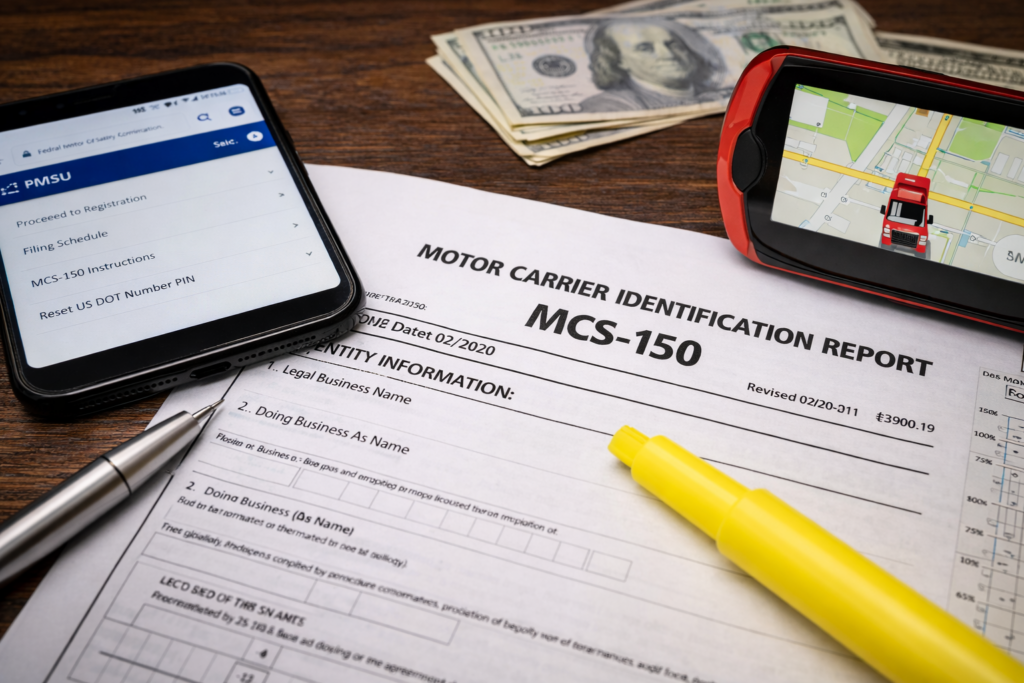
This number serves as a distinct identifier, allowing the collection of crucial safety and financial data concerning their trucking operations. While the initial application is a one-time requirement, the ongoing upkeep of your USDOT number is a continuous commitment. The Federal Motor Carrier Safety Administration (FMCSA) mandates that carriers submit a refreshed Motor Carrier Identification Report, also referred to as an MCS-150, every two years to maintain their compliant status.
Maintaining your MCS-150 update is a paramount responsibility for carriers and owner-operators looking to preserve their operating authority and ensure seamless load transportation. Let’s delve deeper into the significance of the MCS-150, the process of obtaining it, and how to simplify the biennial update.
What is an MCS-150 Update?
The MCS-150 is a requisite form imposed by the Federal Motor Carrier Safety Administration (FMCSA) to either acquire or renew your USDOT number, an integral component of retaining your operating authority. This unique identifier, issued by the Department of Transportation, serves the purpose of gathering data on your trucking business for safety evaluation. Upon filing your MCS-150 report, the FMCSA leverages your business data to calculate a safety score within its Compliance, Safety, Accountability (CSA) program. This program compiles information from state-reported accidents, roadside inspections, and investigation outcomes, associating it with a carrier’s DOT number. The FMCSA then utilizes this data, in conjunction with the details you provide in your MCS-150 submission, to assess your overall safety performance.
MCS-150 due date is a critical aspect to remember, as meeting this deadline is crucial for ensuring your continued compliance with federal regulations. It’s vital to understand the MCS 150 instructions mileage and adhere to them to complete your submission accurately and on time. To stay informed about your compliance, you may wonder, how do I check my MCS-150 status if I want to renew my MCS-150? Understanding the MCS 150 meaning and the requirements for an MCS-150 mileage update is essential for carriers and owner-operators to maintain their operating authority effectively.
The CSA program encompasses seven Behavior Analysis & Safety Improvement Categories (BASICS), which are used to gauge a motor carrier’s standing relative to other carriers with a comparable number of safety incidents.
How Your MCS-150 Data Feeds the FMCSA Safety System (CSA BASICS)
Unsafe Driving
Covers violations such as speeding, distracted driving, improper lane changes, and reckless behavior.
Hours-of-Service Compliance
Evaluates adherence to HOS rules using logs, dispatch records, bills of lading, and ELD data. Hours-of-Service compliance remains one of the most common sources of violations for carriers, particularly when logs, dispatch records, and actual driving patterns don’t align.
Vehicle Maintenance
Covering how carriers maintain their vehicles, this BASIC includes roadside inspection reports, Driver Vehicle Inspection Reports (DVIRs), equipment repair records, evidence of driver training on load securement, and other relevant documentation.
Controlled Substances
This section scrutinizes whether carriers have operated commercial motor vehicles under the influence of alcohol or drugs. Compliance materials include verified controlled substance test results, any records of refusals to undergo alcohol or controlled substance tests, and driver evaluations and referrals.
Crash Indicator
This component analyzes your history of reported accidents and crashes, requiring documents such as carrier data from the Accident Register and accident reports filed by state or other government entities/insurers.
Hazardous Materials Compliance
Examining how hazardous materials carriers and owner-operators adhere to health and safety regulations, this BASIC necessitates records like hazardous materials incident reports, shipping papers, manifests, evidence of hazardous materials training, and more.
How the MCS-150 Fits Into Ongoing Carrier Compliance
While it’s evident that the FMCSA’s collection of this data is imperative for overall road safety, it also holds critical significance due to the agency’s primary responsibility of overseeing and enforcing compliance with the Federal Motor Carrier Safety Regulations (FMCSR) and the Hazardous Materials Regulations (HMR). These regulations govern safety and financial responsibility within the trucking industry. The comprehensive data acquired through the MCS-150 and associated documentation is indispensable in fulfilling this role, underscoring the importance of carriers and owner-operators providing accurate business information and adhering to punctual MCS-150 renew.
The biennial MCS-150 update for carriers serves as a means for the FMCSA to verify the accuracy and currency of the information it possesses regarding the trucking business. Given the critical nature of this information, the FMCSA further mandates that carriers promptly update their MCS-150 forms whenever there are alterations in business particulars. This includes instances such as changes in business name or the addition of new trucks to the fleet, even if these changes occur between the routine biennial MCS-150 updates.
If you’re wondering how to file MCS-150, it’s essential to understand the process and requirements for submitting this crucial form accurately. Additionally, you might inquire about what is carrier mileage on MCS-150 to ensure that your reporting is complete and accurate. Understanding how do I know if my MCS-150 is up to date is essential to maintaining compliance with federal regulations. You can also explore how can I view my MCS-150 to keep track of your information on record.
If you ever need to retrieve your records, you may wonder how do I get a copy of my MCS-150 and how to fill out MCS-150 to ensure a smooth and accurate submission process. It’s also important to be aware of any MCS-150 fee associated with these processes.
The Significance of Timely Filing
The criticality of submitting your MCS-150 update on schedule cannot be overstated. As per the FMCSA, the primary reason carriers slip out of compliance with MCS-150 registration is a simple failure to renew within the biennial deadline. But why does this seemingly routine act hold such weight, and why is it imperative to adhere to the deadline?
The FMCSA places immense importance on the MCS-150 update, given that it directly impacts both safety and the financial well-being of businesses, not to mention its broader implications for the entire industry and all road users. Owing to this paramount significance, the failure to file your MCS-150 can result in severe consequences for your trucking enterprise, including the deactivation of your USDOT number and the imposition of fines, which could amount to as much as $1,000 per day. Without a valid DOT number, carriers are unable to maintain their operating authority, severely hindering, if not completely jeopardizing, their ability to conduct business effectively.
When to Perform Your Biennial Update
Carriers and owner-operators are typically aware of the requirement to conduct their MCS-150 update once every two years. However, the exact deadline for completing the MCS-150 update can vary from one carrier to another. Fortunately, there’s a relatively straightforward method to ascertain your specific deadline.
Carriers can determine their MCS-150 deadline by examining the last two digits of their USDOT number. The second-to-last digit designates the year when the carrier needs to renew their MCS-150. If this digit is odd, the renewal falls in years ending with odd numbers. Conversely, if it’s an even number, the renewal occurs in years ending with even numbers. For instance, if the second-to-last digit in a USDOT number is “2,” the carrier should prepare for renewal in even-numbered years like 2022, 2024, and so on.
To pinpoint the month by which you must complete your MCS-150 update, consider the last digit of your DOT number. Deadlines span from January to October, with each number representing a specific month. So, if a carrier’s DOT number ends with “5,” this signifies that they must submit their MCS-150 in May. Carriers have until the end of their assigned month to fulfill this requirement. What does MCS 150 mileage mean?
What Are the MCS-150 Requirements?
Compliance with MCS-150 requirements is essential for carriers, as the FMCSA necessitates extensive information to uphold safety regulations. Meeting these requirements involves meticulous record-keeping across all facets of your business. This encompasses details such as the number of drivers and trucks in your fleet, the mileage covered in the previous year, insurance particulars, and more. Additional key information to include in your MCS-150 update consists of:
- Legal business name
- USDOT Number
- MC Number
- Carrier mileage
- Type of company operations (Interstate vs. intrastate, hazardous vs. nonhazardous materials). For carriers unsure how their operation is classified, understanding the difference between interstate and intrastate trucking is critical before submitting an MCS-150.
- Type of operation (Carrier, shipper, broker, freight forwarder, etc.)
- Cargo classification
- Number of vehicles
- Driver information
Now, you might be pondering, “How do I initiate my MCS-150 update? And how can I check my MCS-150 status?” How to calculate mileage for MCS-150? The process of submitting your MCS-150 is reasonably straightforward, offering a couple of options.
The most efficient method is the online filing, achievable through the FMCSA Online Registration System. Once you complete the form and submit it, your USDOT number is instantaneously updated. Provided that all the information is accurate, you can resume your hauling operations without delay. Alternatively, you have the option to paper file your MCS-150 update via mail, fax, or web form. However, it’s important to note that this process may take four to six weeks for completion. Biennial update MCS-150 form
Where MCS-150 Fits Into Day-to-Day Dispatch & Operations
Filing an MCS-150 is not just a regulatory checkbox – it reflects how your operation actually runs.
Mileage reporting, vehicle counts, and operation type all depend on accurate records across dispatch, load history, and back-office documentation. When those records are scattered or inconsistent, compliance updates become stressful and error-prone.
Dispatch support helps carriers stay organized throughout the year by maintaining consistent load records, mileage tracking, and operational documentation – making biennial updates like the MCS-150 far easier to complete when deadlines arrive.
For owner-operators and small fleets, this operational clarity is often what prevents last-minute compliance issues that can disrupt authority or delay loads.