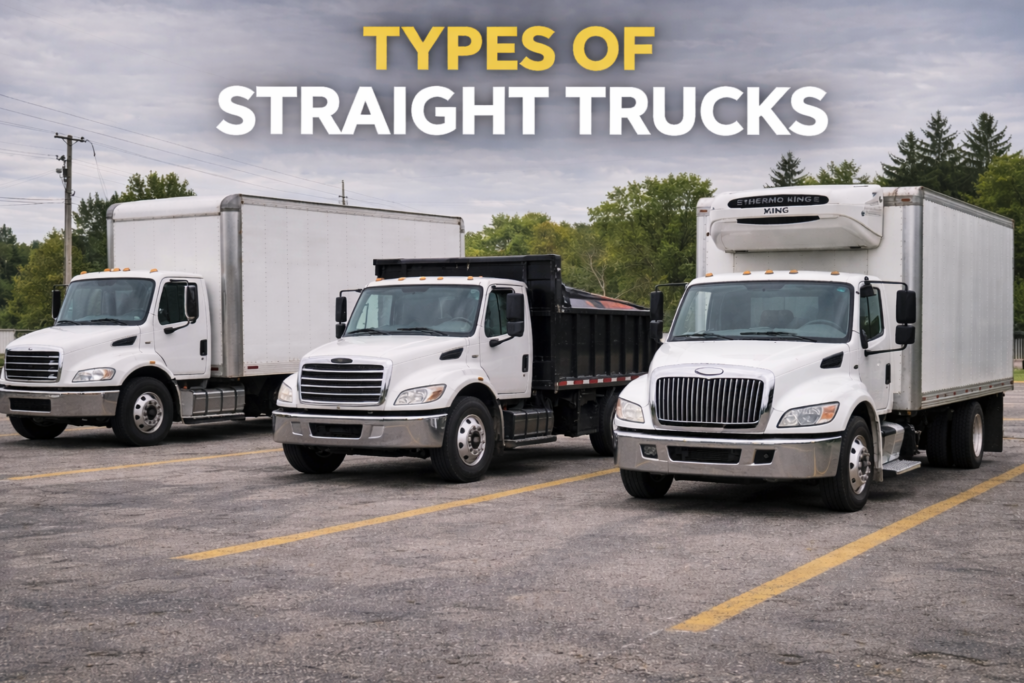
If you’re a company with freight to transport, there are numerous methods at your disposal within the vast transportation industry. Services abound, catering to the diverse shipping needs between businesses, whether it’s a full 53-foot flatbed, a partial load of palletized cargo, or the services of a hot shot driver (whose pool is rapidly expanding). While finding a solution for your company’s next move is certainly possible, it can be an overwhelming task.One such option in the transportation arsenal is the straight truck, also known as a “box truck” or a “small straight truck.”
In this article, we provide a thorough overview of straight trucks, including their dimensional capabilities, the types of businesses that typically use them, and the pros and cons of transporting freight inside these vehicles. Whether you’re looking for the straight truck definition, exploring the straight truck meaning, or understanding the various types of straight trucks, such as the straight truck flatbed, we’ve got you covered. By the end, you’ll have the knowledge and resources needed to make informed decisions for your next freight move.
What Is a Straight Truck?
A straight truck, also referred to as a “box truck” or “cube truck,” is a commercial motor vehicle with a single frame connecting each axle from the cab to the trailer’s rear. Available in various lengths, straight trucks feature a distinct box-like compartment for loading cargo. They have become integral to supply chains across industries, offering a time and cost-efficient means of moving cargo. Fully-loaded straight trucks usually don’t exceed 26,000 pounds, making them operable without a Commercial Driver’s License (CDL) and a viable transportation solution for many companies.
Dimensions of Straight/Box Trucks
Straight trucks come in sizes ranging from 22 to 26 feet. Typically measuring 96 inches wide by 96 inches tall internally, these trucks can carry a maximum cargo weight of 8,000 pounds. The choice of box truck size depends on the transportation company, emphasizing the importance of consulting your provider for details tailored to your specific situation.
Freight Suited for Straight Trucks
Box trucks function as smaller dry van trailers, capable of moving partial and less-than-truckload quantities of various cargos, including non-perishable and dry goods such as retail products, electronics, machine parts, and palletized freight. However, straight trucks can only handle cargo loaded from the back via forklift, pallet jack, or by hand. Some trucks may be equipped with lift gates, but it’s crucial to communicate this requirement with your provider to ensure accommodation and appropriate pricing.
While straight trucks are well suited for regional and partial loads, many owner-operators discover that profitability depends less on cargo type and more on how those loads fit into a full weekly plan. Straight truck work often involves tighter appointment windows and thinner reload markets, which makes planning between loads just as important as the freight itself.
Advantages of Using Straight Trucks
1. Expediency
Straight trucks prioritize your needs by providing dedicated services, avoiding delays associated with sharing space on a larger trailer during less-than-truckload transport. This expedites the transportation process compared to partial-truckload (PTL) and/or less-than-truckload services.
2. Cost-Effectiveness
For dedicated capacity, using a straight truck can often be more cost-effective than booking a 53-foot trailer, especially for smaller loads. In situations where timelines demand efficiency, employing a straight truck for freight shipping can be the most economical option.
Disadvantages of Using Straight Trucks
While there are few disadvantages to using straight trucks for freight shipping, it’s crucial to consider capacity constraints. Straight trucks are suitable for smaller quantities of freight, and exceeding their internal capacity can lead to delays. Proper planning and consultation with your transportation provider are essential to avoid unexpected issues.
Conclusion
Straight trucks play a valuable role in regional and short-haul freight, especially for operators prioritizing flexibility and lower operating complexity. However, choosing the right equipment is only one part of building a sustainable operation.
In practice, straight truck profitability depends less on truck type and more on how consistently the week is planned — including reload timing, lane selection, and minimizing unpaid repositioning miles. This is especially true for straight truck operators working thinner outbound markets, where a single missed reload can disrupt the entire week.
These planning gaps – not bad freight – are often what turn acceptable loads into weak weeks. This dynamic is explored in Why Good Loads Still Turn Into Bad Weeks, which breaks down how decisions between loads quietly determine real income.