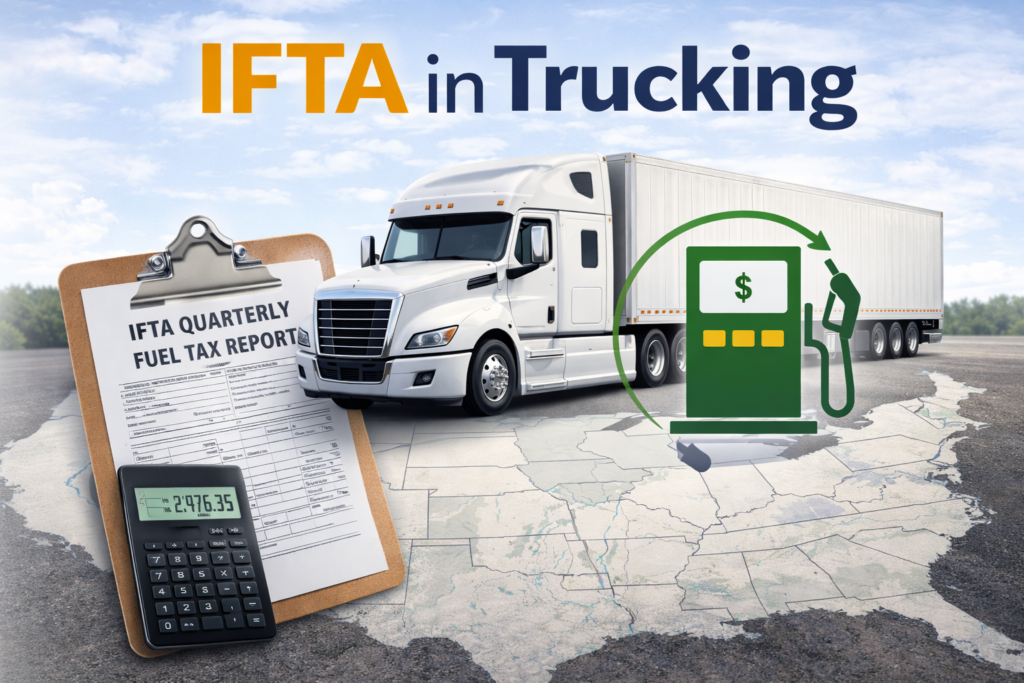
Fuel tax is one of the most misunderstood and most operationally sensitive – cost centers in trucking.
For owner-operators running multi-state lanes, fuel tax reporting directly affects:
• Net profit per mile
• Audit exposure
• Cash flow timing
• Compliance risk
The International Fuel Tax Agreement (IFTA) was designed to simplify multi-jurisdiction fuel reporting – but it does not eliminate responsibility. If handled incorrectly, IFTA filings can trigger penalties, audits, and unexpected back payments.
Here’s what IFTA is, who needs it, and why it matters to your trucking business.
What Is IFTA Tax? A Brief Overview
The IFTA stands for the International Fuel Tax Agreement. This is an agreement that exists between the nations of the United States and Canada, allowing carriers and logistics firms that operate in both countries to do so on a single fuel tax license.
This agreement does not cover the whole of the United States, nor does it cover the entirety of Canada. Instead, the Lower 48 states of the US are covered, while ten provinces and jurisdictions of Canada are covered, too. Carriers and logistics professionals who move between these states and provinces, including those who operate across the international border, pay their fuel tax directly to the state or province they are based in. Each state and province still draws its tax according to its own laws, but there is no need for owner-operators and drivers to file complicated fuel tax reports for each state line – or another jurisdictional boundary – crossed.
The agreement is designed to save time, money, and effort. In the process, it also provides a boost to local economies as this agreement supports the work of logistics and haulage firms rather than hindering them.
Which Areas Are Covered Under the IFTA?
As discussed above, ten states and provinces of Canada are included in the International Fuel Tax Agreement. These are:
- Alberta;
- British Columbia;
- Manitoba;
- New Brunswick;
- Newfoundland and Labrador;
- Nova Scotia;
- Ontario;
- Prince Edward Island;
- Quebec;
- Saskatchewan.
Basically, any driver or logistics firm is covered right across Canada, excluding the three northwestern territories of Yukon, Northwest Territories, and Nunavut.
In the US, the list is even more comprehensive. Drivers and logistics firms will benefit from the IFTA across all of the lower 48 states. The only jurisdictions NOT covered by IFTA are as follows:
- Alaska is NOT covered under the IFTA.
- Hawaii is NOT covered under the IFTA.
- The District of Columbia is NOT covered under the IFTA.
- ALL OTHER states ARE covered under the IFTA.
IFTA does not eliminate fuel tax. It centralizes reporting. Carriers still owe taxes based on miles driven in each jurisdiction – even if fuel was purchased elsewhere.
IFTA applies primarily to vehicles that fall under commercial motor vehicle classification and are subject to federal safety oversight under the FMCSA safety audit process.
The History of the IFTA
The International Fuel Tax Agreement is just one in a long line of agreements and cooperations that have flourished as part of the friendly relationship between Canada and the US. Like many other legal and political agreements between the two countries, the IFTA was born out of a very specific need – in this case, the need to collect fuel tax without damaging the businesses of owner-operators and drivers in the field of logistics.
Each year, millions of tons of freight cross back and forwards across the US-Canadian border. This freight provides a huge boost to the economies of both governments and societies north and south of the border, but this is not the only border that the freight must cross. The federated systems of both the US and Canada mean that each individual state, province, or territory is permitted to set its own taxation limits and regulations. This leads to complications during cross-border trade and logistics processes.
To put it simply, before the IFTA was implemented, drivers of freight vehicles were required to apply for fuel permits for every single state and territory entered on their journey. This does not cause too much hardship if the journey is between New York State in the US and Ontario in Canada, or between Maryland and Pennsylvania. But, often, this is not the case. A driver may find themselves driving across ten or more state and provincial boundaries on their way to the destination, particularly in the northeastern US where state boundaries are more numerous.
The fact that individual fuel permits need to be applied for is troublesome enough for logistics firms. However, there are many more factors to be taken into account. Drivers and organizations had to contend with:
- Differing rules regarding filing periods and filing requirements between different states and provinces.
- Differing definitions of key legal and tax terminology between different states and provinces.
- Different things need to be reported, with some states and provinces relatively relaxed in terms of requirements and others imposing stricter reporting regulations.
- Differing permit costs between states and provinces.
- Differing filing processes between states and provinces, with some states and provinces requiring in-person filing and others allowing filing to be handled online.
All of this contributed to soaring costs for logistics firms. Not only did they have to pay for these additional permits, but they also had to eat into their fuel resources when traveling to permit processing centers, risk late cargo deliveries through permit violations, and potentially lose business along the way. It was a very negative situation indeed.
Following the implementation of the IFTA, logistics firms and drivers now find that their life and work is much easier. Businesses are saving thousands of dollars a year on reduced admin costs – even millions of dollars in some cases. This achieves a better deal for company bosses, drivers, clients, and the general public alike.
Do I Need an IFTA Sticker and License?
Not all businesses or drivers need an IFTA fuel sticker for trucks or the license that accompanies these stickers. Basically, you will need an IFTA license and the proper decals if you meet the following criteria.
- You operate a commercial haulage vehicle or logistics fleet.
- You use vehicles that are classed as “qualified motor vehicles” under IFTA rules. This means:
- A vehicle designed to transport people or property between locations
- A vehicle that fits into one of the following categories:
- The vehicle has two axles and a gross vehicle weight of more than 11,797 kg (26,000 lbs) – basically, any vehicle with a weight above this level will need an IFTA sticker.
- The vehicle has three or more axles (no weight requirement for this category).
- You are based in one of the member states or provinces listed above.
- You operate across two or more of these member states or provinces.
For carriers running regional or cross-border freight, understanding how operating structure affects fuel tax exposure is just as important as choosing between OTR, regional, or local lanes.
How IFTA Impacts Owner-Operator Profitability
For independent operators, IFTA is not just paperwork – it’s margin math.
If you purchase most of your fuel in low-tax states but run heavily in higher-tax jurisdictions, you may owe additional tax during quarterly reconciliation.
Poor recordkeeping can result in:
• Estimated mileage assessments
• Audit penalties
• Interest charges
• Temporary suspension
IFTA compliance is administrative but its impact is financial.
What Is IFTA License and How to Apply?
If your business meets the above criteria, you will need to display an IFTA sticker on your vehicles and have a valid IFTA license for your business.
You will need to apply for your license, and the stickers to signify that your vehicles are in accordance with IFTA requirements, in the state or province in which your business is based. You will need a registered business name, a business mailing address, a federal business number, and a USDOT number in order to apply.
Where and how you file your application will depend upon the state you operate in. You will need to change your IFTA sticker each year to show that your IFTA status is fully up to date. IFTA sticker costs vary between states and provinces.
Quarterly fuel tax reporting requires precision. Errors compound quickly – especially for multi-state operators.
Logity Dispatch supports owner-operators and fleets with:
• Accurate IFTA reporting
• Mileage reconciliation
• Fuel documentation review
• Compliance tracking
Being a p rofessional dispatch service provider, our goal is simple: reduce audit risk, protect margins, and keep your operation focused on revenue – not paperwork.
If you’re ready to stabilize your compliance structure, contact Logity Dispatch today.