Table of Content
- What Amazon Relay is
- Relay loads and brokered box truck freight
- 26ft Box Truck Dispatch With No Upfront Payments
- Amazon Relay requirements for a box truck carrier
- Insurance Amazon requires
- Applying and onboarding
- How Relay loads are booked
- What the box truck loads on Relay looked like on November 9, 2026
- Getting paid
- Frequently asked questions
Short answer
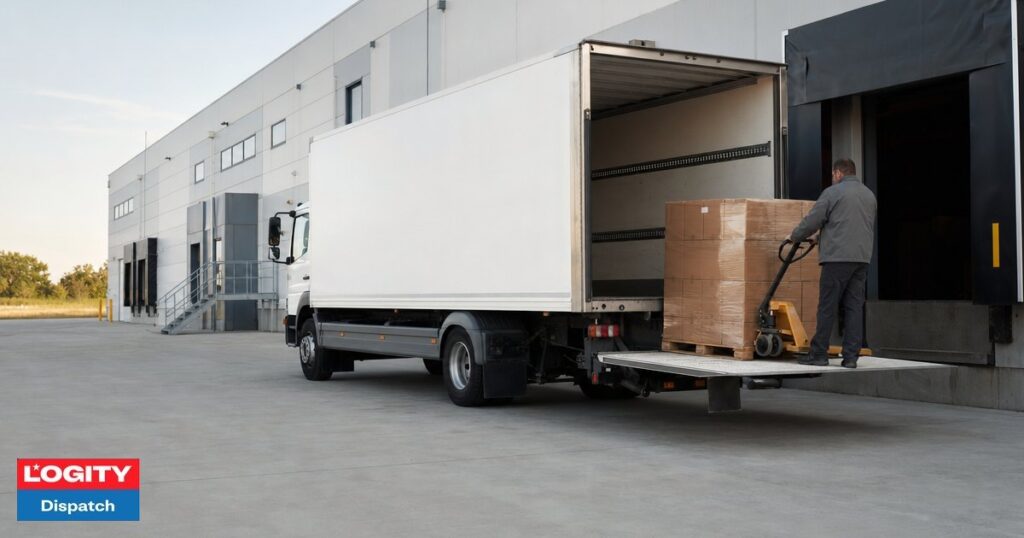
Amazon Relay takes box trucks, but its FAQ lists only 26 ft and 16 ft trucks with a working tuck-under liftgate. Your company needs a DOT number with interstate authority active for at least 180 days, a valid MC number, safety scores under Amazon’s limits and insurance at Amazon’s minimums. Once approved, you book loads yourself in the Relay portal or app: spot loads from the load board, automatic matches through Post A Truck, and, after you earn a performance grade, auctions and contracts. Amazon pays weekly.
Amazon Relay is Amazon’s own load board for trucking companies. This guide covers what a box truck carrier needs to get approved, how loads are found and booked once you are in, and what the public box truck loads on Relay looked like on the day we checked. Every requirement below comes from Amazon’s own pages on relay.amazon.com, read on November 9, 2026. Amazon can change them, so check the linked page before you apply.
What Amazon Relay is
Relay’s home page describes it as a free web portal and mobile app where approved trucking companies find, book and manage verified loads, with “no freight broker, no minimum fleet size” and weekly payments. You deal with Amazon directly. There is no subscription fee to join.
Amazon also says on its FAQ that it “does not tender loads through any third-party load boards.” Amazon loads are only given to approved carriers through the Relay portal or app. If you see an Amazon load on another board, it does not come from Amazon to you that way. Our guide to box truck load boards and apps covers the other places box truck freight is posted.
Relay loads and brokered box truck freight
Relay is one source of box truck work. Loads on it are booked by the approved carrier in Amazon’s own portal and app. Freight that brokers and shippers post elsewhere is a separate market, with its own rate talks and its own paperwork. That is the work the Logity Dispatch box truck service describes: finding loads that fit your truck, negotiating the rate and booking only at a rate you approve, for 10% of gross. That service asks for an MC that has been active for at least one year.
Amazon Relay requirements for a box truck carrier
These are the minimum requirements in the Relay FAQ. They apply to the company, not only to the truck.
| Requirement | What the Relay FAQ asks for |
|---|---|
| Authority | A DOT number with interstate authority active for at least 180 days, and a valid MC number. You can apply before day 180 and Amazon will keep you updated. |
| Entity type | A “Carrier” entity type, authorized for property and for hire |
| FMCSA safety rating | Satisfactory, None or Not Rated |
| BASIC scores | Unsafe Driving below 60%, HOS Compliance below 60%, Vehicle Maintenance below 75%, Controlled Substances / Alcohol below 75%, Driver Fitness below 75% |
| Violation rates | Driver violation rate at or below 35%, vehicle violation rate at or below 50% |
| Equipment | 26 ft or 16 ft box truck with a functional tuck-under liftgate |
If you are not sure where your company stands on the BASIC categories, our piece on how brokers and insurers read CSA scores explains what they measure. Relay’s insurance guide says its BASIC thresholds are 5% lower than federal standards.
The liftgate question
The FAQ equipment list names box trucks only with “a functional tuck-under lift-gate.” An older Relay article on how to become a carrier, from April 2024, lists “26′ or 16′ standard and refrigerated box trucks” and does not mention a liftgate. We treat the FAQ as the current rule. If your truck has no liftgate, or a rail gate rather than a tuck-under, ask during the application before you count on Relay loads.
Insurance Amazon requires
The Relay FAQ lists these minimums:
- Commercial general liability of at least $1,000,000 per occurrence and $2,000,000 aggregate
- Auto liability of at least $1,000,000 per occurrence, including $50,000 of trailer replacement coverage
- Cargo coverage of at least $100,000
- Workers’ compensation in every jurisdiction where your company operates
- Employer liability of at least $100,000 per occurrence
Relay’s insurance guide words two of these differently. It says the $50,000 trailer interchange applies “if you’re running a semi,” and that workers’ compensation and employer liability apply to companies with W-2 employees. For a box truck owner who drives alone, those two lines are the ones to confirm with Amazon and your agent before you buy coverage.
The same guide says newer carriers typically pay $12,000 to $18,000 a year for the required coverage and experienced carriers with clean records $8,000 to $14,000. It does not split those figures by equipment, so they are not a box truck quote. Our guide to box truck insurance cost covers what drives a box truck premium. Amazon checks your certificate of insurance through a third-party vendor, and the guide says a lapse in coverage stops your company from booking or hauling Relay loads until it is reinstated.
Applying and onboarding
The 2024 how-to article says the application can be finished in as little as 20 minutes and must match your FMCSA record “down to the last dash.” Its steps include your DOT number, company details, a one-time password, your equipment inventory and payment information.
According to the FAQ, a completed application is typically approved or rejected within 1 to 3 weeks, and delays usually come from checking insurance. If you hear nothing within 2 weeks, check that your FMCSA contact details match your application exactly. After approval, the FAQ lists three steps:
- Complete the Relay 101 course in the Learning Center, which takes about 10 minutes.
- Add your drivers and equipment to your Relay profile.
- Start booking loads on the Relay load board.
Each driver, including you if you drive, creates a profile in the Relay app, verifies identity with a selfie and a photo of the driver’s license, and goes through a background check. Amazon also verifies the business and every owner with more than 25% of it.
How Relay loads are booked
Relay has four ways to get freight. Which ones you can use depends on your performance grade.
| Booking option | How it works | Who can use it |
|---|---|---|
| Spot load board | You search and filter loads and book one. Most prices are all-in and preset; on some spot loads you can ask for a different rate through Relay Assistant, an AI chat tool | All approved carriers |
| Post A Truck | You post when and where your truck is free, up to two weeks ahead, with pickup radius, maximum deadhead, trip type and the payout you require. Relay books a matching load | All approved carriers; higher grades get priority |
| Auctions | You bid on lanes | C+ grade or higher |
| Contracts | You book recurring routes for set payouts, offered in weekly increments | B grade or higher |
Sources for the table: Relay’s load board guide (updated October 30, 2026), its Post A Truck guide (updated November 1, 2026) and its performance grades article. Relay’s contracts article says the contract marketplace includes box trucks and lists the 26 ft box truck as contract equipment.
How the performance grade works
Every new carrier starts with basic load board access. You become eligible for a grade after completing ten or more Relay loads in the last six active weeks. Your score is the lowest of four measures: on-time delivery, app usage, acceptance without cancellations, and loads run without disruptions. Grades A+, A and B+ also get early access to new spot loads and contracts. Dropping below C+ risks losing contracts you have already booked.
What a Relay payout includes
Relay’s rates guide breaks each payout into a base rate, a fuel surcharge that moves with fuel prices, and tolls when the route has them. You see the total before you book.
What the box truck loads on Relay looked like on November 9, 2026
Relay’s home page shows a public snapshot of its loads. We set the equipment filter to Box Truck and sorted by loads per week. All ten top lanes were short local runs:
| Lane and average miles | Loads a week | Average trip rate |
|---|---|---|
| Staten Island, NY to Brooklyn, NY: 25 mi | 193 | $200 to $250 |
| Avenel, NJ to New York, NY: 35 mi | 76 | $275 to $325 |
| Avenel, NJ to Brooklyn, NY: 40 mi | 71 | $275 to $350 |
| New York, NY to Rutherford, NJ: 20 mi | 69 | $175 to $225 |
| Within Tucson, AZ: 25 mi | 66 | $150 to $200 |
| Within Jacksonville, FL: 15 mi | 64 | $150 to $200 |
| Fontana, CA to San Bernardino, CA: 20 mi | 63 | $175 to $250 |
| Staten Island, NY to Middle Village, NY: 45 mi | 61 | $200 to $275 |
| Within Oklahoma City, OK: 15 mi | 56 | $150 to $175 |
| Within Las Vegas, NV: 25 mi | 55 | $150 to $200 |
Relay notes that “rates and volume shown are based on recent averages and may vary” and that live rates are given at booking. This is one snapshot of the top lanes by volume, not every box truck load on Relay.
The same rows show $4.44 to $13.33 a mile. That figure says little on runs of 15 to 45 miles, because most of the day goes to docks, stops and traffic, not miles. Judge each load by its total pay against your own floor for the hours it takes. Our guide to box truck rates per mile shows how to build that floor.
Getting paid
The Relay FAQ says the payment cycle runs weekly from Sunday to Saturday. Everything completed before 23:59 on Saturday is paid the following Friday. Relay creates invoices automatically, and you can dispute a payment in the portal within 30 days of reviewing your weekly invoice.
Frequently asked questions
Can you use a box truck on Amazon Relay?
Yes. The Relay FAQ lists 26 ft and 16 ft box trucks, both with a functional tuck-under liftgate. Your company also has to meet Amazon’s authority, safety and insurance requirements.
How long does my MC need to be active for Amazon Relay?
The Relay FAQ asks for a DOT number with interstate authority active for at least 180 days and a valid MC number. You can apply earlier and Amazon will keep you updated until you qualify.
What insurance does Amazon Relay require?
The FAQ lists general liability of $1,000,000 per occurrence and $2,000,000 aggregate, auto liability of $1,000,000 per occurrence, cargo of $100,000, workers’ compensation where you operate and employer liability of $100,000. Relay’s insurance guide says the trailer and workers’ compensation lines depend on running a semi and having W-2 employees, so confirm them for your company.
How long does Amazon Relay approval take?
The FAQ says a completed application is typically approved or rejected within 1 to 3 weeks. If you hear nothing in 2 weeks, check that your FMCSA contact details match the application.
How often does Amazon Relay pay?
Weekly. Loads completed from Sunday to Saturday, before 23:59 on Saturday, are paid the following Friday, and invoices are created automatically.