Table of Content
- What is a trucking fuel card?
- How do trucking fuel cards work?
- Which fuel cards are worth comparing in 2026?
- How much do fuel cards save per gallon?
- Best fuel cards for owner-operators and small fleets
- Are there prepaid fuel cards for truckers?
- Can you get a fuel card with bad credit or no credit check?
- How to get a fuel card for your trucking business
- What to check before you sign
- Frequently asked questions
Short answer
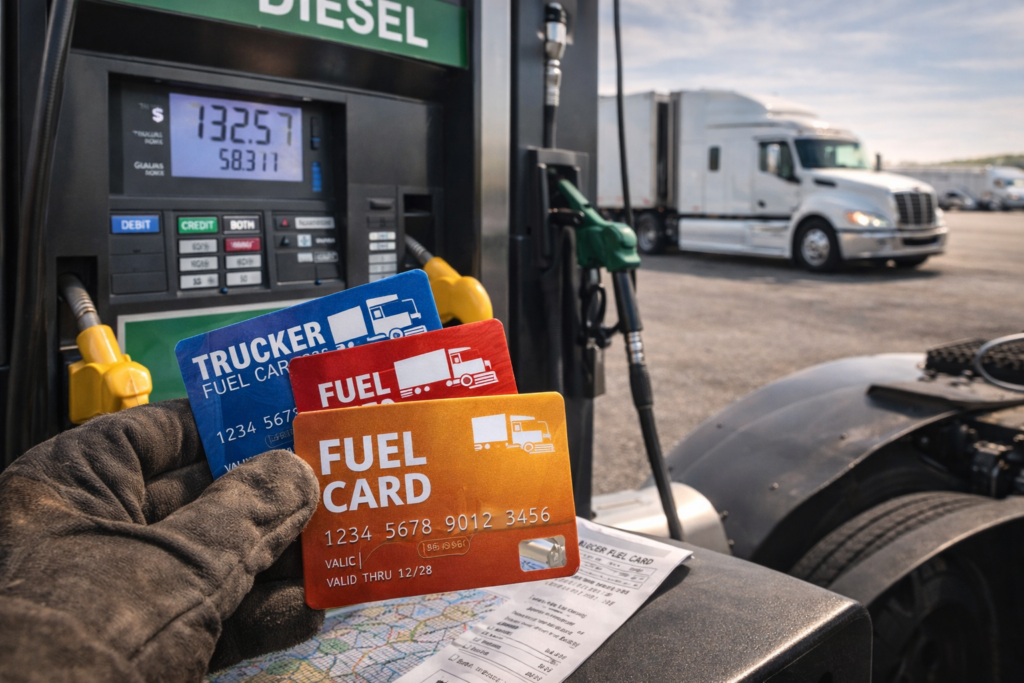
A trucking fuel card is a fleet payment card that buys diesel at a negotiated network price instead of the posted pump price, and reports every gallon by driver, truck and location. Issuers publish average savings of 20 to 50 cents a gallon. The best card is the one whose discount network covers the lanes you already run.
Written by the Logity Dispatch team for owner-operators and small fleets deciding which fuel card to carry. Every discount figure, network size and credit term below was read from the issuer’s own public page on 14 September 2026, and the diesel price it is measured against comes from the U.S. Energy Information Administration week of 21 September 2026. Where an issuer’s terms were not readable to us that day, we say so instead of repeating a number from someone else’s article.
What is a trucking fuel card?
A trucking fuel card is a fleet payment card that settles diesel purchases at a price negotiated between the card issuer and a network of truck stops, rather than at the price on the sign. It is not a loyalty card and it is not, in most cases, an ordinary credit card.
Three things separate it from the card in your wallet:
- Price. In-network stops bill you at a contracted cost-plus or retail-minus price. The discount is the gap between that and the posted price.
- Control. The issuer can cap gallons per transaction, restrict purchases to diesel, lock the card to specific states or stops, and require a driver ID and odometer reading at the pump.
- Data. Every transaction carries truck number, driver, location, gallons and price, which is what makes a fuel card the cleanest source for IFTA reporting and for a real cost per mile figure.
That third point is the one most operators underrate. A card that saves you eight cents a gallon but hands you clean quarterly fuel-tax data can be worth more than a card that saves twelve and leaves you sorting paper receipts.
How do trucking fuel cards work?
You apply, the issuer sets your funding method and your limits, and cards or RFID tags go out to your drivers. At the pump the driver enters a card number and usually a driver ID, and the transaction is priced against the issuer’s agreement with that chain instead of the street price.
The funding method is the part that decides whether you qualify, and there are three of them:
| Funding model | How you pay | Who it suits |
|---|---|---|
| Credit line | The issuer extends a weekly credit line and bills you on terms | Carriers with trading history and a credit file |
| Factoring-backed | Fuel advances are netted against the invoices you factor | Owner-operators already factoring their freight |
| Self-funded or prepaid | You load the card from your own debit or credit card | New authorities, thin or damaged credit |
A factoring-backed card is the common path for a one-truck operation, because the issuer is underwriting your customers’ invoices rather than your own credit file. If you are weighing that route, our note on how owner-operators get funded covers the trade-off in full.
Which fuel cards are worth comparing in 2026?
The table below carries only figures published by the issuer itself and read on 14 September 2026. Savings figures are the issuer’s stated averages across a network. They are not a guarantee at any individual stop, and no honest comparison can promise one.
| Card | Stated savings | Network | Funding | Strongest fit |
|---|---|---|---|---|
| OTR Fuel Card (OTR Solutions) | $0.50/gal average | 8,000+ stations, 3,000+ in network at $0 in-network transaction fees | Factoring-backed, weekly credit lines from $1,000; states no credit checks required | Owner-operators fuelling at TA and Petro |
| RTS Fuel Card | 45 cents/gal average | 4,000+ stations; Pilot Flying J and Southern Tire Mart partners | Three tiers: Total Fleet, Self-Funded, Fleet One (credit to $3,200 per truck, per week) | Operators who want a self-funded option without a credit test |
| Love’s Express | $.20/gal | Love’s network, RFID automated fuelling via QuikQ | Billing programme, no application or transaction fees, cards and tags free | Fleets whose lanes already run on Love’s |
| Mudflap | Not published as a single average | 3,600+ in-network truck stops; 70,000+ locations accept the card | App discounts on your own card, or the Mudflap Fuel Card with terms | Drivers who want a discount without changing banks |
| WEX, EFS and Fleet One | Not published as a single average | National; Fleet One EDGE, EFS Fleet Card and EFS Fleet Mastercard | Credit, by product line | Growing fleets that need several card products under one account |
| Comdata | Not published as a single average | National, with Comchek, CAT Scale and National Tire Program tie-ins | Credit, segmented by fleet size | Fleets past roughly 20 trucks |
| Fuelman | Not published as a single average | National, gasoline and mixed-fleet weighted | Credit | Mixed fleets running pickups and vans alongside trucks |
What is deliberately missing. Several cards that appear on other lists are not in this table because we could not read their current terms on 14 September 2026: the public pages for TCS Fuel and AtoB returned a firewall response to us, and Shell’s and BP’s United States fleet pages served either a script-rendered shell or a European fleet page. Absence here means unverified, not inferior.
What happened to the DAT One Fuel Card
It has not launched yet. On 14 September 2026 DAT’s own fuel card page read: “The new DAT One Fuel Card is coming soon.” If you have seen it ranked first on a comparison list, that list is ahead of the product.
Fleet One and WEX are the same company
Fleet One is no longer an independent issuer. Its domain now resolves to efsllc.com, part of WEX, and the product survives as the Fleet One EDGE Card inside the EFS family. Comparing “WEX versus Fleet One” in 2026 compares two products from one issuer, not two competing networks.
How much do fuel cards save per gallon?
Start from what a gallon costs. For the week of 21 September 2026 the U.S. Energy Information Administration put the national average on-highway diesel price at $6.529 a gallon, up 24.4 cents on the week and $2.780 on the year. Regional averages the same week ranged from $6.139 on the Lower Atlantic to $8.246 in California. A card that takes 20 cents off that price, the figure Love’s Express publishes, is cutting 3.1 percent off the biggest variable cost in the truck.
Against that base, here is what the published discounts are worth on a truck burning 15,000 gallons a year, which is roughly 100,000 miles at 6.7 mpg:
| Stated discount | Per gallon | Per 15,000 gallons | Share of a $6.529 gallon |
|---|---|---|---|
| Love’s Express | $0.20 | $3,000 | 3.1% |
| RTS average | $0.45 | $6,750 | 6.9% |
| OTR Solutions average | $0.50 | $7,500 | 7.7% |
Two cautions on that arithmetic. First, the per-year column assumes every gallon is bought in network, and no real route does that. Take the issuer’s average, multiply by the share of your gallons that actually land at in-network stops, and you have the honest number. Second, a discount only reaches your bank account if it is not eaten by transaction fees, card fees or a detour. Twenty miles out of route to reach a cheaper stop is deadhead you are paying for.
Fuel savings and fuel surcharge are separate levers and it is worth keeping them separate in your head: the surcharge is revenue you negotiate with the broker, the card discount is cost you take out of the pump price. A good week uses both.
Best fuel cards for owner-operators and small fleets
A one-truck operation and a forty-truck fleet are not shopping for the same thing. The owner-operator needs a card that will approve them without two years of trading history and that discounts where they already stop. The fleet needs controls, reporting and several card products under one account.
For a single truck or a fleet under five, the shortlist is short:
- OTR Fuel Card if you factor your invoices. The card is factoring-backed, weekly credit lines start at $1,000, and OTR states no credit checks are required.
- RTS Self-Funded if you do not factor and your credit file is thin. RTS states this tier offers the same discounts regardless of credit score.
- Mudflap if you want to keep your own bank card and simply pay less at the pump. Mudflap sells both the app and a fuel card with fleet controls.
Past roughly twenty trucks the question changes from approval to administration, and Comdata segments its own offer at exactly those breakpoints: 1 to 20 trucks, 21 to 80, and 81 or more. WEX’s EFS family covers the same ground with Fleet One EDGE for growing fleets and the EFS Fleet Card for mid and large fleets.
If your fleet runs pickups and vans as well as tractors, Fuelman is built around that mix, with a diesel card, a mixed-fleet card and a Mastercard product. It is the weakest fit for pure over-the-road diesel and the strongest for a yard full of different vehicles.
Are there prepaid fuel cards for truckers?
Yes, and they are usually called self-funded rather than prepaid. You load the card from your own debit or credit card and spend down the balance, so the issuer is not lending you anything and has no reason to pull your credit.
The trade-off is real and worth stating plainly. A self-funded card gives you the network discount but none of the working capital. A credit-line card gives you both, at the cost of an underwriting decision. If cash flow between load and settlement is your actual problem, a prepaid card does not solve it; factoring or a credit line does.
RTS sells self-funding as a named tier. OTR’s card is funded out of your factoring proceeds, which behaves like credit from the driver’s side but is underwritten against your customers rather than against you.
Can you get a fuel card with bad credit or no credit check?
Yes. Two of the issuers above say so in writing, which is worth more than a forum post:
- OTR Solutions lists “No credit checks required” on its fuel card page, read 14 September 2026.
- RTS describes its Self-Funded tier as offering “the same great discounts on fuel and maintenance regardless of credit score”.
What a damaged credit file costs you is not the discount, it is the credit line. Expect to fund the card yourself, expect lower per-transaction limits at the start, and expect the issuer to raise them once you have a settlement history with them. That is the normal path for a new authority, and it is the same underwriting logic that shapes every other funding decision in your first year.
How to get a fuel card for your trucking business
- Map your gallons first. Pull three months of fuel receipts and count which chains you actually buy from. The card that discounts a chain you never visit is worth nothing.
- Pick a funding model. Factoring already in place points to a factoring-backed card. No factoring and thin credit points to a self-funded tier. Established credit opens the credit-line products.
- Apply with your authority details. MC and DOT numbers, EIN, bank details, and for credit products, trade references. Approval on funded tiers is typically same week.
- Set controls before the cards ship. Diesel only, a gallon cap that matches your tank, driver ID required, and a stop list if you run fixed lanes.
- Reconcile the first month by hand. Compare the card’s in-network price against the posted price on at least ten transactions. That is how you find out whether the published average holds on your lanes.
Step five is the one almost nobody does, and it is the only one that tells you whether the card is earning its keep. Ten receipts are enough. If the real gap is half the advertised average, you are buying outside the network and the fix is routing, not a different card.
What to check before you sign
- Transaction fees. A card advertising a big discount and charging $2 a fill gives most of it back on small purchases. OTR publishes $0 in-network transaction fees; Love’s publishes no application or transaction fees. Ask every issuer the same question in writing.
- In-network versus accepted. These are different lists. Mudflap’s own numbers show the scale of the gap: 3,600+ in-network, 70,000+ accepting.
- Retail-minus or cost-plus. Cost-plus pricing usually beats retail-minus at high-volume stops and loses at low-volume ones. Ask which model applies at the chains you use.
- Credit line mechanics. Weekly or monthly, per truck or per account, and what happens when you hit the ceiling mid-week.
- Data out. Whether the issuer exports transactions in a format your accounting or IFTA process can read. This is where IFTA duties split between operator and dispatcher gets decided in practice.
One more, rarely discussed: a fuel card changes where you stop, and where you stop changes your fuel burn and your hours. A network that forces two extra stops a week costs more in time than it returns in cents.
Frequently asked questions
What is the best fuel card for owner-operators?
There is no single best card. The right one is whichever network covers the lanes you already run. OTR Solutions and RTS both publish owner-operator terms and accept applicants without a credit check on at least one tier, which is why single-truck operators usually start there.
How much does a trucking fuel card actually save per gallon?
Issuers publish averages between 20 and 50 cents a gallon: Love’s Express states $.20, RTS states an average of 45 cents, OTR Solutions states an average of $0.50. These are averages across a network, not a guaranteed discount at every stop on your route.
Can I get a trucking fuel card with bad credit or no credit check?
Yes, on funded tiers. RTS sells a Self-Funded card that gives the same discounts regardless of credit score, and OTR Solutions states no credit checks are required for its fuel card. You fund those cards yourself instead of borrowing against a credit line.
Do fuel cards work at every truck stop?
No. Every card has an in-network list where the discount applies and a wider list where the card is merely accepted. Mudflap, for example, states 3,600+ in-network truck stops but 70,000+ locations that accept the card. Check the network against your lanes before signing.
Is a trucking fuel card the same as a fuel credit card?
Not always. A fuel credit card extends a credit line you repay monthly. A fuel card can be credit-based, factoring-backed or self-funded from your own money, and it adds fleet controls a consumer card has no reason to offer, such as per-driver limits and gallon caps.
A fuel card lowers what a mile costs. What a mile pays is the other half of the same equation, and it is decided by the loads you accept. Logity Dispatch runs dispatching for owner-operators and small fleets, and we will tell you when the rate on offer does not cover the fuel it takes to run it. The cost per mile math is the place to start.
Sources checked on 14 September 2026: OTR Solutions fuel card page, RTS Financial fuel card page, Love’s Express Credit, Mudflap, EFS (WEX), Comdata and Fuelman public product pages, and the DAT One Fuel Card page. Diesel prices are the U.S. Energy Information Administration Gasoline and Diesel Fuel Update for the week of 21 September 2026, all grades including taxes. TCS Fuel, AtoB, Shell and BP United States fleet terms could not be read on that date and are not described above.