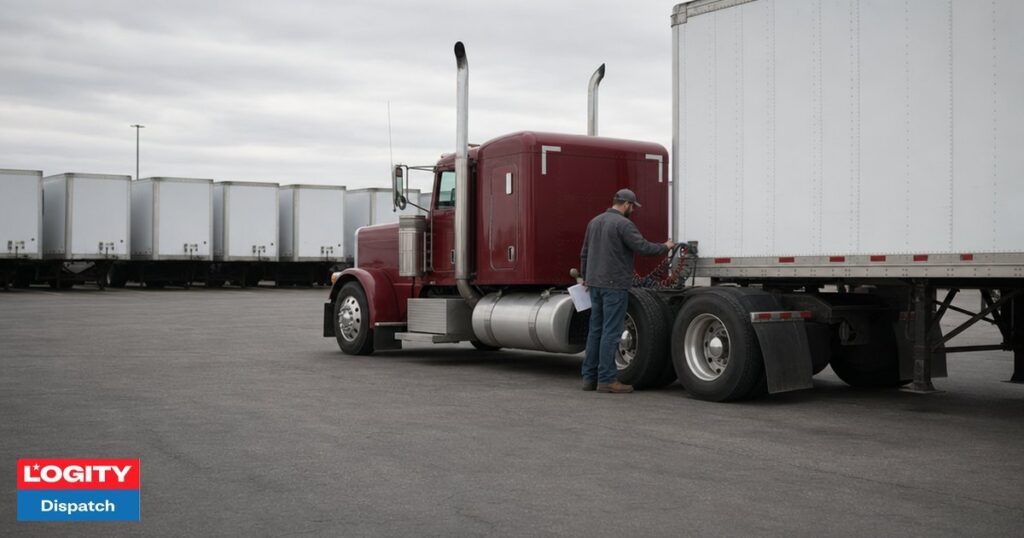
Short answer
Power only loads come from three places: carrier and broker trailer pool programs (J.B. Hunt 360box, Uber Freight Powerloop), the Power Only equipment type on load boards, and leasing onto a carrier that supplies the trailers. Before the first load you need an active authority with at least $750,000 in liability (or a written lease with a carrier), a standard fifth wheel, and trailer interchange coverage backed by a signed interchange agreement.
Power only means you bring the tractor and the driver, and someone else owns the trailer. For an owner-operator without a trailer, that is a way to haul van and reefer freight without buying or leasing a trailer first. The harder question is where the loads actually come from, and what a program will ask for before it lets you hook its trailer. This guide covers both, plus the insurance line most new power only carriers miss.
If you want the money side first, read our breakdown of power only loaded mile math and the bobtail problem. This post is about access and paperwork.
Where power only loads come from
Most power only freight moves in trailers that sit in a pool at shipper yards and drop lots. The company that owns or controls the pool decides who may pull them. That gives you four main doors in.
| Source | How you book | Whose authority |
|---|---|---|
| J.B. Hunt Power Capacity Solutions | Committed, repeat lanes on a private load board, with structured rates and a dedicated contact | Yours |
| J.B. Hunt brokerage (Carrier 360) | On demand: filter the Carrier 360 load board by power only and book; live loads and select 360box drop and hook | Yours |
| Uber Freight Powerloop | Book Powerloop trailer loads one at a time or bundled, commit weekly drop and live capacity, or run dedicated tours | Yours |
| Load boards (DAT) | Search the Power Only (PO) equipment type; brokers post loaded moves and empty trailer repositioning | Yours |
| Leasing onto a carrier | The carrier dispatches you on its own trailers under a written lease | The carrier’s |
Trailer pool programs
J.B. Hunt describes three ways to haul its power only freight: Power Capacity Solutions for steady, committed lanes, brokerage loads booked as you go through Carrier 360, and contracting as an independent contractor under J.B. Hunt’s own authority. Its 360box trailers need no special truck setup beyond a standard tractor hitch, according to the company’s FAQ.
Uber Freight runs power only through Powerloop, its trailer pool. Its carrier page lists three ways in: book single loads, bundle several loads across its network, or commit drop and live capacity every week. Committed capacity usually means steadier freight, but you trade some of the freedom to pick each load.
Load boards
DAT lists Power Only (PO) as its own equipment type, with two variants worth knowing. Power Only Load Out is a loaded trailer you pull to a destination. Power Only Towaway is an empty trailer you reposition, and you cannot load other freight into it. A towaway can fill a gap, but price it as an empty move, because that is what it is.
Leasing onto a carrier
If you do not have your own authority yet, a carrier with its own trailers can lease your tractor. Under 49 CFR 376.12 that lease must be in writing and state what you are paid, who pays for fuel, tolls, permits and empty miles, and that you get paid within 15 days after you turn in the delivery paperwork. Read those lines before you sign. They decide what you keep.
What you need before the first power only load
Running power only under your own authority, the list is short but every item gets checked at sign-up.
- Active USDOT and MC numbers. Programs and brokers onboard by your authority, and they check that it is active before they book you.
- Liability insurance at the federal minimum or above. 49 CFR 387.9 sets $750,000 for for-hire carriers hauling general freight in a truck of 10,001 pounds or more. Many shippers and brokers ask for more, so ask for the number before you buy a policy.
- Trailer interchange coverage and a signed interchange agreement. This is the item specific to power only, covered in the next section.
- A standard fifth wheel and gladhands that work. J.B. Hunt, for example, says any standard tractor hitch works with its 360box trailers.
- A plan for the empty miles. You will often bobtail to the trailer pool or deadhead an empty trailer back. That cost is part of every rate you accept.
If you are still choosing coverage in general, our guide to owner-operator insurance requirements walks through liability, cargo and the rest of the stack.
Trailer interchange insurance: what it covers and when you need it
Trailer interchange insurance is physical damage coverage for a trailer you do not own while you have it under a written interchange agreement. If the trailer is hit, stolen or burned while it is in your care, custody or control, this policy pays to repair or replace it. Your liability policy covers damage you do to other people and their property. Your cargo policy covers the freight. Neither one pays for the trailer itself.
The agreement comes first
The coverage follows the contract. Under 49 CFR 376.31, an interchange between authorized carriers needs a written agreement that describes the equipment, names the points of interchange, says how the equipment will be used and what is paid for it, and is signed by both parties. Keep a copy of every agreement you sign. If you file a claim, the insurer will ask for it.
What the trailer owner will ask for
Expect to send a certificate of insurance before you get your first trailer. Some equipment providers also want to be listed as an additional insured or loss payee on your policy. When you pick up and drop, the interchange receipt or EDI record shows the time and condition of the trailer. That record usually decides whose insurance pays after a loss, so write down any damage before you leave the yard.
| Item | What to check |
|---|---|
| Limit | The trailer value the agreement requires you to cover. Ask each program for its number. |
| Deductible | What you pay out of pocket per claim before coverage starts |
| Typical owner-operator premium | About $120 to $450 a year for a $20,000 to $30,000 limit with a $1,000 deductible and a clean MVR (FreightWaves Checkpoint estimate) |
| Named parties | Whether the trailer owner must be an additional insured or loss payee |
What to ask a power only program before you sign up
- Whose authority do I run under? J.B. Hunt, for example, offers both: your own authority through its brokerage and PCS, or its authority as an independent contractor.
- What interchange limit do you require, and do you need to be named on my policy? Get it in writing before you call your agent.
- How much notice do I get when the load needs an empty trailer? J.B. Hunt says its 360box team usually tells you within 12 hours of pickup.
- What happens if the trailer is not at the yard? Ask who pays for the extra miles if you get sent to a different lot.
- Is the freight committed or on demand? Committed lanes are steadier. On demand lets you pick loads but leaves more empty time.
On preloaded trailers you also did not watch the freight go in. Our checklist for drop and hook versus live loads covers the inspection, seal and scale checks to make before you pull out.
A dispatcher can do the program comparison, rate checks and paperwork for you. Logity offers truck dispatch services for owner-operators with a personal dispatcher and no forced dispatch.
Frequently asked questions
Can I run power only without my own authority?
Yes, by leasing onto a carrier that supplies the trailers. Under 49 CFR 376.12 the lease must be in writing, state your pay, and require payment within 15 days after you submit the delivery documents.
What is the minimum insurance for power only under my own authority?
The federal minimum public liability for for-hire carriers of general freight in trucks of 10,001 pounds or more is $750,000 (49 CFR 387.9). Programs and brokers often require more, plus trailer interchange coverage.
What does trailer interchange insurance cover?
Physical damage to a trailer you do not own while it is in your care under a written interchange agreement. It does not replace your liability or cargo policies.
How much does trailer interchange insurance cost for an owner-operator?
FreightWaves Checkpoint estimates about $120 to $450 a year for a single power unit with a $20,000 to $30,000 limit and a $1,000 deductible. Your quote depends on your state, record and the limit the agreement requires.
What is a Power Only Towaway load on DAT?
An empty trailer you tow to a new location. You cannot load other freight into it, so price it as an empty move. Power Only Load Out is a loaded trailer you deliver.