Table of Content
- What Tools Are You Legally Required to Carry in a Commercial Truck?
- What Should Be in a Truck Driver’s Tool Kit?
- What Tools Do You Need for a Tire or Air-System Problem?
- What Electrical and Lighting Tools Should You Carry?
- What Securement Equipment Do You Need?
- What Fluids and Consumables Belong on the Truck?
- What Safety and Documentation Items Complete the Kit?
- What Tools Are Not Worth Carrying?
- When Should You Use the Tool and When Should You Call?
- FAQ
Short answer
A working truck kit has three layers: the three items federal regulation requires on every power unit — a rated fire extinguisher, spare fuses and three warning triangles (49 CFR 393.95) — the roadside repair tools that get you moving again, and the securement gear your freight type demands. Everything else is optional.
Most tool lists for drivers are shopping lists. This one is ordered by what happens if the item is missing: a citation, a tow bill, or an inconvenience. The first three items are not advice. They are 49 CFR 393.95, and an inspector will look for them.
No prices appear on this page. Tool prices move faster than an article can be maintained, and a number that cannot be dated to a source is worse than no number. The regulatory figures below are from the 2025 annual edition of the Code of Federal Regulations, read 31.08.2026.
What Tools Are You Legally Required to Carry in a Commercial Truck?
Three, and they are specified precisely. Under 49 CFR 393.95, “each truck, truck tractor, and bus (except those towed in driveaway-towaway operations) must be equipped as follows”:
| # | Required item | The specification, verbatim from 49 CFR 393.95 |
|---|---|---|
| 1 | Fire extinguisher | A power unit not carrying placardable hazmat needs “a fire extinguisher having an Underwriters’ Laboratories rating of 5 B:C or more; or two fire extinguishers, each of which has an Underwriters’ Laboratories rating of 4 B:C or more.” A unit carrying placardable hazardous materials needs “a rating of 10 B:C or more.” |
| 2 | Spare fuses | “Power units for which fuses are needed to operate any required parts and accessories must have at least one spare fuse for each type/size of fuse needed for those parts and accessories.” |
| 3 | Warning devices | “Three bidirectional emergency reflective triangles that conform to… § 571.125”; or “at least 6 fusees or 3 liquid-burning flares.” |
Four details in that regulation cost people money because they are not read closely:
- The extinguisher must be visibly checkable. It “must be designed, constructed, and maintained to permit visual determination of whether it is fully charged” (393.95(a)(3)), and it must be “securely mounted to prevent sliding, rolling, or vertical movement” (393.95(a)(4)). A loose extinguisher rolling behind the seat fails on both counts even if it is full.
- The UL rating has to be readable on the unit. Each extinguisher “must be labeled or marked by the manufacturer with its Underwriters’ Laboratories rating” (393.95(a)(2)). A worn-off label is a finding.
- Flame devices are banned on some loads. Fusees, flares and oil lanterns “shall not be carried” on a vehicle hauling Division 1.1, 1.2 or 1.3 explosives, on a cargo tank hauling flammable gas or flammable liquid loaded or empty, or on any CMV using compressed gas as a motor fuel (393.95(g)). If that is your operation, triangles are not a choice.
- Extra devices are additions, not replacements. “Other warning devices may be used in addition to, but not in lieu of, the required warning devices” (393.95(f)(3)). An LED beacon does not substitute for the triangles.
Where the triangles go, and how long you have
Carrying them is half the rule; placing them is the other half. Under 49 CFR 392.22, when a CMV stops on the traveled portion or shoulder for any reason other than a necessary traffic stop, the driver activates the hazard flashers immediately and then places the devices “as soon as possible, but in any event within 10 minutes”:
| Position | Distance | Direction |
|---|---|---|
| First device | “4 paces (approximately 3 meters or 10 feet)” | On the traffic side, toward approaching traffic |
| Second device | “40 paces (approximately 30 meters or 100 feet)” | In the lane or shoulder occupied, toward approaching traffic |
| Third device | “40 paces (approximately 30 meters or 100 feet)” | In the lane or shoulder occupied, away from approaching traffic |
Fusees, if that is what you carry, must each burn for 30 minutes and liquid-burning flares for at least 60 (393.95(j)) — which is the practical reason most fleets carry triangles instead. And if you carry red flags for a projecting load, they “shall be not less than 12 inches square” (393.95(k)).
What Should Be in a Truck Driver’s Tool Kit?
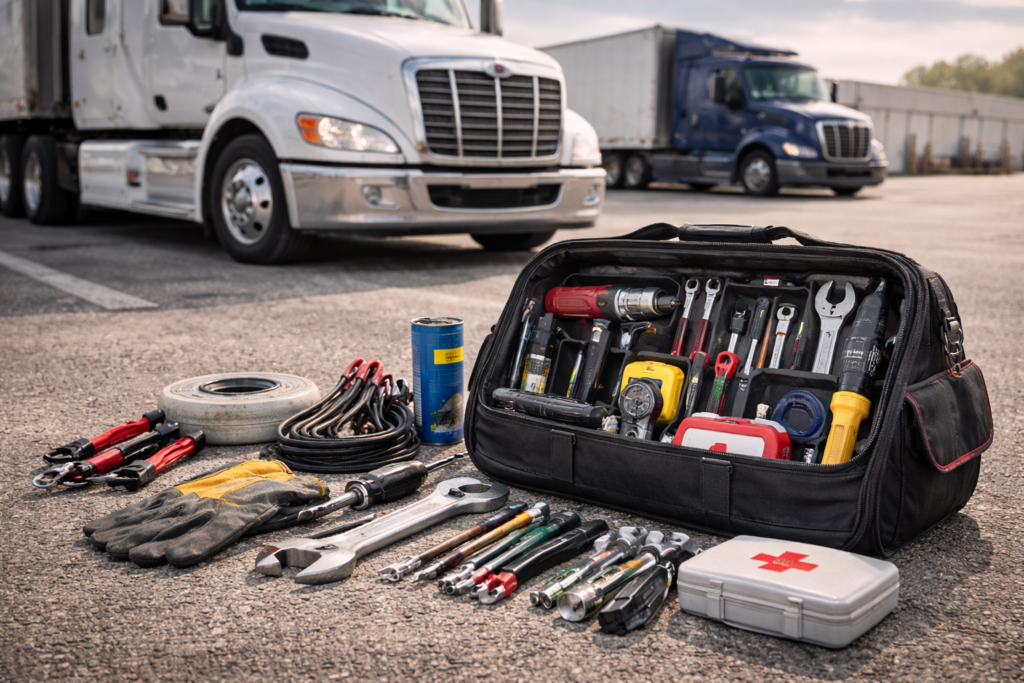
The core hand-tool kit is twelve items. It handles the fasteners, clamps and brackets you will actually be asked to deal with on a shoulder, and nothing more — the moment a repair needs a torque spec, it is a shop job.
| # | Tool | What it is actually for on the road |
|---|---|---|
| 4 | 3/8″ drive socket set, SAE and metric | Trucks mix both. A metric-only set will strand you on a US-built bracket |
| 5 | 1/2″ drive breaker bar | Fasteners on a truck are torqued past what a ratchet will move |
| 6 | Combination wrench set | Where a socket will not fit — clamps, brackets, fittings |
| 7 | Adjustable wrench | The one tool that fits the fitting you did not plan for |
| 8 | Locking pliers (vise grips) | Rounded fasteners, and holding a part while you do something else |
| 9 | Water-pump / channel-lock pliers | Hose clamps, air fittings, anything round |
| 10 | Needle-nose pliers | Electrical terminals, cotter pins, retrieving what you dropped |
| 11 | Screwdriver set, flat and Phillips | Lamp lenses, panel screws, hose clamps |
| 12 | Ball-peen hammer | Frozen pins, seized slack adjusters, persuasion |
| 13 | Pry bar | Landing gear, fifth-wheel release, stuck kingpin plates |
| 14 | Utility knife with spare blades | Strap ends, packaging, seals |
| 15 | Hacksaw with spare blades | Cutting a strap, a zip tie run, or a bolt you will replace |
Two rules about this set. Buy it once at a grade that will not round a fastener, because the failure mode of a cheap socket is not that it wears out — it is that it destroys the bolt head at the moment you need it. And keep it in a hard case that latches, because a tool that has migrated under a bunk is a tool you do not have.
What Tools Do You Need for a Tire or Air-System Problem?
Nine items, and this is the group that most often turns a two-hour delay into a fifteen-minute one.
| # | Item | Why it earns its space |
|---|---|---|
| 16 | Tread depth gauge | 49 CFR 393.75 sets the minimums; see below |
| 17 | Tire pressure gauge | Under-inflation is the most common cause of the failure you are trying to avoid |
| 18 | Tire thumper or mallet | A fast walk-around check, not a substitute for the gauge |
| 19 | Air hose with glad-hand fitting | Lets you air a tire from the truck’s own supply |
| 20 | Spare glad-hand seals | The single cheapest part that ends a trip when it splits |
| 21 | Spare glad-hand couplers | When the seal is not the thing that broke |
| 22 | Valve stem core tool and spare cores | A leaking core is a five-minute fix with the tool and a tow without it |
| 23 | Tire chains, where the season and route require them | Carrying them is often the legal requirement, not using them |
| 24 | Chain tensioners and bungees | Chains without tensioners come off, at speed |
The tread numbers are regulated, so measure rather than judge. Under 49 CFR 393.75, front-wheel tires on a bus, truck or truck tractor “shall have a tread groove pattern depth of at least 4/32 of an inch when measured at any point on a major tread groove”; all other tires need “at least 2/32 of an inch.” The regulation also bans operating on a tire that “has body ply or belt material exposed through the tread or sidewall”, has “any tread or sidewall separation”, or “is flat or has an audible leak.” A gauge costs almost nothing and turns all of that from a judgment call into a reading.
What Electrical and Lighting Tools Should You Carry?
Seven. Lighting violations are among the easiest findings for an inspector to make and among the easiest for a driver to fix on the spot — but only with the right four items in the box.
| # | Item | Note |
|---|---|---|
| 25 | Digital multimeter | Tells you whether the problem is the lamp, the wire or the ground |
| 26 | Circuit test light | Faster than the meter for the yes/no question |
| 27 | Spare marker and clearance lamps, with bulbs | Match them to your trailer before you need them |
| 28 | Spare 7-way trailer cord | The failure that takes the whole trailer dark |
| 29 | Dielectric grease | The reason the connection you just fixed lasts more than a week |
| 30 | Wire stripper/crimper and assorted terminals | Repairs that survive vibration |
| 31 | Headlamp with spare batteries | Hands-free, because both hands will be busy |
Note that 393.95(b) already requires the spare fuses. Items 25 to 31 are what let you find out which fuse and why.
What Securement Equipment Do You Need?
Eight, and this group is entirely determined by your freight type — a dry van operator needs a fraction of what a flatbed operator carries, and a flatbed operator who buys the van kit is not equipped.
| # | Item | Freight type |
|---|---|---|
| 32 | Ratchet straps, rated to the load | All |
| 33 | Winch bar | Flatbed |
| 34 | Grade 70 transport chain with binders | Flatbed, heavy equipment |
| 35 | Corner protectors | Flatbed, anything with an edge that cuts webbing |
| 36 | Edge guards and rubber matting | Flatbed, stepdeck |
| 37 | Load bars / cargo bars | Dry van, reefer |
| 38 | Tarps with bungees | Flatbed |
| 39 | Padlocks and numbered seals | All, and required by many shippers |
The working-load rating on a strap or chain is not decoration. Securement is enforced against the aggregate rating of the devices used, and a strap whose label is worn off cannot be counted toward it — which is a reason to replace worn webbing rather than keep it as a spare.
What Fluids and Consumables Belong on the Truck?
Six, all of which are cheap and all of which are unobtainable at 2 a.m. on the shoulder.
| # | Item | Note |
|---|---|---|
| 40 | Washer fluid, rated for the season | Summer fluid freezes and takes the pump with it |
| 41 | Engine oil and coolant for top-up | Matched to the spec in your manual, not whatever the truck stop has |
| 42 | Diesel exhaust fluid | Running out derates the engine, and the derate is not negotiable |
| 43 | Fuel anti-gel additive, in winter | Add before the temperature drops, not after |
| 44 | Zip ties and self-fusing silicone tape | The two items that hold a repair together to the next exit |
| 45 | Shop rags and waterless hand cleaner | So the repair does not end up on the paperwork |
What Safety and Documentation Items Complete the Kit?
Five. Four of them are about not getting hurt, and the fifth is about not getting held.
| # | Item | Note |
|---|---|---|
| 46 | Work gloves and safety glasses | Every item above is used at the roadside, in the dark |
| 47 | High-visibility vest | Required at many facilities and sensible everywhere else |
| 48 | Wheel chocks | Before you go under, beside or in front of anything |
| 49 | First-aid kit | Not federally required on a general-freight CMV — carry it anyway |
| 50 | Current registration, insurance, permits, and the inspection report book | The documents an officer asks for before looking at anything mechanical |
That is fifty, with the first three carrying the force of regulation and the other forty-seven carrying the force of experience.
What Tools Are Not Worth Carrying?
A shorter list, and it saves weight, which is payload.
- Anything requiring a torque specification you do not have. Wheel fasteners, brake components and driveline work are shop jobs. Carrying the tool encourages the attempt.
- A duplicate of what the tractor already provides. If your truck has an onboard air supply, a separate 12-volt compressor is redundant weight.
- Specialty tools for a system you are contractually not allowed to touch. Many lease and maintenance agreements void coverage on driver repairs; check before you buy the tool.
- A second set of everything “just in case.” Every pound of tools is a pound off your legal payload — the federal gross vehicle weight ceiling on the Interstate System is 80,000 pounds (23 CFR 658.17(b)), and a tool box does not get an exemption.
When Should You Use the Tool and When Should You Call?
The honest test is not whether you can do the repair. It is whether a failed attempt makes the tow worse. Replacing a marker lamp, a glad-hand seal, a fuse or a valve core fails safe — worst case, you are where you started. Anything touching brakes, wheels, steering or the driveline fails unsafe, and a partially completed repair on those systems turns a service call into a recovery.
The kit above is built around that line. It carries everything for the first category and almost nothing for the second.
FAQ
What are truck essentials?
Truck essentials are the items you cannot legally or practically operate without: a rated fire extinguisher, spare fuses and three warning triangles required by 49 CFR 393.95, plus a basic hand tool set, a tread depth and pressure gauge, spare lamps and fuses, and securement gear matched to your freight.
What are service truck must-haves?
A service truck adds to the standard kit: a larger socket and wrench range, an onboard air supply, work lighting, a jack rated for the equipment being serviced, and fluid stock. The three items required by 49 CFR 393.95 apply to a service truck exactly as they do to any other power unit.
What is a trucking kit?
A trucking kit is the assembled set of tools, spares and consumables a driver keeps on the vehicle to handle roadside problems and to satisfy the equipment requirements in the Federal Motor Carrier Safety Regulations. It is not a fixed product — it is built around freight type, route and season.
What tools do you need for a semi truck?
The same three regulated items every power unit needs, plus a 3/8″ socket set in SAE and metric, a breaker bar, pliers, a tread depth gauge, spare glad-hand seals, spare lamps and a multimeter. A semi’s extra needs over a straight truck are mostly air-system spares and securement gear.
Do “transportation tools” mean equipment or software?
Both, and search results mix them. On this page “tools” means physical equipment carried on the vehicle. Transportation management software — TMS, load boards, ELD platforms — is a separate category and is not covered here.
Written by Alex Morgan, Logity Dispatch. Equipment requirements verified 31.08.2026 against 49 CFR 393.95, 49 CFR 392.22 and 49 CFR 393.75, CFR 2025 annual edition (title 49 volume 5, revised 01.10.2025), retrieved from govinfo.gov; the weight ceiling against 23 CFR 658.17(b), CFR 2025 annual edition. No prices are listed on this page: tool pricing could not be sourced and dated, and an undated price is not a fact. State requirements, seasonal chain laws and shipper rules can add to the federal minimums above — check the ones on your lane.