Table of Content
- What is a CDL?
- What are the three CDL classes?
- Class A vs Class B: what actually changes?
- How do the three CDL classes compare?
- Which CDL class is most common, and which should you get?
- What is a CLP, and how is it different from a CDL?
- How do you get a CDL, step by step?
- What endorsements sit on top of a class?
- Frequently asked questions
Short answer
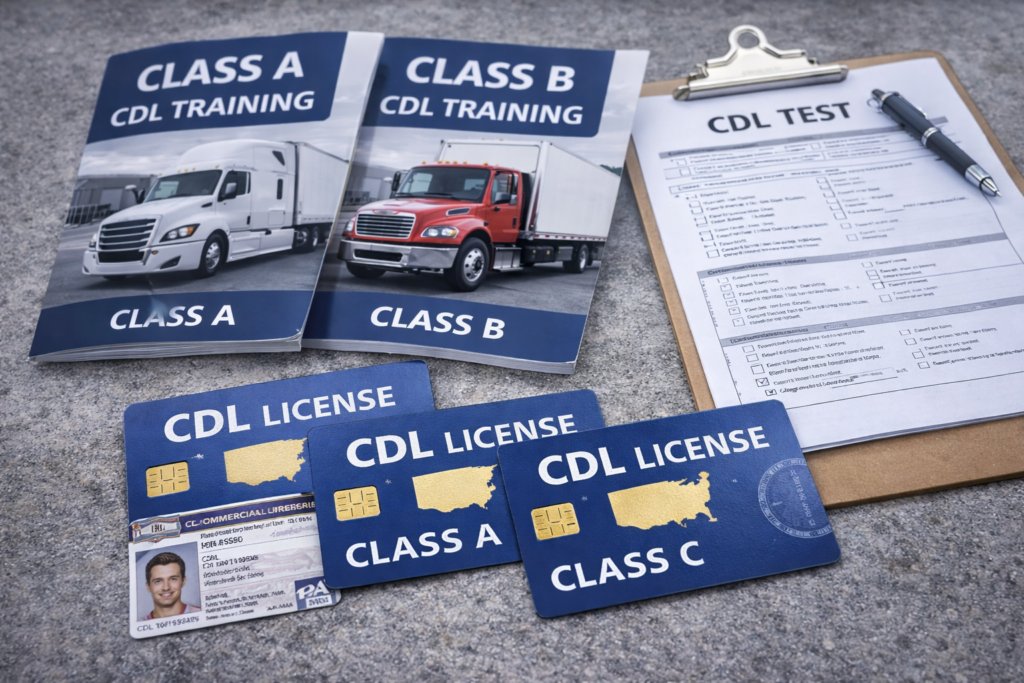
A commercial driver’s license comes in three classes. Class A covers combination vehicles rated 26,001 pounds or more when the towed unit is rated over 10,000 pounds. Class B covers heavy single vehicles. Class C covers smaller vehicles that carry 16 or more passengers including the driver, or hazardous materials. Class A also authorizes B and C vehicles.
Written by the Logity Dispatch team for drivers choosing a license class and for the carriers who hire them. Every class definition, age rule and permit rule below was read from the regulation itself on 14 September 2026, using the eCFR copy of title 49 issued 9 September 2026. Where a number is a state matter rather than a federal one, we say so instead of quoting a figure that only holds in one state.
What is a CDL?
A commercial driver’s license is the federal credential a driver must hold to operate a commercial motor vehicle in the United States. It exists because of the Commercial Motor Vehicle Safety Act of 1986, which ended the practice of one driver holding licenses in several states and set a single national knowledge and skills standard.
The license is issued by your state, but the rules that define it are federal. That split explains most of the confusion people run into: the classes, the tests and the age floors come from 49 CFR parts 380, 383 and 391, while fees, renewal periods and appointment waits are set where you live.
Holding a CDL also puts you inside a compliance system that does not apply to ordinary drivers: medical certification, the federal drug and alcohol testing program, and hours of service limits.
What are the three CDL classes?
The regulation does not call them classes. 49 CFR 383.91(a) calls them vehicle groups, and the letter on your license is the group you tested in. The dividing line is weight rating, not the size of the truck or what it is carrying.
Class A CDL
A Class A CDL is the combination group. Under 383.91(a)(1) it is any combination of vehicles with a gross combination weight rating of 26,001 pounds or more, provided the vehicle or vehicles being towed are rated over 10,000 pounds.
Two conditions, both of which have to hold. A tractor pulling a 53-foot trailer is the obvious case. A pickup pulling a heavy equipment trailer can also be Class A, which surprises people who think the class is about the tractor. If you are weighing that boundary, the difference between tare, net and gross weight is worth reading before you buy a trailer.
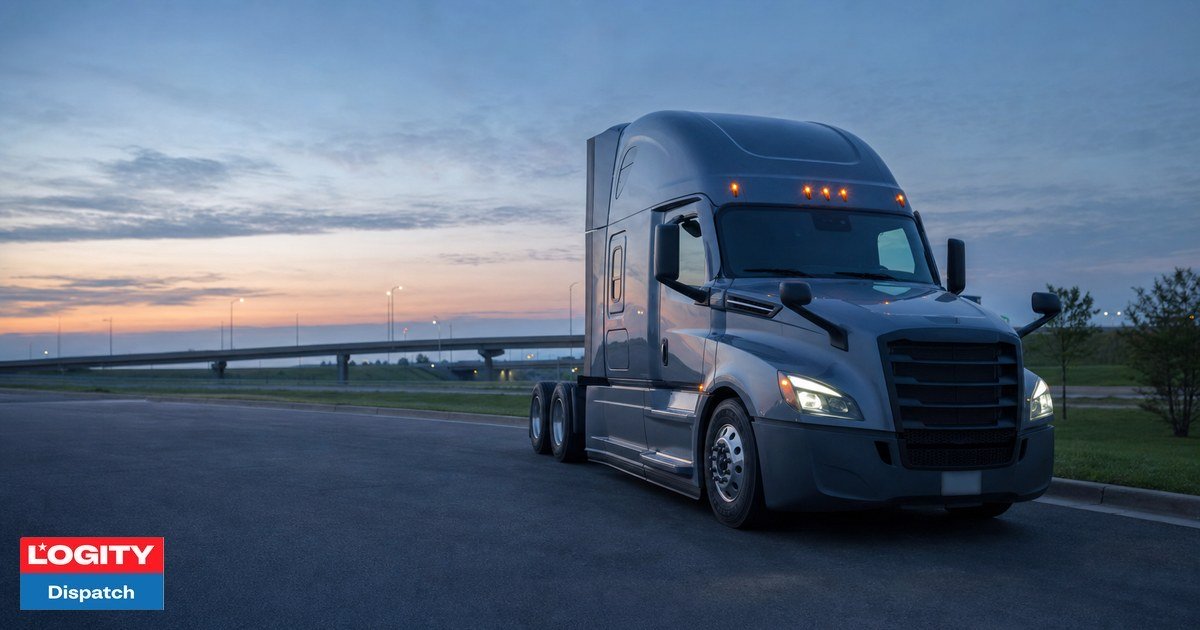
- Semi-trucks: a tractor unit with one or more loaded semi-trailers.
- Flatbeds and step decks hauling oversized or irregular freight.
- Tanker combinations carrying liquids or gases.
- Livestock carriers.
- Double and triple trailer combinations, which also need the T endorsement.
Class B CDL
A Class B CDL is the heavy straight vehicle group. Under 383.91(a)(2) it is any single vehicle rated 26,001 pounds or more, or such a vehicle towing a trailer rated at 10,000 pounds or less.
The weight floor is the same as Class A. What changes is that the mass sits on one frame. If you want the detail on what counts as a straight truck, we have a breakdown of straight truck types.
- Straight trucks and larger box trucks used for local delivery.
- City, transit, tour and most school buses.
- Dump trucks with a small trailer behind them.
- Cement mixers, refuse trucks and other heavy single-frame equipment.
Class C CDL
A Class C CDL is the small vehicle group, defined by cargo rather than weight. Under 383.91(a)(3) it is any vehicle or combination that meets neither the Class A nor the Class B definition, but that is either designed to carry 16 or more passengers including the driver, or is used to transport hazardous materials requiring placards.
This is the class most often described wrongly. It is not a junior CDL and it is not a step toward Class A. It exists so that a light vehicle still falls under federal licensing when what it carries makes it dangerous.
- Shuttle and passenger vans seating 16 or more including the driver.
- Smaller school buses under the Class B weight floor.
- Straight trucks carrying placarded hazmat, which also need the H endorsement.
Class A vs Class B: what actually changes?
Both start at the same 26,001 pounds. The question the regulation asks is whether the weight is towed or carried, and how heavy the towed part is.
| Question | Class A | Class B |
|---|---|---|
| What the rating applies to | The combination (GCWR) | The single vehicle (GVWR) |
| Weight floor | 26,001 lb or more | 26,001 lb or more |
| Towed unit | Rated over 10,000 lb | Rated 10,000 lb or less, or none |
| What else it lets you drive | Class B and Class C vehicles | Class C vehicles |
| Typical work | Over the road, flatbed, tanker, reefer | Local delivery, transit, dump, refuse |
The last row is the one that decides careers. 49 CFR 383.91(c) says a driver who passed the Class A tests may operate Class B and Class C vehicles, and a driver who passed the Class B tests may operate Class C vehicles, provided the required endorsements are held. The reverse never applies: a Class B holder cannot pull a heavy trailer, whatever their experience.
How do the three CDL classes compare?
| Class | Federal definition (49 CFR 383.91) | Typical vehicles | Also authorizes |
|---|---|---|---|
| A | Combination rated 26,001 lb or more, towed unit over 10,000 lb | Tractor-trailer, flatbed, tanker combination, livestock | Class B and C |
| B | Single vehicle rated 26,001 lb or more, or towing 10,000 lb or less | Straight truck, large box truck, bus, dump truck | Class C |
| C | Neither A nor B, but 16 or more passengers including the driver, or placarded hazmat | Shuttle van, small school bus, hazmat straight truck | Nothing above it |
Which CDL class is most common, and which should you get?
Class A is the most widely held and the most useful, for one structural reason rather than a preference: it is the only class that authorizes the other two. A Class A holder with the right endorsements can legally take a tractor-trailer run, a straight truck run and a passenger van run. Nobody below them can.
- Take Class A if you want the widest set of jobs, plan to run over the road, or expect to pull anything heavy. It is also the usual license for hot shot operators once the trailer goes over 10,000 pounds.
- Take Class B if you know your work will stay local and single-frame: transit, refuse, concrete, school district routes.
- Take Class C only when the vehicle you already drive falls into that group, usually passenger vans or placarded hazmat.
One caution about pay comparisons: the class does not set the rate, the freight does. If you are modelling income, look at what becoming an owner-operator costs rather than at a class-to-salary chart.
What is a CLP, and how is it different from a CDL?
A commercial learner’s permit is a separate document that lets you train behind the wheel on public roads before you hold a CDL. 49 CFR 383.25 sets the conditions, and two of them are stricter than most drivers expect.
- The accompanying CDL holder must hold the proper group and endorsements for that vehicle and trip, and must be physically in the front seat next to you. In a passenger vehicle they may instead sit directly behind or in the first row behind the driver. Either way they must keep you under direct observation.
- A CLP holder may not operate a commercial motor vehicle transporting hazardous materials at all.
- Only three endorsements are allowed on a CLP: passenger, school bus and tank. All other federal endorsements are prohibited until the CDL is issued.
- The CLP holder must be at least 18 and must hold a valid ordinary driver’s license from the same state.
| Aspect | CDL | CLP |
|---|---|---|
| Purpose | Operate commercially on your own | Behind-the-wheel training under supervision |
| Supervision | None required | A qualified CDL holder in the front seat |
| Hazmat | Allowed with the H endorsement | Prohibited outright |
| Validity | Set by your state, commonly several years | One year from first issue, under 383.25(c) |
| Renewal | State renewal cycle | Renewable, but not past one year from first issue without retesting |
A note on a number you will see elsewhere. Many articles, including an earlier version of this one, say a CLP lasts 180 days. That was the old rule. The current text of 383.25(c) reads “valid for no more than one year from the initial date of issuance,” and permits issued for a shorter period may be renewed within that year without retaking the knowledge tests. Checked against the eCFR on 14 September 2026.
How do you get a CDL, step by step?
- Check the age rule for the work you want. Eighteen is enough for a CLP and for intrastate driving. 49 CFR 391.11(b)(1) requires 21 for interstate commerce.
- Hold a valid ordinary driver’s license issued by the state that will issue your CLP.
- Pass the DOT physical and get your medical examiner’s certificate from a provider on the National Registry.
- Pass the general knowledge test for the group you want, plus any endorsement knowledge tests, and receive your CLP.
- Complete entry-level driver training with a provider on the FMCSA Training Provider Registry. Under 49 CFR 380.603 this applies to anyone who obtained a CLP on or after 7 February 2022, and the theory and behind-the-wheel portions must be finished within one year of each other.
- Hold the CLP for at least 14 days before taking the skills test.
- Pass the skills test in a representative vehicle for your group: pre-trip inspection, basic control skills, and an on-road drive.
- Collect your endorsements. Hazmat also requires a TSA security threat assessment, which takes weeks, so start it early if you need it.
Two of these steps are where people lose months. Entry-level driver training is not optional for new applicants and the provider must be on the federal registry, not merely a local school. And the hazmat background check runs on TSA time, not yours.
What endorsements sit on top of a class?
The class says what you may drive. Endorsements say what you may do with it. They are not a higher class and they do not change your weight authority. 49 CFR 383.93 sets which ones need a knowledge test and which also need a skills test, and 49 CFR 383.153(a)(9) fixes the letter codes printed on the card.
| Code | What it covers | Extra requirement |
|---|---|---|
| H | Placarded hazardous materials | Knowledge test, plus the TSA security threat assessment required by 383.71(b)(8) |
| N | Tank vehicles | Knowledge test |
| P | Passengers | Knowledge and skills test, and the endorsement is class specific |
| S | School bus | Knowledge and skills test, held with P |
| T | Double and triple trailers | Knowledge test. Doubles and triples are combination vehicles, so this rides on a Class A |
| X | Tank plus hazardous materials | Both underlying tests |
The same regulation prints the other direction as well. 49 CFR 383.153(a)(10) lists the restriction codes a state can stamp on your card, and they narrow what your class allows: L no air brakes, Z no full air brakes, E no manual transmission, O no tractor-trailer, K intrastate only, M and N passenger-vehicle limits, and V for a medical variance. The E and O codes catch drivers out most often, because testing in an automatic truck or in a straight vehicle writes the limit onto a license that otherwise reads Class A.
Frequently asked questions
What is the difference between a Class A and a Class B CDL?
Class A is defined by the combination: the vehicle and trailer together rate 26,001 pounds or more and the towed unit rates over 10,000 pounds. Class B is a single heavy vehicle that may tow only a light trailer. Class A also covers Class B vehicles.
What can you drive with a Class C CDL?
A Class C CDL covers vehicles that meet neither the Class A nor the Class B definition but carry 16 or more passengers including the driver, or transport placarded hazardous materials. Shuttle vans, smaller school buses and hazmat straight trucks are typical examples.
How long is a commercial learner’s permit valid?
One year from the date it was first issued, under 49 CFR 383.25(c). A permit issued for a shorter period can be renewed, but it cannot stay valid more than one year from that first issue date without retaking the knowledge tests.
How old do you have to be to get a CDL?
You must be 18 to hold a commercial learner’s permit. Federal rules require a driver to be at least 21 to operate in interstate commerce or to haul placarded hazardous materials, so an 18-year-old CDL holder is limited to intrastate work.
Which CDL class should a new driver get?
Class A, in most cases. It authorizes Class B and Class C vehicles as well, so one license opens tractor-trailer, straight-truck and van work. Choose Class B only if you know you will stay with buses, dump trucks or local box trucks.
Choosing a class is the first decision. Keeping the truck loaded afterwards is the one that pays for it. Logity Dispatch runs dispatching for owner-operators and small fleets across every class above.
Sources checked on 14 September 2026, against the eCFR copy of title 49 issued 9 September 2026: 49 CFR 383.25 (commercial learner’s permit), 383.71 (driver application procedures), 383.91 (commercial motor vehicle groups), 383.93 (endorsements), 383.153 (endorsement and restriction codes), 380.603 (entry-level driver training applicability) and 391.11 (general qualifications of drivers). Fees, renewal periods and skills-test scheduling are set by your state licensing agency and are not covered by these federal sections.