Table of Content
- What the rule actually requires
- Four cases where a paper log replaces the ELD
- What you do with the paper log
- Short-haul: when no log is needed at all
- Be Ready Before the Auditor Calls
- The 8 days in 30 rule and short-haul together
- Operations where part 395 does not apply
- A seasonal rule that is not a log exemption
- Before you unplug the ELD
- Frequently asked questions
Short answer
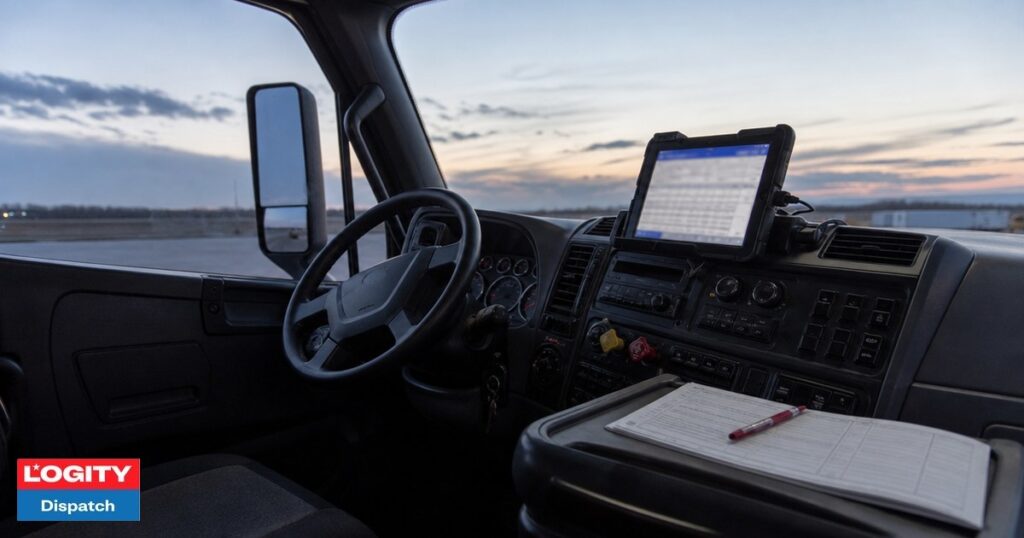
Being exempt from the ELD is not the same as being exempt from logs. Under 49 CFR 395.8, four situations let you keep a paper record of duty status instead of an ELD: you need a log on no more than 8 days in any 30-day period, you run driveaway-towaway where the vehicle you drive is part of the shipment, you tow a motor home or RV trailer in driveaway-towaway, or the truck was manufactured before model year 2000 according to the VIN on the registration. In all four you still keep a paper log. The short-haul exemptions in 395.1(e) go further: if every condition is met, you need no log at all, but the carrier must keep 6 months of time records.
What the rule actually requires
49 CFR 395.8 starts from one requirement: a motor carrier must require each driver to record duty status for each 24-hour period. The default method is an ELD. Paragraph (a)(1)(i) says a carrier operating commercial motor vehicles must install and require each of its drivers to use an ELD, subject to the exceptions in paragraph (a)(1)(ii).
So there are two separate questions for an owner-operator. First, do you have to record duty status at all? Second, if you do, does it have to be on an ELD? The exemptions answer different questions, and an answer to the second one does not answer the first.
Four cases where a paper log replaces the ELD
Paragraph (a)(1)(ii)(A) lets a carrier require a manual record of duty status instead of an ELD if the driver is operating a commercial motor vehicle:
- On no more than 8 days in any 30-day period. The rule counts the days on which a record of duty status is required, not the days you drive.
- In driveaway-towaway where the vehicle being driven is part of the shipment. The truck you drive is the cargo being delivered.
- In driveaway-towaway where the vehicle being transported is a motor home or a recreation vehicle trailer.
- That was manufactured before model year 2000. The rule ties this to the vehicle identification number as shown on the vehicle’s registration, not to the engine or to a rebuild.
None of these four removes the log. Paragraph (a)(1)(ii)(B) says the record must be recorded in duplicate for each 24-hour period, on the grid shown in paragraph (g) of the same section. Paragraph (d) lists what the form must carry besides the grid, including the date, total miles driving today, truck and trailer number, the carrier’s name and main office address, the driver’s signature, and shipping document numbers or the shipper and commodity.
What you do with the paper log
The paper log has its own handling rules in 395.8:
- The driver submits the record to the carrier within 13 days of the 24-hour period it covers.
- The carrier keeps records of duty status and supporting documents for each driver for at least 6 months from the date of receipt.
- The driver keeps a copy of the record for the previous 7 consecutive days, in the driver’s possession and available for inspection while on duty.
For an owner-operator running under your own authority, you are both the carrier and the driver here, so both sides of that list are yours.
Short-haul: when no log is needed at all
49 CFR 395.1(e) has two short-haul exemptions. They do not swap the ELD for paper. They take the driver out of 395.8 entirely, as long as every condition is met.
The 150 air-mile radius driver, 395.1(e)(1)
A driver is exempt from 395.8 and 395.11 if all four of these hold:
- The driver operates within a 150 air-mile radius, which the rule states as 172.6 statute miles, of the normal work reporting location.
- The driver, except a driver-salesperson, returns to the work reporting location and is released from work within 14 consecutive hours.
- A property-carrying driver has at least 10 consecutive hours off duty separating each 14 hours on duty.
- The motor carrier keeps accurate and true time records for 6 months showing the time the driver reports for duty each day, the total hours on duty each day, the time the driver is released each day, and, for drivers used for the first time or intermittently, the total time for the preceding 7 days.
Property trucks that need no CDL, 395.1(e)(2)
A driver of a property-carrying commercial motor vehicle that does not require a commercial driver’s license is exempt from 395.3(a)(2), 395.8 and 395.11 if the driver stays within a 150 air-mile radius of the normal work reporting location, returns there at the end of each duty tour, and does not drive after the 14th hour after coming on duty on 5 days of any 7 consecutive days, or after the 16th hour on 2 days of any 7 consecutive days. The carrier keeps the same 6 months of time records. A driver using this exemption is not eligible to use 395.1(e)(1), (g) or (o).
The time records are one of the conditions of the exemption, so a short-haul operation with no time records does not meet the exemption’s conditions.

The 8 days in 30 rule and short-haul together
The two parts of the rule meet on the days that fall outside short-haul. On a day the driver meets every condition of 395.1(e)(1), no record of duty status is required. On a day the driver does not, a record is required. Because paragraph (a)(1)(ii)(A)(1) counts the days on which a record is required, a driver who needs a log on no more than 8 of any 30 days can keep that log on paper. Past 8 days in a 30-day period, this exception no longer fits, and unless another one applies, so does the ELD requirement in paragraph (a)(1)(i).
Operations where part 395 does not apply
Two more exemptions in 395.1 go beyond logs. They take the whole of part 395 off the table, hours limits included:
- Agricultural operations, 395.1(k). During planting and harvesting periods, as determined by each State, part 395 does not apply to drivers transporting agricultural commodities from the source to a location within a 150 air-mile radius, farm supplies from a distribution point to a farm or other place of use within 150 air miles, farm supplies from a wholesale to a retail distribution point within 150 air miles, or livestock within a 150 air-mile radius from the final destination of the livestock. The dates come from the State, not from the driver.
- Utility service vehicles, 395.1(n). Part 395 does not apply to a driver of a utility service vehicle as defined in 395.2.
A seasonal rule that is not a log exemption
395.1(f) covers retail store deliveries from December 10 to December 25. It applies to drivers making only local deliveries from retail stores or retail catalog businesses to the ultimate consumer, within a 100 air-mile radius of the work reporting location. What it removes is 395.3(a) and (b), the hours limits. It does not mention 395.8, so it is not an exemption from the log or from the ELD.
| Situation | ELD | Log |
|---|---|---|
| Log needed on 8 days or fewer in any 30 | Not required | Paper log |
| Driveaway-towaway, vehicle is the shipment | Not required | Paper log |
| Driveaway-towaway of a motor home or RV trailer | Not required | Paper log |
| Truck manufactured before model year 2000 | Not required | Paper log |
| 150 air-mile short-haul, all conditions met | Not required | None, carrier keeps time records |
| Non-CDL property truck, all conditions met | Not required | None, carrier keeps time records |
| Agricultural, State planting and harvest periods | Part 395 does not apply | Part 395 does not apply |
| Retail store deliveries, December 10 to 25 | Not changed | Not changed |
Before you unplug the ELD
Check which question your exemption answers. A pre-2000 truck or a light 30-day schedule moves you from ELD to paper, and you still owe the log, in duplicate, on the grid. A short-haul day removes the log only when every condition is met and the time records exist. Neither the four ELD exceptions nor 395.1(e)(1) removes the hours limits in 395.3, so the 11 and 14 hour limits stay part of the plan. If you do run on an ELD, planning loads around the clock is where the device turns into a dispatch tool.
Frequently asked questions
Is a pre-2000 truck exempt from the ELD?
Yes, under 49 CFR 395.8(a)(1)(ii)(A)(4), if the vehicle was manufactured before model year 2000 as reflected in the VIN on its registration. The driver still has to keep a paper record of duty status.
What is the 8 days in 30 ELD exemption?
A carrier may use paper logs instead of an ELD for a driver who needs a record of duty status on no more than 8 days within any 30-day period. The count is of days a log is required.
Do short-haul drivers need an ELD?
A driver who meets every condition of the 150 air-mile exemption in 395.1(e)(1) is exempt from 395.8, so no log and no ELD. The carrier must keep 6 months of time records showing report time, total on-duty hours and release time for each day.
Is an ELD exemption the same as a log exemption?
No. The four ELD exceptions in 395.8 replace the ELD with a paper log. Only exemptions that remove 395.8, such as the short-haul exemptions in 395.1(e), remove the log.
How long do I keep paper logs?
The carrier keeps records of duty status and supporting documents for at least 6 months from receipt. The driver keeps a copy of the previous 7 consecutive days available for inspection while on duty.