Table of Content
- What Is a SCAC Code?
- What Does a SCAC Code Look Like?
- Is a SCAC Code the Same Thing as a SCAC Number?
- Who Is Required to Have a SCAC Code?
- What Happens If You Reach the Border Without a SCAC?
- How Do You Get a SCAC Code?
- How Long Does It Take to Get a SCAC Code?
- How Is a SCAC Different From a USDOT Number, MC Number and EIN?
- Why Do Freight Brokers and Freight Forwarders Need a SCAC Code?
Short answer
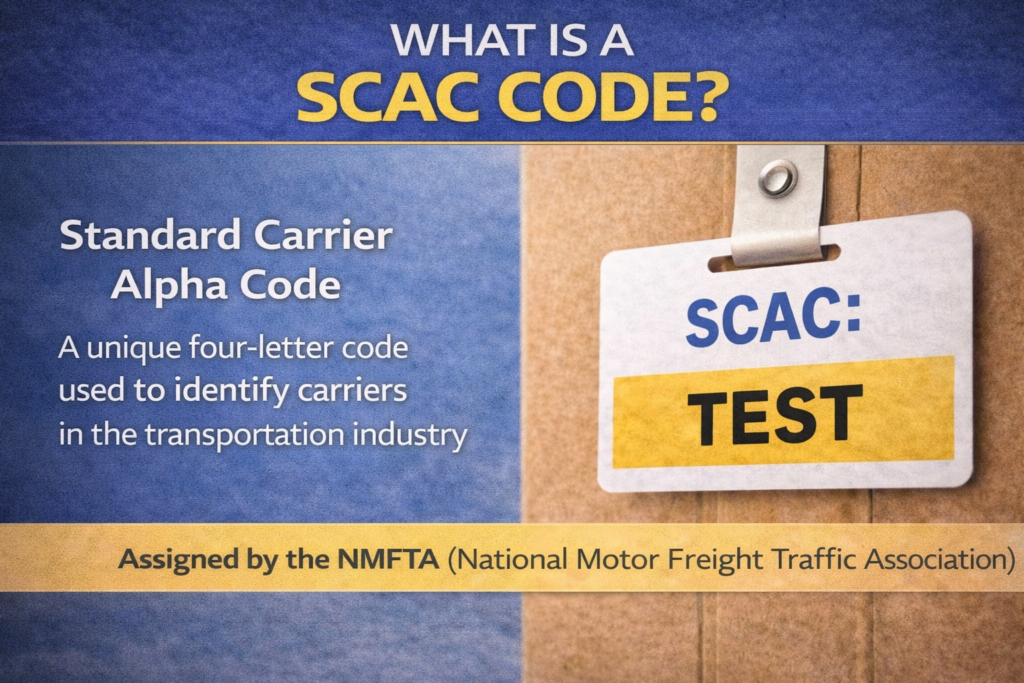
A SCAC is a four-character Standard Carrier Alpha Code assigned to a carrier by the National Motor Freight Traffic Association. US Customs regulations require it to identify the carrier on truck cargo crossing into the United States and on export cargo filings, and it is the code that goes in front of every bill of lading number.
Most pages on this subject tell you a SCAC is “an industry identifier”. That is true and useless. The reason a SCAC matters is that federal regulation names it by title in four separate places and makes your freight undeliverable without it in one of them. This page gives you those citations, tells you who is actually required to hold a code, walks the application, and says plainly which numbers we could not verify rather than repeating them.
What Is a SCAC Code?
SCAC
A four-character Standard Carrier Alpha Code assigned to a carrier by the National Motor Freight Traffic Association and published in its Directory of Standard Multi-Modal Carrier and Tariff Agent Codes. It identifies the carrier (not the truck, not the shipment) in electronic freight documents.
The definition is not ours. It is written into US Customs regulation, in the section that governs bill of lading numbering:
“The first element will be the first four characters consisting of the carrier or issuer’s four digit Standard Carrier Alpha Code (SCAC) assigned to the carrier in the National Motor Freight Traffic Association, Inc., Directory of Standard Multi-Modal Carrier and Tariff Agent Codes, applicable supplements thereto and reissues thereof.”
19 CFR 4.7a(c)(2)(iii), live eCFR as of 27.08.2026.
Three things follow from that sentence, and they answer most of the confusion around the term.
A SCAC belongs to a company, not to a vehicle. One carrier holds one code no matter how many trucks it runs. It is not a plate, not a VIN, not a trailer number.
NMFTA assigns it, not FMCSA and not DOT. This is the single most common mistake in the category. Your USDOT number and your MC number come from FMCSA. Your SCAC does not. They are different issuers, different applications, and holding one has no bearing on holding another.
The code is four characters. Both Customs regulations that name a length say four: 19 CFR 4.7a(c)(2)(iii) says “four digit”, and 19 CFR 192.14(c) says “the unique carrier identifier is the 4-character Standard Carrier Alpha Code (SCAC)”. If someone hands you a two- or three-character code and calls it a SCAC, they have handed you something else.
One footnote worth having, because we see the search for it: the term is very often typed as “SCAT code”. There is no such thing in freight. It is the same code, mistyped.
What Does a SCAC Code Look Like?
The code itself is four letters. Where it gets interesting is what sits behind it, because the regulation defines the whole string a SCAC starts.
A bill of lading number under 19 CFR 4.7a(c)(2)(iii) is built in two elements:
| Element | Length | Content |
|---|---|---|
| First | Exactly 4 characters | The carrier or issuer’s SCAC |
| Second | Up to 12 characters | Alphabetic, numeric, or both: the carrier’s own reference |
| Total | Up to 16 characters | The unique bill of lading identifier |
The same regulation adds a rule people forget until it bites them: that identifier “shall not be used by the carrier, freight forwarder or issuer for another bill of lading for a period of 3 years after issuance”. Your numbering scheme has to be able to run three years without repeating.
There is a second structure, on the equipment side. FMCSA’s intermodal identification rule describes an item of equipment being identified by “the Vehicle Identification Number (VIN) and 4-character Standard Carrier Alpha Code (SCAC) code and 6-digit unique identifying number”, and requires the provider’s lookup database to answer a query submitted as “SCAC plus trailing digits” (49 CFR 390.21(g)(4)(iii) to (v)). That is where the container and chassis numbers you see on the yard come from: four letters of SCAC, then digits.
We are deliberately not printing a live carrier’s code as an example. Codes are assigned, reassigned and retired, and an example that ages into a wrong answer is worse than none.
Is a SCAC Code the Same Thing as a SCAC Number?
Yes. They are two names for one thing, and the second name is a slight misnomer: the code is alphabetic, which is what the “Alpha” in Standard Carrier Alpha Code refers to.
You will see all of these used for the same four characters: SCAC, SCAC code, SCAC number, carrier SCAC, carrier code. Documents and portals are inconsistent about which they ask for. If a form asks for a “SCAC number” and you have a “SCAC code”, you have the right thing.
Who Is Required to Have a SCAC Code?
There is no single regulation that says “carriers must obtain a SCAC”. What exists is a set of filings that cannot be completed without one. That is the useful way to answer the question: not who is required to hold a code, but which jobs you cannot do without one.
| Situation | Is a SCAC required? | Where that comes from |
|---|---|---|
| Hauling commercial cargo by truck into the United States | Yes: carrier identification in the advance filing is the SCAC | 19 CFR 123.92(d)(2) |
| Filing outward cargo information for export by vessel, rail or truck | Yes: “the unique carrier identifier is the 4-character SCAC” | 19 CFR 192.14(c) |
| Preparing Electronic Export Information (EEI) for vessel, rail or truck | Yes: SCAC is the carrier classification schedule for those modes | 15 CFR 30.61(g) |
| Issuing bills of lading under Customs rules | Yes: the first four characters of the BOL number are the SCAC | 19 CFR 4.7a(c)(2)(iii) |
| Providing intermodal equipment for interchange | In practice yes: the identification methods and the required lookup database are built on SCAC plus trailing digits | 49 CFR 390.21(g)(4) |
| Purely domestic interstate for-hire trucking, no border crossing, no intermodal | Not by federal regulation, but see below | n/a |
That last row is the honest one, and it is where most owner-operators sit. No federal rule we can cite requires a domestic-only motor carrier to hold a SCAC.
What does require it is your customers. Retail and manufacturing shippers running EDI, intermodal ramps, drayage, freight forwarders, and government freight programs all key their systems on carrier codes. In those relationships the SCAC is not a compliance item, it is an admission ticket, and the carrier without one is filtered out of the tender before a human sees the name.
So the practical test is not “am I legally obliged?” It is: do I cross a border, touch intermodal equipment, file export information, or want to be tendered freight by a shipper who runs EDI? Any one yes, and you need a code.
What Happens If You Reach the Border Without a SCAC?
You do not reach the border. That is the point of the rule, and it is worth spelling out because it is the one place where a missing SCAC has a hard consequence rather than a commercial one.
For any truck carrying commercial cargo into the United States, CBP “must electronically receive … no later than either 30 minutes or 1 hour prior to the carrier’s reaching the first port of arrival in the United States, or such lesser time as authorized, based upon the CBP-approved system employed to present the information” (19 CFR 123.92(a)).
Among the data elements that filing must contain:
“Carrier identification (this is the truck carrier identification SCAC code (the unique Standard Carrier Alpha Code) assigned for each carrier by the National Motor Freight Traffic Association; see § 4.7a(c)(2)(iii) of this chapter).”
19 CFR 123.92(d)(2).
Two details in that section that carriers get wrong:
Whose job is the filing? By default, yours. “The incoming truck carrier must present all required information to CBP in the time and manner prescribed” (123.92(c)(1)). The US importer or its customs broker may elect to present the portion of the information it holds, and then “the carrier is responsible for presenting to CBP the remainder” (123.92(c)(2)). Dual-party presentation splits the filing; it does not remove your half of it.
A few loads are exempt, and not the ones people assume. The exceptions at 123.92(b) are domestic cargo transiting Canada or Mexico between two US ports, and certain informal entries: merchandise entered on CBP Form 368 or 368A, unconditionally or conditionally free merchandise “not exceeding $2,500 in value” eligible for CBP Form 7523, and US products being returned on CBP Form 3311. Everything else moving commercially across that border is inside the rule, including cargo in transit to a third country and cargo entered under bond.
How Do You Get a SCAC Code?
The application goes to NMFTA, the association that maintains the directory the Customs regulation points at. It is not filed with FMCSA, it is not part of your MC or USDOT application, and no FMCSA-facing service provider can issue one.
What the application asks for is the identity of the company that will hold the code: legal name, trade name, physical and mailing address, the officer responsible, contact details, and what kind of operation you run, because the directory is a multi-modal directory and the code is published with your company record in it. Have your legal name exactly as it appears on your authority; a mismatch between the name on your SCAC record and the name on your bills of lading is a slow problem to unpick later.
Two things to get right before you apply, both of which cost more to fix afterwards:
- Apply as the entity that will appear on the bill of lading. The SCAC gets published against a company record and then propagates into your customers’ systems, into EDI trading partner setups, and into the front of every BOL number you issue. Applying under a holding company or a personal name and then re-papering it is a change every trading partner has to process.
- Decide whether you need more than one. Carriers running distinct operations, say a dry van fleet and a drayage arm, sometimes hold separate codes so the reporting separates cleanly. That is a business decision made before you file, not after.
On fees, renewal cycles and turnaround times: we are not printing numbers we could not verify. NMFTA’s site refused every request from our environment on 31.08.2026 (403), so we have no primary source for the current fee, the renewal date or the processing time, and every figure circulating in trade copy on those three points traces back to somebody’s undated summary. Get them from NMFTA at the point of application. What we can tell you is what is not in question: the issuer, the four-character format, and the filings that require it, all cited above.
How Long Does It Take to Get a SCAC Code?
The honest answer is that no regulation sets a turnaround, and NMFTA’s published processing time is not something we could retrieve on 31.08.2026 to quote you accurately.
What you can plan around is the sequencing, which is the part that actually determines whether you are ready on time:
- Your SCAC does not depend on your operating authority. You do not have to wait for MC authority to be granted before applying for a code. These are separate issuers on separate clocks.
- Your customers’ onboarding does depend on your SCAC. EDI trading-partner setup, ramp accounts and shipper portals all want the code as an input. That is where the real lead time sits, and it starts after you have the code, not before.
- Border filing capability is a third clock. Being able to transmit the 123.92 data through a CBP-approved system is its own setup, and it needs the SCAC to be complete.
Plan backwards from the first load that needs it, not forwards from the day you apply.
How Is a SCAC Different From a USDOT Number, MC Number and EIN?
Four numbers, four issuers, four jobs. Carriers mix them up constantly, and the mix-up usually surfaces at the worst moment: a form that will not submit, a tender that will not process.
| SCAC | USDOT number | MC number | EIN | |
|---|---|---|---|---|
| Issued by | NMFTA | FMCSA | FMCSA | IRS |
| What it identifies | Your company in freight documents and EDI | Your company for safety recording | Your operating authority | Your business for tax |
| Format | 4 characters, alphabetic | Numeric | Numeric, prefixed MC | 9 digits |
| Goes on the truck? | No | Yes: required marking | No | No |
| Required by federal rule? | For border, export and BOL filings: yes | For interstate CMV operation: yes | For for-hire regulated freight: yes | For most employers: yes |
| Where you feel it missing | Shipper EDI rejects you; the border filing cannot be completed | You are out of service | You cannot be paid to haul regulated freight | You cannot hire or bank properly |
The one-line version: the USDOT number is who you are to the regulator, the MC number is what you are allowed to do, and the SCAC is who you are to everyone else’s software.
Why Do Freight Brokers and Freight Forwarders Need a SCAC Code?
Because the regulation that governs bill of lading numbering does not only speak to carriers. It says “the carrier or issuer’s four digit Standard Carrier Alpha Code”, and it repeats the point when it sets the reuse rule: the identifier may not be reused “by the carrier, freight forwarder or issuer” for three years (19 CFR 4.7a(c)(2)(iii)).
If you issue the bill of lading, you need a code to number it. That is the whole logic. A broker who never issues a BOL and never files cargo information may not need one; a forwarder issuing house bills does, and so does anyone filing outward cargo information under 19 CFR 192.14, where the carrier identifier field takes a SCAC for every mode except air.
There is also the ordinary commercial reason. Brokers and forwarders sit inside their customers’ EDI, and EDI addresses parties by code. Not having one makes you a manual exception in a system built to avoid manual exceptions.
What is a SCAC number?
A SCAC number is the same thing as a SCAC code: a four-character Standard Carrier Alpha Code assigned to a carrier by the National Motor Freight Traffic Association. The “number” is alphabetic, which is what “Alpha” in the name refers to.
What does SCAC code mean?
SCAC stands for Standard Carrier Alpha Code. It is a four-character identifier assigned by NMFTA that identifies a carrier, not a truck or a shipment, in bills of lading, customs filings and EDI messages between shippers and carriers.
What is a SCAC code in trucking?
In trucking, the SCAC is how a carrier is named in electronic freight documents. It prefixes every bill of lading number under 19 CFR 4.7a, and it is the carrier identification field in the advance cargo filing required for trucks entering the United States under 19 CFR 123.92.
Do I need a SCAC code?
You need one if you cross the US border with commercial cargo, file export cargo information, issue bills of lading under Customs rules, or handle intermodal equipment. For purely domestic for-hire trucking no federal rule requires one, but shippers running EDI generally will.
What is a SCAC code for trucking companies?
It is the trucking company’s own four-character code, issued once to the company by NMFTA and used for every truck it operates. It is separate from the USDOT number and the MC number, which come from FMCSA and do not substitute for it.
Written by Alex Morgan, Logity Dispatch. Verified 31.08.2026 against live eCFR (api.ecfr.gov, up to date as of 27.08.2026): 19 CFR 4.7a(c)(2)(iii), 19 CFR 123.92, 15 CFR 30.61(g), 19 CFR 192.14(c) and 49 CFR 390.21(g)(4). NMFTA’s website could not be reached from our environment on 31.08.2026, so no fee, renewal date or processing time is stated on this page: confirm those directly with NMFTA at the point of application.