Table of Content
- Flatbed Trucks
- What Makes Flatbed Different From Other Trailer Types?
- Flatbed Truck License
- What License Is Required to Drive a Flatbed Truck?
- Class A CDL
- When Do You Need Additional Endorsements?
- Flatbed CDL Requirements: What Tests Must You Pass?
- Age & Basic Eligibility
- Flatbed Driving: Income vs. Risk
- Final Answer: Yes, You Need a Class A CDL
Updated February 26, 2026
Flatbed freight is one of the most specialized – and highest-paying – segments in trucking.
But higher rates come with higher responsibility.
The short answer: Yes. Most flatbed operations require a Class A CDL.
The long answer depends on weight, cargo type, endorsements, and how you operate your authority.
Let’s break it down.
Flatbed Trucks
What Makes Flatbed Different From Other Trailer Types?
Flatbeds are open-deck trailers with no walls and no roof. They’re used for:
- Lumber
- Steel coils
- Construction materials
- Heavy equipment
- Oversized machinery
- Vehicles
- Prefab structures
Most flatbed trailers are 48–53 feet long and approximately 8.5 feet wide. Oversized loads may require:
- Escort vehicles
- Overweight/oversize permits
- Multi-state routing compliance
Unlike dry van freight, flatbed hauling requires:
- Load securement expertise
- Tarping
- Chain binders
- Weight distribution awareness
- Higher physical involvement
Because of this complexity, experienced flatbed drivers often command higher rates – but they also face increased compliance exposure.
If you’re running under your own authority, that exposure directly impacts your insurance premiums and CSA profile. Learn more about the FMCSA safety audit process
Flatbed Truck License
What License Is Required to Drive a Flatbed Truck?
In most cases, you need a:
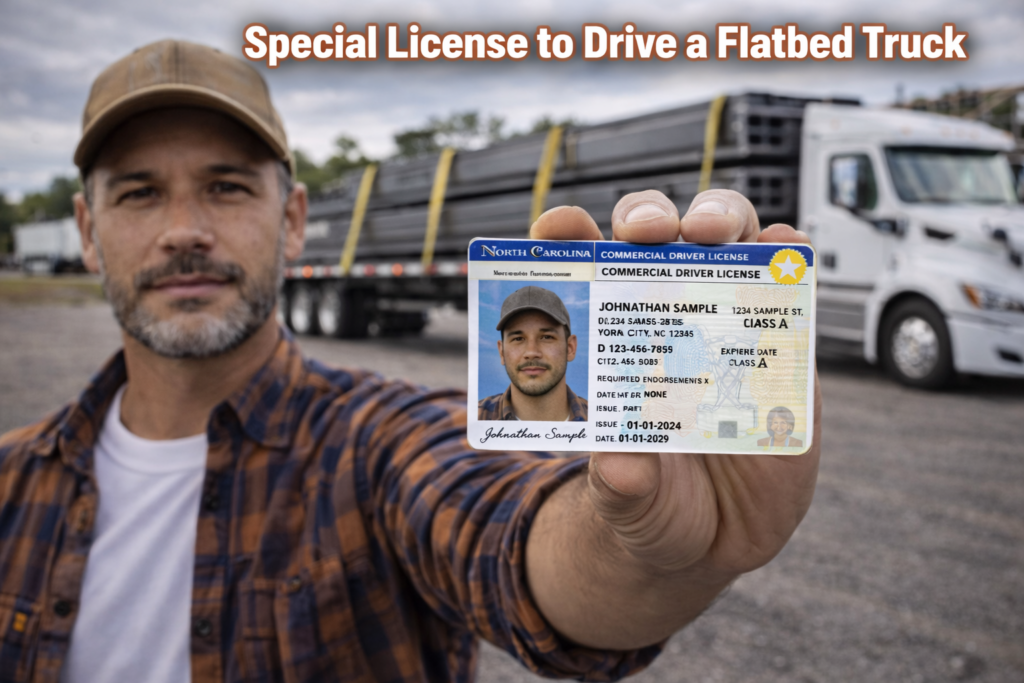
Class A CDL
A Class A Commercial Driver’s License is required if:
- The combined gross vehicle weight rating (GCWR) is 26,001+ pounds
- The trailer being towed weighs over 10,000 pounds
Flatbed tractor-trailer combinations fall squarely into this category.
With proper endorsements, a Class A CDL may also allow you to operate certain Class B and C vehicles.
Anyone who wants to drive a large vehicle in the United States for commercial activity must get a commercial driver’s license (CDL). Depending on what you are transporting, you may need specific endorsements, such as “P” for passengers, “T” for tanks of liquid cargo, and “H” for hazardous materials (flammable, radioactive, or explosive). There are three classes of CDL: A, B, and C.
Class A CDL
This license is required for driving flatbeds, tractor-trailers, truck/trailer combinations, tank vehicles, and livestock carriers — any combination with a combined gross weight (also known as the gross combination weight rating or GCWR) of 26,001+ pounds to tow a 10,000+-pound vehicle. Certain endorsements you can get with your Class A CDL can entitle you to drive Class B and Class C vehicles as well.
Class B CDL
A Class B license allows you to operate one vehicle with a 26,0001+ pound GCWR to tow a vehicle weighing less than 10,000 pounds. Types in this class include straight trucks, box trucks, dump trucks with small trailers, large passenger buses, segmented buses, and some tractor-trailers. Certain endorsements you can get with your Class B CDL can entitle you to drive Class C vehicles as well.
Class C CDL
A Class C license is required for vehicles meant to transport 16+ occupants or hazardous materials. These could be small HazMat vehicles or passenger vehicles not covered under a Class A or Class B license.
When Do You Need Additional Endorsements?
Flatbed drivers may also need endorsements depending on freight type:
- H – Hazardous Materials (HazMat)
- N – Tanker
- T – Double/Triple Trailers
For example:
- Hauling steel coils? Standard Class A.
- Hauling industrial chemicals on a flatbed tank? HazMat required.
- Oversize wind components? Permit and routing compliance required.
Your equipment choice affects your liability profile – especially in rollover-prone cargo like machinery and high-center loads.
If you’re unsure how liability works when operating under dispatch, review your truck driver rights and federal safety protections.
Flatbed CDL Requirements: What Tests Must You Pass?
To obtain a Class A CDL for flatbed driving, you must pass:
General Knowledge Exam
Required for all CDL holders.
Air Brakes Endorsement
Covers air brake system function, inspection, and failure protocols.
Combination Vehicle Exam
Covers:
- Coupling and uncoupling
- Weight transfer
- ABS systems
- Trailer dynamics
Pre-Trip Inspection Test
Includes:
- Internal and external inspection
- Securement awareness
- Emergency protocols
Flatbed operators are held to a high standard during roadside inspections – especially regarding load securement violations.
Age & Basic Eligibility
To qualify for a Class A CDL:
- Must be 21+ for interstate driving
- (Some states allow 18-20 for intrastate only)
- Must hold a standard driver’s license
- Must pass DOT medical exam
Flatbed Driving: Income vs. Risk
Flatbed freight can pay more than dry van.
But it also carries:
- Higher injury risk
- Greater cargo liability
- Increased compliance scrutiny
- More inspection exposure
The license gets you legal.
Operational structure keeps you profitable.
If you’re new to flatbed and want to understand how structured dispatch prevents revenue volatility, read: Why Good Loads Still Turn Into Bad Weeks. Flatbed freight rewards operators who think beyond the next load.
Final Answer: Yes, You Need a Class A CDL
Flatbed driving requires:
✔ Class A CDL
✔ Load securement knowledge
✔ Compliance discipline
✔ Risk awareness
The license is the entry ticket. The structure is what determines long-term earnings. Flatbed freight pays well – but only when the operation is structured correctly.
At Logity Dispatch, we help flatbed owner-operators with:
- Load planning structure
- Compliance support
- Rate negotiation
- Authority protection
- Revenue stability
Because flatbed isn’t just hauling – it’s risk management on wheels.
Contact Logity Dispatch to build a more predictable flatbed operation.