Table of Content
- What is a proof of delivery (POD)?
- What is the difference between a POD and a bill of lading?
- What must a bill of lading contain?
- What makes a POD clean or an exception POD?
- What is OS&D, and how do you note it on a POD?
- Is an exception on the POD the same as a freight claim?
- Why does the POD control when you get paid?
- How long should you keep PODs and bills of lading?
- What should you check before you leave the receiver?
- Where does a dispatcher fit into this?
- Frequently asked questions
Short answer
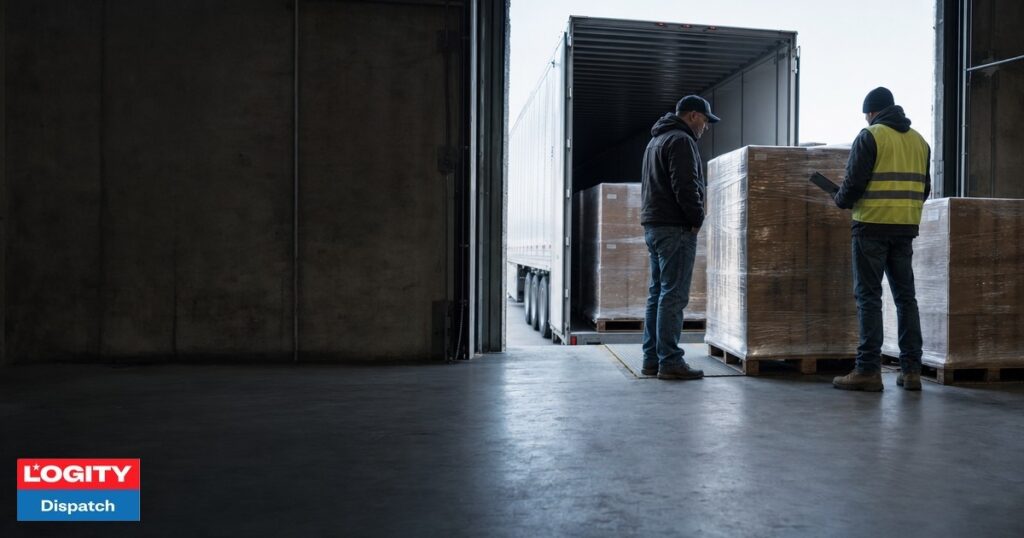
A proof of delivery (POD) is the signed record that the receiver took the freight. Often it is the delivery copy of the bill of lading, signed at the dock; sometimes it is a separate delivery receipt or an electronic signature. The bill of lading is the shipping contract and receipt issued when the freight is tendered, and 49 CFR 373.101 lists what it must contain. The POD is what proves the job was finished, which is why rate confirmations and factoring agreements commonly name it as a document you must send before you are paid. A clean POD says the freight arrived as described. An exception POD records a shortage, overage or damage, and that note can slow or reduce your pay even though, under 49 CFR 370.3(c), a note on a delivery receipt is not a freight claim by itself.
Written by the Logity Dispatch team for owner-operators and small fleets. We book freight and handle load paperwork for owner-operators. Every rule below was checked on 28 September 2026 against its primary source: 49 CFR parts 370, 371, 373, 377 and 379 as served by the eCFR API at title 49’s 24 September 2026 issue date, and 49 U.S.C. 14706 and 14101 as published by the Legal Information Institute at Cornell Law School. Where we could not source a number, we left it out.
What is a proof of delivery (POD)?
A proof of delivery is the document that shows the consignee received the shipment: who signed, when, and in what condition the freight arrived. In trucking the term is practical rather than legal. None of the federal rules cited in this article uses the phrase “proof of delivery”. What they do talk about are bills of lading, receipts, freight bills and “delivery receipts”, and the POD is usually one of those papers with the receiver’s signature on it.
In practice a POD takes one of three forms:
- The bill of lading, signed and dated by the receiver at delivery. This is the most familiar version on truckload freight.
- A separate delivery receipt that the receiver or the warehouse issues, sometimes stamped.
- An electronic signature captured in an app or portal, with a time stamp and, often, photos.
Which one counts is not up to you. It is whatever your rate confirmation, broker agreement or factoring agreement names as the delivery document. Our rate confirmation checklist walks through where those terms sit.
What is the difference between a POD and a bill of lading?
The bill of lading comes first. Under 49 U.S.C. 14706(a)(1), a motor carrier “shall issue a receipt or bill of lading for property it receives for transportation under this part.” It is created at pickup, it describes what was tendered, and it is the document the carrier’s cargo liability is measured against. The POD comes last. It is the same paper, or a paper tied to it, signed at the other end to show the freight arrived.
| Bill of lading (BOL) | Proof of delivery (POD) | |
|---|---|---|
| When it is made | At pickup, when the freight is tendered | At delivery, when the receiver signs |
| What it proves | What the carrier received and agreed to carry, from whom, to whom | That the consignee received the freight, and in what condition |
| Federal rule | 49 CFR 373.101 lists the required contents; 49 U.S.C. 14706(a)(1) requires it to be issued | No separate federal definition; it is usually the signed BOL or a delivery receipt |
| Who needs it for money | Needed to support a cargo claim under 49 CFR 370.7(b) | Usually required by the broker or factor before the freight charges are paid |
One detail matters when paperwork goes missing. 49 U.S.C. 14706(a)(1) also says: “Failure to issue a receipt or bill of lading does not affect the liability of a carrier.” A lost BOL does not make the carrier any less responsible for the cargo. It only makes everyone’s job of proving what happened harder.
What must a bill of lading contain?
49 CFR 373.101 applies to for-hire, non-exempt motor carriers. It says every such carrier “shall issue a receipt or bill of lading for property tendered for transportation in interstate or foreign commerce” containing five items:
| 373.101 | Required item |
|---|---|
| (a) | Names of consignor and consignee |
| (b) | Origin and destination points |
| (c) | Number of packages |
| (d) | Description of freight |
| (e) | Weight, volume, or measurement of freight (if applicable to the rating of the freight) |
The same section adds that the carrier “shall keep a record of this information as prescribed in 49 CFR part 379.” Everything else you see on a shipper’s BOL form, such as seal numbers, appointment times, reference and PO numbers or special instructions, comes from the shipper’s form and the deal, not from 373.101.
The piece count in 373.101(c) is the line that decides most delivery arguments. If the BOL says 26 pallets and the receiver counts 25, the POD is where that difference gets written down.
The rule in one sentence
49 CFR 373.101: every motor carrier subject to 373.100 “shall issue a receipt or bill of lading for property tendered for transportation in interstate or foreign commerce” naming the consignor and consignee, origin and destination, number of packages, description of freight and, when it affects the rate, weight, volume or measurement.
What makes a POD clean or an exception POD?
A clean POD is signed by the receiver with no notes: the count matches the bill of lading and nothing is recorded as damaged. An exception POD carries a note, usually written next to the signature, that something did not match. The common exceptions are:
- Short: fewer pieces arrived than the BOL lists.
- Over: more pieces arrived than the BOL lists.
- Damaged: the count is right, but some freight or packaging is damaged.
- Refused: the receiver would not accept all or part of the load.
A clean POD is the document that lets a load close. An exception POD opens a question: who is responsible for the difference, and does it change what anyone owes. That is why the wording of an exception matters. “1 pallet short” is a fact. “Load damaged” with no detail is an argument waiting to happen.
What is OS&D, and how do you note it on a POD?
OS&D is industry shorthand for over, short and damaged freight. The phrase shows up in the federal records rules too: Appendix A to 49 CFR part 379 has a line for “reports, statements, tracers, and other data pertaining to unclaimed, over, short, damaged, and refused freight.” When freight does not match the paperwork at delivery, the exception belongs on the POD before anyone leaves the dock.
A useful exception note is specific and countable:
- Count before you sign. Compare what comes off the trailer with the number of packages on the bill of lading.
- Write exactly what is different: how many pieces are short or over, which pieces are damaged, and what the damage looks like.
- Get the receiver’s name printed next to the signature, with the date and time.
- Take photos of the freight, the note and the signed page before the paper leaves your hand.
- Tell your broker or dispatcher the same day, while the receiver can still be reached.
Do not sign a clean POD for freight you know is short or damaged, and do not let a receiver add notes to a copy after you have left. The signed page you drive away with is the one both sides will point to later.
Is an exception on the POD the same as a freight claim?
No, and this is the point that saves carriers money. 49 CFR 370.3(c) says that “notations of shortage or damage, or both, on freight bills, delivery receipts, or other documents” shall, “standing alone,” not be considered sufficient to meet the minimum claim filing requirements. A note on the POD tells everyone there may be a claim. It is not the claim.
Under 49 CFR 370.3(b), a claim is a written communication filed with a proper carrier, within the time limits in the bill of lading or contract, that does three things:
- Contains facts sufficient to identify the shipment.
- Asserts liability for alleged loss, damage, injury, or delay.
- Makes claim for payment of a specified or determinable amount of money.
370.3(a) adds that a carrier shall not voluntarily pay a cargo claim unless it has been filed that way. So if a broker holds your pay because of an exception note, it is fair to ask for the written claim, the amount, and the supporting documents. 49 CFR 370.7(b) says a claim, where investigation requires it, is supported by the bill of lading, evidence of the freight charges and the invoice or a certified statement of value.
The clock on a cargo claim is set by statute and regulation, not by the POD:
| Step | Rule | Source |
|---|---|---|
| Filing a claim | A carrier may not set a period of less than 9 months for filing a claim against it | 49 U.S.C. 14706(e)(1) |
| Going to court | A carrier may not set less than 2 years to bring a civil action, counted from the carrier’s written notice that it disallowed part of the claim | 49 U.S.C. 14706(e)(1) |
| Acknowledgment | The carrier acknowledges a proper claim in writing within 30 days of receipt, unless it has paid or declined it in writing within those 30 days | 49 CFR 370.5(a) |
| Decision | The carrier pays, declines or makes a firm compromise offer in writing within 120 days, or explains the delay in writing then and every 60 days after | 49 CFR 370.9(a) |
Behind all of this sits 49 U.S.C. 14706(a)(1), commonly called the Carmack Amendment. The receiving carrier and the delivering carrier “are liable to the person entitled to recover under the receipt or bill of lading,” and that liability “is for the actual loss or injury to the property.” Carmack is about cargo loss and damage. It does not set broker payment terms, and it does not make a POD note a deduction on its own.
Why does the POD control when you get paid?
Because the people paying you need proof that the job is done. There is a federal credit rule, but it is narrow. 49 CFR 377.203 lets a carrier extend credit on its tariff charges; the credit period begins “on the day following presentation of the freight bill,” defaults to 15 days, and a tariff can set a different period of no more than 30 calendar days. Even under that rule, nothing starts until the carrier presents its bill.
Much freight moves under contracts instead. 49 U.S.C. 14101(b)(1) lets a carrier and a shipper contract “to provide specified services under specified rates and conditions.” On contract or brokered freight, the practical answer to “when do I get paid” is whatever your contract and rate confirmation say, and those terms commonly list the documents that must travel with your invoice. Read the payment line of every rate confirmation before you accept the load. Our guide to payment terms, including COD covers the common versions.
The same logic runs through factoring. A factor buys your invoice and collects from the broker or shipper, so the factor needs the same proof the broker would ask for. What your factor requires is in your factoring agreement; our freight factoring guide shows where the POD sits in that sequence, and recourse vs non-recourse factoring explains who carries the risk when a customer does not pay.
On a brokered load you also have a right to see the paperwork on the other side. Under 49 CFR 371.3(a), a broker keeps a record of each transaction, including the bill of lading or freight bill number, the amount of compensation it received, and the amount of any freight charges it collected with the date of payment to the carrier. It keeps those records for three years under 371.3(b), and under 371.3(c) “each party to a brokered transaction has the right to review the record.”
Here is how a POD problem usually shows up in your pay:
| POD problem | Likely effect on your pay |
|---|---|
| POD missing or not sent | The invoice is incomplete, so payment or funding waits |
| POD unreadable, unsigned or cut off in the scan | The broker or factor asks for it again |
| Exception noted, no detail | Pay held while the difference is sorted out |
| Exception noted with counts and photos | The question is narrow and can be settled on the facts |
| Accessorials not backed by paper | Detention, lumper or TONU charges disputed or unpaid |
Accessorials follow the same rule: they get paid when the paper supports them. See our guides to detention, layover and TONU pay and to lumper fees for what to collect at the dock.
How long should you keep PODs and bills of lading?
Part 379 sets minimum retention periods for motor carriers and brokers. Under 49 CFR 379.3, companies keep records for at least the periods in Appendix A. A few lines from that schedule matter for delivery paperwork:
| Record (Appendix A to part 379) | Minimum period |
|---|---|
| Consignors’ shipping orders, copies of bills of lading and similar documents furnished to the carrier | 1 year |
| Records of freight received, forwarded, and delivered | 1 year |
| Reports and other data on unclaimed, over, short, damaged, and refused freight, when not needed to support claims | 1 year |
| Claims records, including claims the company files against others, with supporting data | 1 year after settlement |
| Broker records of each transaction (49 CFR 371.3(b)) | 3 years |
The retention periods count from the date of the document, according to 49 CFR 379.13. Records can be kept in any technology “that accurately reflects all of the information in the record and remains accessible in a form that can be accurately reproduced later,” under 379.7(a). A clear scan or photo that shows every mark on the page qualifies; a blurry one that loses the exception note does not do its job.
These are minimums. Under 14706(e)(1), a carrier cannot give a shipper less than 9 months to file a cargo claim, so keeping a POD only for the bare minimum can leave you without it when you need it most.
What should you check before you leave the receiver?
A short routine at the dock prevents most POD trouble:
- The consignee name and delivery address on the BOL match where you are.
- The piece count matches what came off the trailer, or the difference is written down.
- Any damage is described on the POD, not just mentioned out loud.
- The receiver signed, printed a name and wrote the date and time.
- Any lumper, detention or other charges are on paper you can send.
- You photographed every page, front and back if anything is written on the back.
- The POD goes to your broker, factor or dispatcher the same day.
If the freight was stolen or went missing on the way, the paperwork steps change. Our cargo theft response guide covers what to do first.
Where does a dispatcher fit into this?
Mostly after the signature. A dispatcher cannot count pallets at the dock for you, and nobody can fix a POD that was signed clean over damaged freight. What a dispatcher can do is make sure the paperwork you did collect turns into an invoice that gets paid, instead of sitting in a phone gallery.
That is the part we handle. Our trucking paperwork service covers bills of lading, rate confirmations and invoicing, and sends paperwork to brokers and factoring companies. Our invoicing service creates and delivers invoices, tracks unpaid ones and handles disputes, and our dispatch service books the loads in the first place. If you would rather do the paperwork yourself, do it the same day. A POD sent tonight is paid sooner than one found next week.
Frequently asked questions
What does POD mean in trucking?
POD stands for proof of delivery. It is the signed record that the receiver took the freight, usually the delivery copy of the bill of lading or a separate delivery receipt, showing who signed, when, and whether anything was short, over or damaged.
Is a signed BOL the same as a POD?
Often, yes. When the receiver signs and dates the bill of lading at delivery, that copy usually serves as the proof of delivery. Some receivers issue their own delivery receipt or capture an electronic signature instead. Your rate confirmation or factoring agreement says which document counts.
What happens if the receiver writes damage on the POD?
The load becomes an exception delivery, and payment may be held while the difference is sorted out. The note alone is not a freight claim: under 49 CFR 370.3(c), notations of shortage or damage on delivery receipts do not, standing alone, meet the minimum claim filing requirements. A claim must be in writing and name a specified or determinable amount.
How long does a carrier have to answer a freight claim?
Under 49 CFR 370.5(a), the carrier acknowledges a proper claim in writing within 30 days unless it has already paid or declined it. Under 49 CFR 370.9(a), it must pay, decline or make a firm compromise offer in writing within 120 days, or explain the delay in writing and update the claimant every 60 days.
How long should I keep bills of lading and PODs?
Appendix A to 49 CFR part 379 sets a minimum of 1 year for copies of bills of lading and records of freight delivered, counted from the date of the document. Claims records are kept 1 year after settlement, and brokers keep transaction records 3 years under 49 CFR 371.3(b). Since a carrier cannot set less than 9 months for filing a claim under 49 U.S.C. 14706(e)(1), keeping PODs longer than the minimum is safer.
Sources checked on 28 September 2026: 49 CFR 370.3, 370.5, 370.7 and 370.9; 49 CFR 371.3; 49 CFR 373.101; 49 CFR 377.203; 49 CFR 379.3, 379.7, 379.13 and Appendix A to part 379, all retrieved from the eCFR API at title 49’s 24 September 2026 issue date; 49 U.S.C. 14706 and 14101 as published by the Legal Information Institute at Cornell Law School. Quoted phrases are quoted from those texts. This article explains what the rules say. It is not legal advice, and your contract, rate confirmation and factoring agreement decide your own payment terms.